Group Classes vs One-on-One Dog Training: Which Is Right for You?
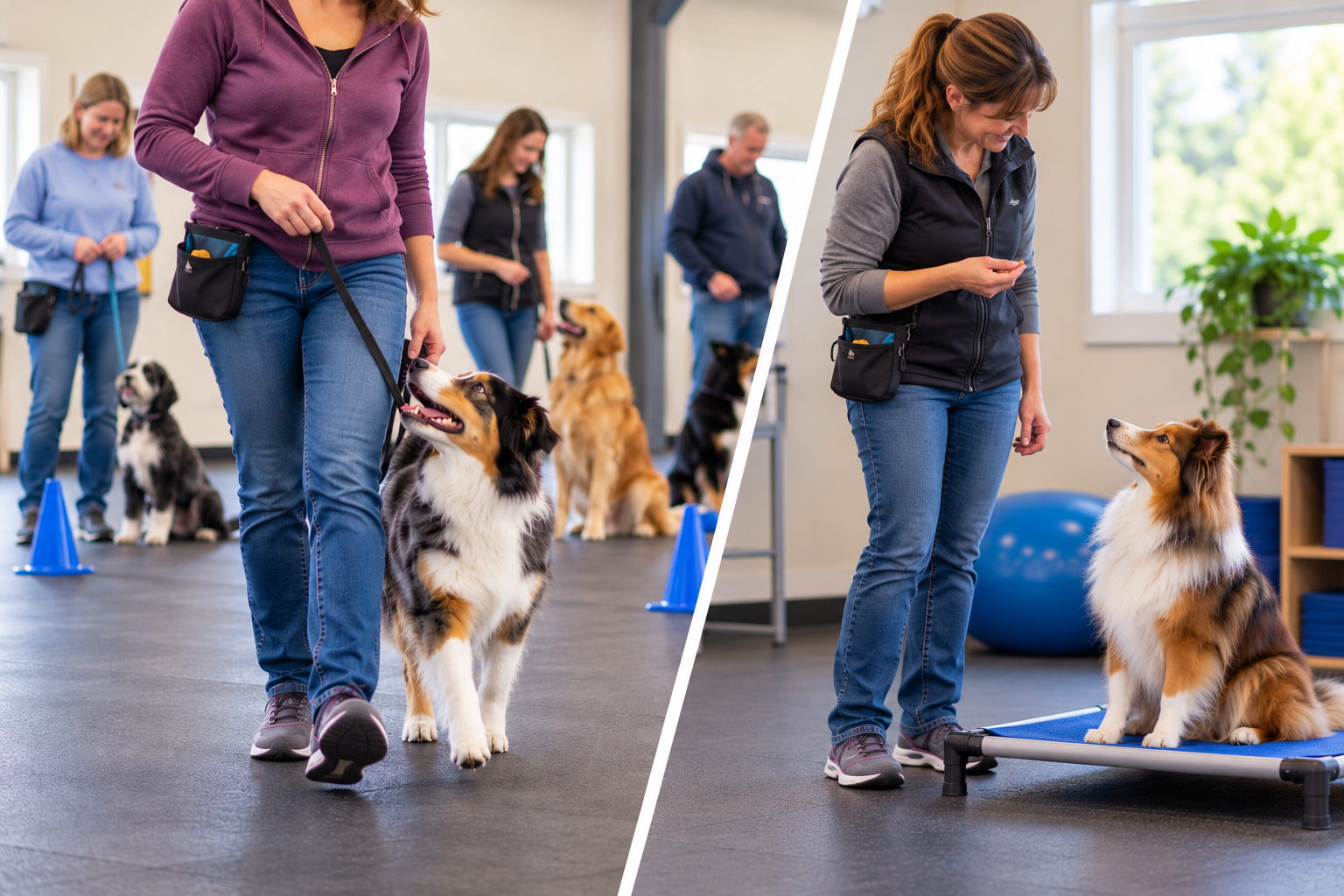
Dog owners practising skills in a small group training class beside a one-on-one training session with a dog settled on a raised cot.
Category: Dog Training
Quick Answer
Should you enrol in a group dog training class or work privately with a trainer?
The answer depends on what you want to accomplish, how your dog learns, and what type of environment will help both of you succeed.
Group classes provide something that's difficult to recreate in a private lesson: the opportunity to practise skills around other dogs and people in a structured environment.
One-on-one training provides something a group class can't offer to the same degree: individualized coaching focused entirely on you, your dog and your specific goals.
Neither is automatically better.
Group classes may be a good choice when you want to:
Build everyday manners.
Practise around controlled distractions.
Develop focus around other dogs and people.
Follow a structured curriculum.
Learn alongside other dog owners.
Participate in activities or dog sports.
One-on-one training may be a better choice when you:
Have a very specific training goal.
Need individualized coaching.
Have a situation unique to your household.
Want to progress at your own pace.
Have a dog who isn't comfortable or able to learn in a group environment.
Need training for specialized skills.
And sometimes, the most effective answer is:
Use both.
What's the Difference Between Group Classes and One-on-One Training?
The obvious difference is the number of dogs and people involved.
But there's a more important difference:
The learning environment changes.
In a private lesson, the trainer can focus entirely on one dog-handler team.
In a group class, your dog learns while:
Other dogs are present.
People are moving.
Another handler may be rewarding their dog.
Interesting smells are nearby.
Someone may drop a treat.
Another dog may perform an exercise.
Doors may open and close.
Those distractions aren't necessarily a disadvantage.
For many dogs, learning to work successfully around them is part of the reason we choose a group class.
What Are the Benefits of Group Dog Training Classes?
One of the biggest advantages of group training is the opportunity to practise around controlled distractions.
Perhaps your dog can perform a beautiful SIT in your kitchen.
But what happens when another dog walks past?
That's a different skill.
Dogs don't automatically understand that something learned in one environment applies everywhere.
They need opportunities to practise behaviours:
In different places.
Around different people.
Around other dogs.
With movement nearby.
With increasingly challenging distractions.
A thoughtfully managed group class can provide those opportunities.
Group Classes Aren't Just About Socialization
People sometimes assume the main benefit of a group class is allowing dogs to meet one another.
That isn't necessarily the goal.
In many classes, one of the most valuable lessons a dog can learn is:
“There is another dog over there, and I don't need to interact with them.”
That's an important real-world skill.
Your dog will encounter other dogs:
On walks.
At the veterinarian.
In parking lots.
At parks.
At training facilities.
In the community.
We don't necessarily want every dog to believe:
“DOG! I need to go say hello!”
Learning to remain engaged with their person while other dogs are nearby can be much more useful.
Group Classes Help Skills Move Into the Real World
One-on-one training often allows us to reduce distractions while initially teaching a skill.
That's valuable.
But eventually, most everyday behaviours need to work when life is happening.
Consider loose-leash walking.
Walking nicely across an empty training room is one step.
Walking nicely when:
Another dog is nearby.
Someone walks past.
A person is talking.
Food is on the ground.
Something interesting is happening.
...is another level of learning.
A group environment gives us opportunities to begin adding those challenges in a controlled way.
What Are the Benefits of One-on-One Training?
Private training gives us the opportunity to focus very specifically on your dog, your goals and your questions.
Instead of following a group curriculum, the session can be adapted around what you need.
Perhaps you want help with:
Loose-leash walking.
Recall.
Cooperative care.
Crate training.
Settling.
Preparing for visitors.
A specific household routine.
Introducing training equipment.
Preparing for a particular goal.
Specialized service-dog skills.
You also have more time to discuss what's happening outside the training session.
Private Training Can Move at Your Pace
In a group class, the instructor has to consider the progression of the whole class.
Private training can be adjusted more easily from moment to moment.
If your dog understands something quickly, you may be able to progress.
If your dog needs more time, you can slow down.
If a completely different question becomes more important, the lesson can shift.
That flexibility can be extremely valuable.
Private Lessons Aren't Only for Problem Dogs
This is an important misconception.
Booking a private lesson doesn't mean your dog has a serious behaviour problem.
One-on-one training can be useful for perfectly ordinary goals.
For example:
“I'd like someone to help me improve my timing.”
“Our recall is pretty good, but I want to make it stronger.”
“I'd like to introduce a head collar properly.”
“I want to teach my dog to cooperate with nail care.”
“We're preparing for a specific training goal.”
Sometimes one focused private lesson can provide exactly the piece of coaching you need.
When Might a Group Class Be the Better Choice?
A group class may be particularly useful when:
Your Dog Needs Practice Around Distractions
If your dog knows their skills at home but struggles when other dogs or people are present, a structured group environment can provide valuable practice.
You Want a Structured Curriculum
Some people prefer knowing:
“This is what we're working on this week.”
A well-designed course provides a logical progression rather than requiring you to decide what to train next.
You're Interested in Dog Sports
Activities such as:
Agility.
Hoopers.
Rally Obedience.
Other structured sports.
...can work particularly well in class environments where teams develop skills progressively.
You Enjoy Learning With Other People
Watching another team work through a challenge can be surprisingly helpful.
Sometimes another student asks the exact question you didn't realize you had.
When Might One-on-One Training Be the Better Choice?
Private training may be particularly useful when:
You Have a Specific Goal
Perhaps you don't need a complete course.
You need help with one particular issue.
A private lesson can concentrate on that goal.
Your Household Situation Is Unique
Maybe your training involves:
Children.
Multiple pets.
Accessibility considerations.
An unusual schedule.
A specific home setup.
Individual coaching can help make the training practical for your real life.
You're Training Specialized Skills
Some types of training need to be highly individualized.
For example, service-dog training needs to reflect the individual handler, dog and tasks being trained.
A standardized group curriculum may not provide enough flexibility.
You Learn Better One-on-One
The human learner matters too.
Some people prefer:
More time to ask questions.
Individual feedback.
Fewer distractions.
More repetition.
A lesson tailored to their learning style.
That's a perfectly valid reason to choose private training.
What If My Dog Can't Learn Around Other Dogs?
There's an important difference between:
“My dog is distracted.”
and:
“My dog is overwhelmed.”
A distracted dog may still be able to:
Eat.
Respond to familiar cues.
Re-engage with their handler.
Settle between exercises.
Learn.
That's often something we can work with.
An overwhelmed dog may be:
Unable to eat.
Continually scanning the environment.
Barking or lunging repeatedly.
Trying to escape.
Frozen or shut down.
Unable to recover.
Too stressed to engage in training.
Putting a dog into a group environment simply because they “need socialization” isn't necessarily helpful.
Exposure and productive learning are not the same thing.
The environment needs to be appropriate for the individual dog.
Does My Dog Need to Be Perfect Before Joining a Group Class?
No.
If your dog already performed every skill perfectly around distractions, you probably wouldn't need the class.
Dogs come to training to learn.
It's completely reasonable for a dog in an appropriate group class to:
Become distracted.
Need extra distance.
Make mistakes.
Need easier repetitions.
Require reinforcement.
Progress at a different pace than another dog.
Training isn't a performance.
It's the process of building the behaviour.
Will My Dog Learn Faster in Private Lessons?
Maybe—but faster isn't always the most useful measurement.
A quiet private environment can make it easier to teach a new skill because there are fewer competing distractions.
But eventually, that skill needs to work where you actually need it.
Your dog might learn:
“Walk beside me in this quiet room.”
The next step may be:
“Walk beside me while another dog is working nearby.”
Those are different stages of learning.
Private lessons can be excellent for establishing the skill.
Group classes can be excellent for helping the skill become more reliable around appropriate distractions.
Can Group Classes Provide Individual Attention?
They should.
A group class doesn't mean an instructor stands at the front of the room and delivers exactly the same instruction to every dog regardless of what happens.
Dogs are individuals.
A good instructor should be able to:
Adjust an exercise.
Increase or decrease difficulty.
Help with reinforcement.
Suggest additional distance.
Modify the setup.
Troubleshoot a problem.
But there are practical limits.
If your situation requires the instructor's full attention for most of the session, a private lesson may be a better learning environment.
What About Dogs With Behaviour Concerns?
This depends entirely on the behaviour and the training environment.
Not every behaviour concern belongs in a group class.
For some dogs, being around several other dogs may make productive learning difficult or create safety concerns.
If your dog:
Has a history of aggression.
Is highly reactive around dogs or people.
Becomes extremely frightened.
Cannot recover around common class distractions.
Has behaviour that creates a safety concern.
...a general group class may not be the appropriate place to address that problem.
Speak with a qualified professional about what type of support is appropriate.
What About Puppies?
For many puppies, group training can provide particularly valuable opportunities.
A thoughtfully managed puppy class allows puppies to practise:
Learning around other puppies.
Calm observation.
Focusing on their person.
Experiencing novel sights and sounds.
Settling.
Handling.
Beginning leash skills.
Appropriate early socialization.
Private lessons can then complement those experiences by addressing your individual puppy and household.
This is why the answer doesn't always need to be:
Group OR private.
Sometimes:
Group AND private makes more sense.
What About Dog Sports?
Group classes can be particularly useful for dog sports because dogs need to learn to work while other dogs and handlers are present.
Depending on the sport, classes can provide access to:
Equipment.
Course setups.
Progressive exercises.
Instructor feedback.
Appropriate distractions.
Sports such as agility, Hoopers and Rally also involve a progression of skills that lends itself well to structured class programs.
Private coaching can still be useful when a team needs help with a specific skill.
Again, the two formats can complement each other.
What About Service-Dog Training?
Service-dog training is a good example of where individualization can become particularly important.
Each team may have different:
Task requirements.
Handler needs.
Training history.
Public-access challenges.
Dog strengths.
Areas requiring additional support.
One-on-one coaching allows training to be tailored to the individual team rather than expecting every service dog and handler to follow exactly the same progression.
What About Online Training?
Digital training adds another useful option.
Online lessons can be helpful when you want to:
Learn at your own pace.
Rewatch demonstrations.
Prepare before an in-person lesson.
Practise at home.
Review something you've forgotten.
Work on foundation skills between classes.
Digital resources can complement either group or private training.
The video teaches you what to do.
Your practice teaches your dog.
Can I Combine Group Classes and Private Lessons?
Absolutely.
In many situations, this can be an excellent approach.
For example:
Group class:
Your dog learns to settle on a bed while other dogs and people are nearby.
Private lesson:
You troubleshoot why your dog struggles to settle when your grandchildren visit.
Or:
Group agility class:
You work through the week's handling exercises.
Private lesson:
You focus specifically on a handling challenge you and your dog have been struggling with.
The skills can support each other.
How Do I Choose?
Start by asking four questions.
1. What Is My Goal?
Do you want:
General manners?
Sport training?
Help with one specific behaviour?
Specialized training?
Real-world distraction practice?
2. Can My Dog Learn Comfortably in a Group?
Some distraction is expected.
Overwhelming stress isn't.
3. How Do I Learn Best?
Would you prefer:
A structured weekly curriculum?
Individual coaching?
A combination?
4. Where Does the Skill Need to Work?
If your dog ultimately needs to perform a behaviour around other dogs and people, you'll eventually need opportunities to practise around distractions—even if you initially teach the behaviour privately.
Frequently Asked Questions
Are group dog training classes worth it?
A well-run group class can provide valuable opportunities to develop skills around controlled distractions that are difficult to reproduce when training alone.
The quality of the class and appropriateness of the environment for your dog matter.
Are private dog training lessons better?
Not automatically.
Private lessons provide greater individualization, while group classes provide a different learning environment.
The better option depends on your goals.
Should I start with private lessons before joining a group class?
Not necessarily.
Many dogs can begin directly in an appropriate group class.
If you're unsure whether your dog will be comfortable or successful in that environment, speak with the training provider before registering.
What if my dog barks in class?
Occasional barking doesn't necessarily mean a dog can't participate.
Consider why the dog is barking and whether they're able to recover and continue learning.
Persistent barking associated with significant fear, frustration or reactivity may indicate that the environment isn't currently appropriate.
Is private training only for behaviour problems?
No.
Private training can be used for everything from basic manners and puppy skills to cooperative care, sports coaching and specialized training.
Do dogs learn better alone or around other dogs?
Dogs often learn new behaviours more easily in lower-distraction environments.
But if we want those behaviours to work around distractions, we eventually need to practise them there.
Both environments can play an important role.
Can I switch between group and private training?
Yes.
Your dog's needs may change over time.
You might begin privately, transition into a group class and occasionally return to private coaching when you need help with a particular skill.
Training doesn't have to follow one format forever.
Key Takeaways
When deciding between group classes and one-on-one training:
✔ Group classes provide structured opportunities to practise around distractions.
✔ Private lessons provide more individualized attention.
✔ Other dogs being present doesn't mean dogs need to interact.
✔ Some distraction in class can be useful.
✔ Being overwhelmed is different from being distracted.
✔ Private lessons aren't only for behaviour problems.
✔ Group classes can be particularly useful for manners and dog sports.
✔ Specialized training may benefit from individualized coaching.
✔ New behaviours are often easier to teach with fewer distractions.
✔ Eventually, real-world skills need to be practised in real-world environments.
✔ You don't necessarily need to choose one format forever.
✔ Group and private training can complement one another.
Most importantly:
Choose the learning environment that allows you and your dog to be successful at the skills you're currently trying to develop.
Training isn't about proving that your dog can handle a particular format.
It's about creating the conditions where learning can happen.
How Paus-n-Train Can Help
At Paus-n-Train, we use both small group classes and one-on-one training because they provide different learning opportunities.
Our group programs give dogs and handlers opportunities to develop skills around carefully managed distractions while following a structured curriculum.
Depending on the program, this can include training such as:
Puppy foundations.
Everyday manners.
Advanced manners.
Rally Obedience.
Agility.
Hoopers.
We intentionally keep our group classes small so teams have room to work and instructors can provide individual coaching within the class environment.
Private lessons allow us to focus more specifically on an individual dog-handler team. They can be useful for troubleshooting a particular skill, developing an individualized plan, cooperative care, preparing for a specific goal or working on specialized training.
Our Owner-Trained Service Dog program is offered through one-on-one training so that training can be tailored to the individual needs of each team.
Students in many of our programs also have access to digital training resources, giving them an opportunity to review concepts and practise between in-person sessions.
You don't have to decide that you're a “group-class person” or a “private-training person.”
The format is simply another training tool.
The right choice is the one that gives you and your dog the best opportunity to learn the skills you need—at this particular point in your training journey.