Hoopers vs Agility: Which Is Right for My Dog?
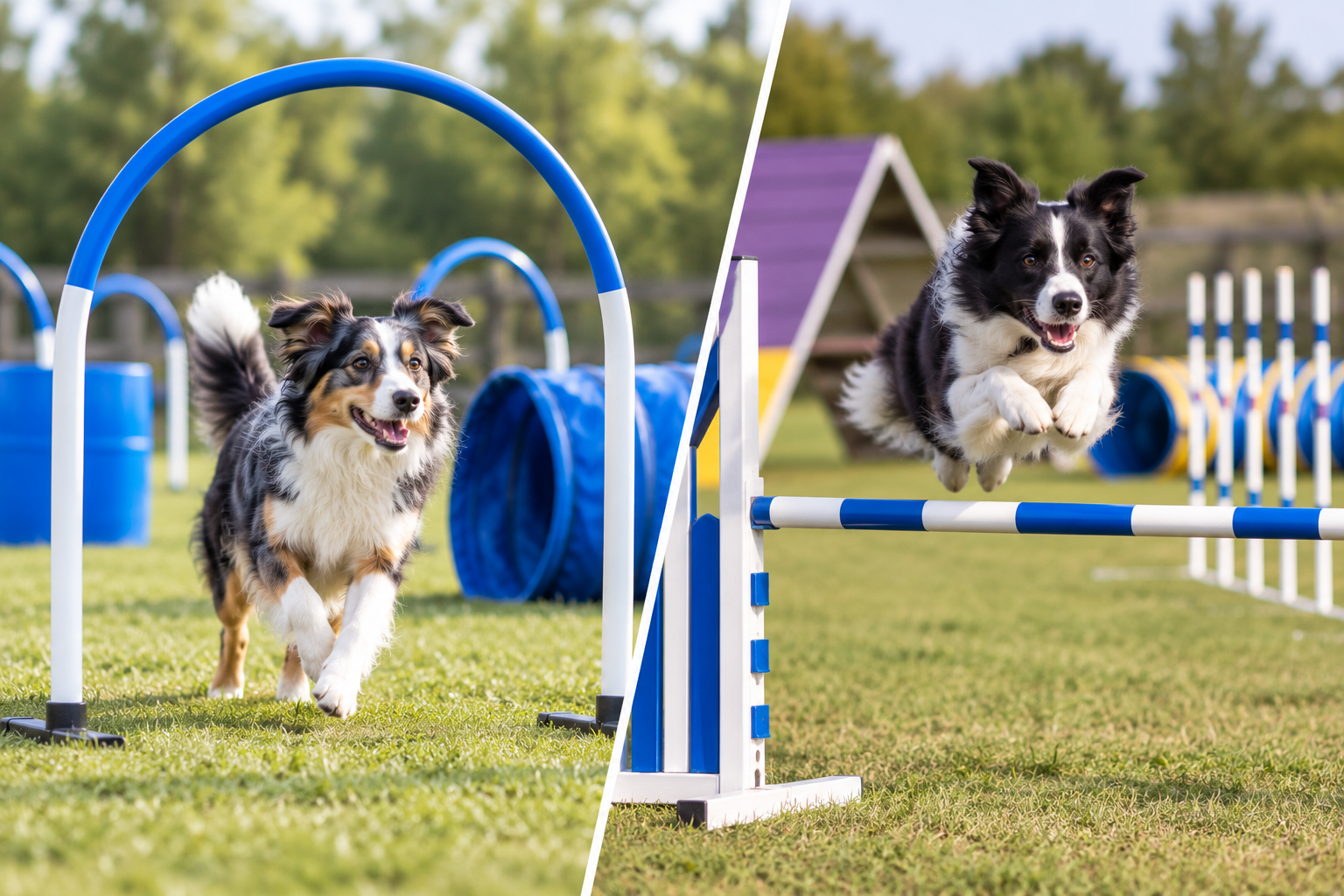
Dogs participating in Hoopers and agility training showing the differences between ground-level hoops and agility jumps.
Quick Answer
Hoopers and agility are both exciting dog sports that challenge dogs and handlers to navigate courses together—but they place different physical and training demands on the dog.
In agility, dogs may navigate:
Jumps.
Tunnels.
Weave poles.
Contact equipment such as the A-frame, dog walk and teeter.
In Hoopers, dogs navigate ground-level equipment such as:
Hoops.
Barrels.
Short, straight tunnels.
Gates.
There are no jumps, weave poles or elevated contact equipment in Hoopers, and the sport emphasizes flowing courses and distance handling.
That can make Hoopers particularly appealing not only for senior dogs, but also for dogs of any age whose health or physical circumstances make traditional agility inappropriate.
For example, a dog may need to avoid jumping or certain agility obstacles because of:
Previous injuries.
Orthopedic conditions.
Joint concerns.
Spinal or back concerns.
Physical limitations.
Veterinary recommendations.
Other health considerations.
However, Hoopers is still a physical activity. Dogs may run, turn, accelerate and decelerate, so it isn't automatically appropriate for every dog who can't participate in agility.
So which sport is better?
Neither.
The better question is:
Which sport is physically appropriate and enjoyable for my individual dog—and for me?
And for some teams, the answer may be:
Both.
What Is Dog Agility?
Agility is a fast-moving dog sport where a handler directs their dog through a numbered obstacle course.
Depending on the course and competition organization, obstacles can include:
Jumps.
Tunnels.
Weave poles.
A-frames.
Dog walks.
Teeters.
Dogs learn how to perform individual obstacles and then follow their handler's cues through increasingly complex sequences.
Handlers develop skills such as:
Timing.
Positioning.
Course planning.
Directional cues.
Front crosses.
Rear crosses.
Blind crosses.
Distance handling.
Obstacle commitment.
Agility can be an incredibly rewarding activity, but it is also an athletic sport.
Dogs need appropriate physical conditioning and must be capable of safely managing the movements and equipment involved.
What Is Hoopers?
Hoopers also involves directing a dog around a course, but the equipment and handling challenge are different.
Instead of jumping over obstacles, the dog travels through or around them.
Equipment can include:
Hoops.
Barrels.
Straight tunnels.
Gates.
The equipment remains at ground level, and course design emphasizes smooth, flowing lines.
Hoopers also places considerable emphasis on teaching the dog to work at a distance from the handler.
As skills develop, the handler can direct the dog around sections of the course without needing to run directly beside them.
Is Hoopers Just an Easier Version of Agility?
No.
This is an important distinction.
Hoopers shouldn't be thought of as:
“Agility for dogs who can't do agility.”
It is its own sport.
The equipment may initially look simple, but the training can be wonderfully challenging.
Teaching your dog to travel through a hoop beside you may be relatively straightforward.
Teaching your dog to confidently travel away from you, commit to the correct obstacle and respond to directional information while you're several metres away?
That's an entirely different challenge.
Hoopers places a strong emphasis on:
Distance.
Directionals.
Independent obstacle performance.
Forward focus.
Clear communication.
So while Hoopers can provide an alternative for some dogs who shouldn't participate in traditional agility, it also attracts perfectly healthy dogs and handlers simply because they enjoy the sport.
What If My Dog Can't Do Agility Because of a Health Issue?
This is an important group of dogs to consider.
A dog doesn't need to be a senior to have physical limitations.
A young or middle-aged dog may have a health condition, previous injury or structural concern that means traditional agility isn't an appropriate activity.
Perhaps your veterinarian has recommended avoiding:
Repetitive jumping.
Weave poles.
Elevated contact equipment.
Certain types of impact.
Particular movements.
For some of these dogs, Hoopers may provide another opportunity to enjoy course work, training and teamwork without those particular agility obstacles.
That can be especially meaningful for a dog who enjoys learning and activity.
But this comes with an important caution:
Being unable to do agility doesn't automatically mean a dog is physically suitable for Hoopers.
Hoopers still involves movement.
Depending on how you participate, that may include:
Running.
Turning.
Acceleration.
Deceleration.
Changes of direction.
Tunnel performance.
The nature of your dog's condition matters.
Before starting Hoopers with a dog who has a known medical, orthopedic or mobility concern, discuss the activity with your veterinarian or appropriate canine rehabilitation professional.
Which Sport Is More Physically Demanding?
Traditional agility generally places greater physical demands on the dog because it can include repeated jumping, weaving and elevated contact equipment.
Agility dogs also accelerate, decelerate and turn while navigating courses at speed.
Hoopers removes several of those elements.
There are no jumps or weave poles, and equipment remains at ground level.
This generally makes Hoopers a lower-impact option.
But lower impact doesn't mean no impact.
A Hoopers dog can still:
Run.
Turn.
Accelerate.
Decelerate.
Change direction.
Travel through tunnels.
That's why the individual dog's health and physical condition matter more than simply choosing the sport with the lower equipment.
Which Is Better for a Young Dog?
Young dogs can learn useful foundation skills for either sport.
A puppy doesn't need to repeatedly jump full-height agility obstacles to begin learning agility.
Early agility foundations can include:
Handler engagement.
Body awareness.
Cone wraps.
Directional skills.
Following handling cues.
Working around equipment.
Recall.
Confidence.
Flatwork.
Hoopers can also introduce young dogs to:
Working through hoops.
Directionals.
Forward focus.
Obstacle commitment.
Distance from the handler.
In either sport, training should be appropriate for the dog's age and physical development.
There's no advantage to rushing.
Which Is Better for a Senior Dog?
For some senior dogs, Hoopers may be an appropriate alternative because it doesn't require jumping, weave poles or elevated contact equipment.
An older dog may still love:
Course work.
Training.
Working with their person.
Learning directionals.
Moving through equipment.
Hoopers may allow some of those activities to continue with different physical demands.
But senior dogs aren't the only dogs who can benefit from that difference.
Physical needs aren't determined by age alone.
A healthy 10-year-old dog may be more physically capable than a 4-year-old dog with an orthopedic condition.
The individual dog matters more than their birthday.
What If My Dog Is Retiring From Agility?
Hoopers can be worth exploring—but first consider why your dog is retiring.
Perhaps your dog can no longer comfortably manage repetitive jumping or another specific agility obstacle.
If they're otherwise comfortable running and turning, Hoopers may provide another way to enjoy course-based training.
But if your dog is retiring because:
Running causes pain.
Turning is uncomfortable.
They have significant mobility limitations.
Exercise causes prolonged soreness.
They struggle with acceleration or deceleration.
...switching to Hoopers doesn't automatically solve the problem.
The equipment is different, but the dog still has to move.
Talk with your veterinarian or rehabilitation professional about what activities are appropriate.
What If My Dog Is Already an Agility Dog?
Hoopers can also be a great addition for a perfectly healthy agility dog.
Your dog may already understand:
Working away from you.
Following handling cues.
Obstacle commitment.
Directional information.
Sequencing.
Hoopers gives you a new way to challenge those skills.
Can your dog continue forward when you stay behind?
Can they respond to a directional cue when you aren't running beside them?
Can they confidently seek an obstacle at a distance?
That can reveal just how much your dog understands independently—and how much they've been relying on your movement.
Can Hoopers Skills Help My Agility?
Potentially, yes.
Hoopers can encourage skills that may also be useful in agility, including:
Forward focus.
Distance handling.
Verbal directionals.
Obstacle commitment.
Independent movement.
Handler awareness.
Hoopers doesn't replace agility training.
The equipment and technical requirements are different.
But it can give agility handlers another opportunity to explore communication at a distance.
What If My Dog Loves to Run and Jump?
Agility may be very appealing.
Some dogs thoroughly enjoy the athletic challenges involved in:
Jumping.
Weaving.
Contact equipment.
Fast course work.
If your dog is physically appropriate for the activity and enjoys it, agility can provide a wonderful outlet.
Good training should still build skills gradually.
A dog being enthusiastic doesn't necessarily mean they're physically or technically ready for every challenge.
What If My Dog Isn't a Natural Athlete?
You don't need a Border Collie to participate in dog sports.
Neither agility nor Hoopers is reserved for a particular breed, size or type of dog.
What matters is finding an activity appropriate for your dog's:
Health.
Physical abilities.
Confidence.
Motivation.
Learning style.
Fitness.
Your goal doesn't need to be competition.
You can participate simply because you and your dog enjoy doing something together.
Which Sport Requires More Running From the Handler?
Generally, agility involves more handler movement.
Agility handlers often need to move around the course to provide timely positional and handling information.
Hoopers places a greater emphasis on distance handling.
As the dog's skills develop, handlers can direct more of the course without running directly beside their dog.
That can make Hoopers appealing to people who:
Have mobility limitations.
Have previous injuries.
Find running difficult.
Prefer less physically demanding handling.
Want to develop distance skills.
The physical needs of both members of the team matter.
Which Sport Is Easier for the Handler?
That depends on the handler.
Less running doesn't mean less skill.
In Hoopers, your dog may be working farther away from you.
That makes your:
Timing.
Verbal cues.
Directionals.
Body position.
Reinforcement placement.
...particularly important.
Agility creates its own handling challenges through movement, timing, obstacle performance and course strategy.
Both sports can keep the human brain very busy!
Which Sport Builds a Better Bond?
Neither has exclusive ownership of teamwork.
Both provide opportunities to:
Learn together.
Communicate.
Solve problems.
Build confidence.
Celebrate progress.
Have fun.
Your relationship isn't determined by which sport you choose.
It's shaped by how you train together.
What If My Dog Is Worried About Equipment?
Either sport should be introduced gradually.
We don't need to force a dog through equipment.
Instead, break the skill down.
For example:
Look at equipment → reinforcement.
Then:
Approach equipment → reinforcement.
Then:
Interact with equipment → reinforcement.
Confidence develops through successful experiences.
Slowing down isn't falling behind.
It's training.
What If I Want to Compete?
Both sports provide opportunities for competition.
Competition can give teams:
Training goals.
New challenges.
Opportunities to test skills.
A community of people enjoying the same activity.
But competition is optional.
There's nothing incomplete about recreational dog sport training.
Your dog doesn't know whether you earned a ribbon.
They know whether they enjoyed participating.
What If I Don't Want to Compete?
That's completely fine.
Your goal might simply be:
Learn something new.
Give your dog an appropriate activity.
Spend time together.
Provide mental enrichment.
Improve your communication.
Have a weekly outing.
Find a sport that accommodates your dog's physical needs.
Those are all worthwhile reasons to participate.
Can My Dog Do Both?
Absolutely—if both activities are physically appropriate.
A healthy dog may enjoy participating in agility and Hoopers.
The sports can even complement one another.
Agility can develop:
Handling.
Confidence.
Sequencing.
Technical obstacle skills.
Hoopers can further challenge:
Distance.
Directionals.
Forward focus.
Independent movement.
You don't necessarily need to choose one forever.
How Do I Decide Which Sport to Try?
Start with three questions.
1. What Is Physically Appropriate for My Dog?
Consider:
Age.
Health.
Fitness.
Body condition.
Previous injuries.
Orthopedic concerns.
Mobility.
Veterinary recommendations.
This question comes first.
2. What Does My Dog Enjoy?
Does your dog enjoy:
Running?
Learning?
Working away from you?
Following movement?
Solving training puzzles?
Course work?
Athletic challenges?
3. What Do I Enjoy?
Don't forget the other half of the team.
Do you enjoy:
Running?
Course analysis?
Distance handling?
Precision?
Training technical skills?
Fast movement?
Problem-solving?
A dog sport should work for both of you.
Hoopers May Be a Good Fit If...
You might particularly enjoy Hoopers if:
You want a sport without jumps or weave poles.
Your dog needs to avoid certain agility equipment.
You're looking for a potentially lower-impact activity.
Your veterinarian has recommended avoiding jumping but considers appropriate ground-level activity suitable.
You have a senior dog who still enjoys training.
Your agility dog is transitioning to different activities.
You're interested in distance handling.
You want to develop directional cues.
You prefer less handler running.
Your dog enjoys working away from you.
You simply think Hoopers looks fun.
You don't need a medical reason to choose Hoopers.
It's a sport worth enjoying in its own right.
Agility May Be a Good Fit If...
You might particularly enjoy agility if:
Your dog is physically suited to the sport.
Your dog enjoys athletic movement.
You enjoy running and active handling.
You're interested in jumps, weave poles and contact equipment.
You enjoy technical course challenges.
You want to learn different handling manoeuvres.
You enjoy fast-paced teamwork.
You want to explore agility competition.
You simply think agility looks fun.
Again, enjoyment matters.
Frequently Asked Questions
Is Hoopers safer than agility?
Hoopers removes some of the physical demands associated with traditional agility, including jumping, weave poles and elevated contact equipment.
However, dogs still run, turn, accelerate and decelerate.
No dog sport is automatically safe or appropriate for every dog.
Can my dog do Hoopers if they can't do agility?
Possibly.
It depends on why agility isn't appropriate.
If your dog needs to avoid jumping or particular agility obstacles but can safely perform the movements involved in Hoopers, it may be an option.
Discuss your dog's individual restrictions with your veterinarian or rehabilitation professional.
Is Hoopers only for senior dogs?
Absolutely not.
Hoopers can be enjoyed by dogs of many ages.
Some dogs participate because of physical considerations.
Others participate because their handlers love distance training.
Some agility teams use it as another sport.
And many people choose it simply because it's fun.
Is Hoopers easier than agility?
Not necessarily.
Hoopers equipment is different, but distance handling and independent obstacle performance create their own training challenges.
Does my dog need agility experience before trying Hoopers?
No.
Dogs can begin Hoopers without any previous agility experience.
Can puppies do Hoopers?
Young dogs can begin learning appropriate foundation skills without needing to run long courses.
Training should always reflect the dog's physical development.
Can senior dogs do Hoopers?
Many can.
However, age alone doesn't determine suitability.
The dog's health, mobility, fitness and comfort matter more.
Can dogs with arthritis do Hoopers?
Possibly, but this needs to be determined for the individual dog.
Arthritis varies considerably in location and severity. Your veterinarian or canine rehabilitation professional can help determine what type and amount of activity is appropriate.
Do I have to compete?
No.
Both sports can be enjoyed recreationally.
Key Takeaways
When comparing Hoopers and agility:
✔ Both are genuine dog sports.
✔ Both develop communication and teamwork.
✔ Agility includes jumps, weave poles and elevated contact equipment.
✔ Hoopers uses ground-level hoops, barrels, straight tunnels and gates.
✔ Hoopers isn't simply “easy agility.”
✔ Hoopers isn't only for senior dogs.
✔ Dogs of any age may have health or physical considerations that make agility inappropriate.
✔ Hoopers may provide an alternative for some of those dogs.
✔ Being unable to do agility doesn't automatically mean a dog can safely do Hoopers.
✔ Lower impact doesn't mean no physical demands.
✔ Distance handling is a major component of Hoopers.
✔ Agility generally involves more handler movement.
✔ Healthy dogs can enjoy both sports.
✔ Competition is optional.
Most importantly:
Choose the sport based on the dog in front of you—not their age, breed or what you think they “should” be able to do.
The right activity is one that is physically appropriate, mentally engaging and enjoyable for both members of your team.
How Paus-n-Train Can Help
At Paus-n-Train, we offer both Agility and Hoopers, which gives teams an opportunity to explore different types of dog sports as their interests and needs evolve.
Our Agility program progressively develops foundation skills, obstacle performance, handling techniques, sequencing and course work.
Our Hoopers program, following Canadian Hoopers of Canada (CHC), develops skills using hoops, barrels, straight tunnels and gates while placing an increasing emphasis on directional cues and distance handling.
Hoopers may appeal to:
People completely new to dog sports.
Experienced agility teams looking for another challenge.
Handlers who prefer less running.
Senior dogs who remain physically appropriate for the activity.
Dogs whose health or physical limitations mean certain agility obstacles are no longer appropriate.
Dogs transitioning away from traditional agility.
Teams who simply discover they love Hoopers.
For dogs with known medical, orthopedic or mobility concerns, we encourage owners to discuss participation with their veterinarian or appropriate canine rehabilitation professional before beginning.
Because choosing a dog sport shouldn't be about asking:
“Which sport is better?”
It should be about asking:
“What can my dog and I safely enjoy together?”
Sometimes that's agility.
Sometimes it's Hoopers.
Sometimes it's both.
And sometimes a dog's changing needs lead us toward an entirely different activity.
Good training means being willing to listen to the dog in front of us and adjust the plan accordingly.