Can Senior Dogs Do Hoopers?
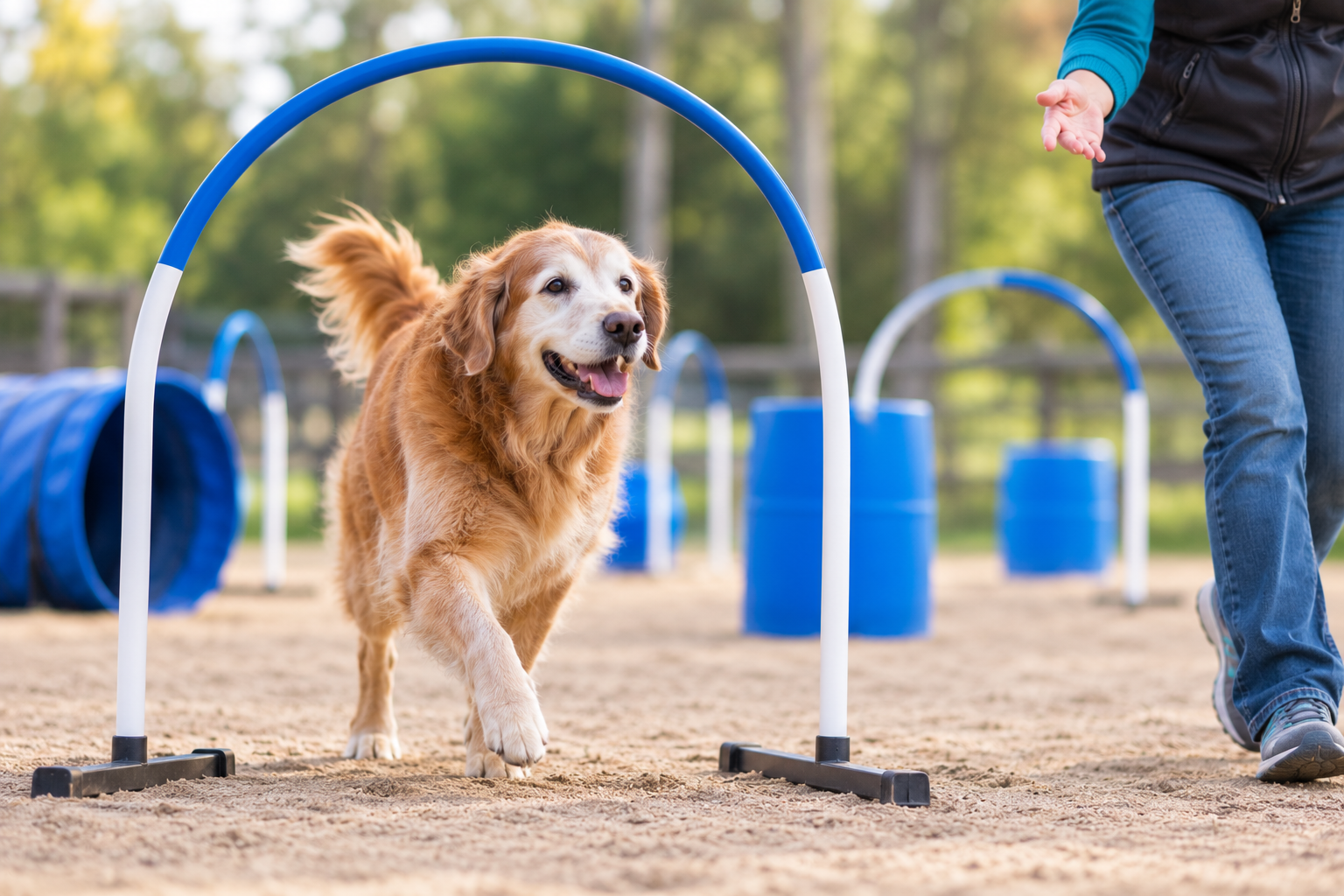
Older dog moving comfortably through a ground-level hoop during a Hoopers training session.
Quick Answer
Yes—many senior dogs can enjoy Hoopers, provided the activity is appropriate for their individual health, mobility and fitness.
Hoopers can be particularly appealing for older dogs because courses use ground-level equipment such as:
Hoops.
Barrels.
Short, straight tunnels.
Gates.
There are no jumps or weave poles, and courses can be designed with smooth, flowing lines.
But lower impact doesn't mean no impact.
Dogs still need to walk or run, turn, accelerate and decelerate. A senior dog with arthritis, an old injury, heart disease or another medical condition may require modifications—or a different activity altogether.
So rather than asking:
“Is my dog too old for Hoopers?”
A better question is:
“Is Hoopers appropriate for my individual dog right now?”
What Is Hoopers?
Hoopers is a dog sport where dogs navigate a course while being directed by their handler.
Instead of jumping over obstacles, dogs travel through or around ground-level equipment.
A Hoopers course can include:
Hoops for the dog to travel through.
Barrels for the dog to go around.
Short, straight tunnels.
Gates that help define the dog's path.
As training progresses, dogs can learn to work increasingly independently and respond to directional cues from a distance.
That combination of movement, communication and problem-solving can make Hoopers a wonderful activity for dogs who enjoy having a job to do.
Why Might Hoopers Appeal to Senior Dogs?
Growing older doesn't necessarily mean a dog stops enjoying training.
Many senior dogs still want to:
Learn.
Explore.
Move.
Problem-solve.
Interact with their person.
Participate in familiar activities.
What may need to change is how we provide those opportunities.
Hoopers gives us lots of possibilities for adapting the activity to the dog standing in front of us.
A senior dog doesn't need to race around a full course to participate.
They might work on:
One hoop.
Two or three obstacles.
A simple directional exercise.
Walking through a short sequence.
Going around a barrel.
Working at a comfortable distance from their handler.
The activity can be about engagement and learning, rather than speed.
Is Hoopers a Low-Impact Dog Sport?
Hoopers is generally considered lower impact than traditional agility because dogs don't need to repeatedly jump over bars or negotiate elevated contact equipment.
There are also no weave poles.
Courses can encourage more flowing movement rather than repeated jumping.
That can make Hoopers appealing for some older dogs.
However, it's important not to interpret lower impact as no physical stress.
A dog moving around a Hoopers course may still:
Accelerate.
Decelerate.
Turn.
Change direction.
Run through tunnels.
Move across different surfaces.
Those movements still place demands on the body.
My Dog Is a Senior. Does That Mean They Need to Slow Down?
Not necessarily.
“Senior” isn't a diagnosis.
Dogs age differently.
An active older dog who has remained fit throughout life may be physically capable of much more than a younger dog with an orthopedic condition.
Breed, size, body condition, previous injuries, lifestyle and health all influence what an individual dog can comfortably do.
This is why chronological age alone isn't a very useful way to determine appropriate activity.
Rather than deciding:
“My dog is 10, so they shouldn't do sports anymore.”
look at the whole dog.
What Should I Consider Before Starting?
Before introducing an older dog to Hoopers, consider:
Mobility
Does your dog move comfortably?
Watch for:
Stiffness.
Limping.
Shortened stride.
Difficulty getting up.
Reluctance to turn.
Slowing considerably during activity.
Difficulty on certain surfaces.
Recovery
How does your dog feel after exercise?
Sometimes discomfort isn't obvious during the activity.
You may notice later that your dog:
Is unusually stiff.
Has difficulty getting up after resting.
Is reluctant to use stairs.
Moves more slowly that evening.
Seems uncomfortable the following morning.
Recovery matters.
Endurance
Older dogs may still love activity but tire more quickly.
Shorter sessions can allow them to participate without becoming physically exhausted.
Medical History
Consider previous:
Joint injuries.
Cruciate injuries.
Back problems.
Arthritis.
Surgery.
Heart conditions.
Respiratory concerns.
Neurological conditions.
Your veterinarian can help determine whether a new activity is appropriate.
Talk to Your Veterinarian
If your senior dog has known health or mobility concerns—or hasn't participated in this type of physical activity before—speak with your veterinarian before beginning.
Depending on the dog, your veterinarian may also recommend assessment by a qualified canine rehabilitation professional.
This is especially important if you've noticed:
Limping.
Stiffness.
Changes in gait.
Reluctance to exercise.
Difficulty getting up.
Sudden changes in performance.
Pain.
Exercise intolerance.
Training shouldn't be used to push a dog through discomfort.
Hoopers Doesn't Have to Be Fast
One of the biggest misconceptions about dog sports is that success must involve speed.
It doesn't.
A senior dog can participate at a pace that works for them.
Imagine a dog walking through one hoop, travelling around a barrel and then moving through another hoop.
The dog is still:
Listening.
Thinking.
Responding to cues.
Moving their body.
Working with their handler.
That's still Hoopers.
The clock doesn't determine whether your dog benefited from the experience.
Short Sequences Can Be Just as Valuable
A full course isn't necessary every time.
For senior dogs, breaking training into smaller pieces may be particularly useful.
For example:
Hoop → barrel → reward.
Or:
Hoop → hoop → reward.
Or simply:
Go around barrel → reward.
Then rest.
Short sequences can help maintain enthusiasm without unnecessary physical repetition.
They also allow the handler to focus on quality.
Think About the Surface
Surface matters for every dog, but it deserves extra consideration as dogs age.
We want dogs to feel secure while moving.
Surfaces that are excessively slippery may make turning or accelerating more difficult and can reduce confidence.
Watch how your dog moves.
Are they:
Shortening their stride?
Moving cautiously?
Slipping?
Avoiding turning?
Hesitating to accelerate?
Your dog may be telling you that the surface is difficult.
Warm-Ups Matter
Don't take an older dog straight from the car and immediately ask them to run a course.
Allow time for gentle movement first.
A warm-up might include:
Comfortable walking.
Gentle changes of direction.
Easy movement.
Simple familiar behaviours.
The purpose isn't to tire the dog before class.
It's to transition gradually from resting to activity.
After training, allow your dog time to gradually settle again rather than abruptly moving from intense activity to complete inactivity.
If your dog has specific physical limitations, ask your veterinarian or rehabilitation professional what type of warm-up is appropriate.
Watch for Fatigue
Senior dogs don't always make sensible decisions about when to stop.
Some enthusiastic dogs will keep working because they love the activity.
That's where we need to make good choices for them.
Watch for changes such as:
Slower movement.
Less precise turns.
Increased panting.
Reduced enthusiasm.
Difficulty responding to familiar cues.
Hesitation.
Stumbling.
Increasingly wide or awkward movement.
Don't wait until your dog is exhausted.
Finish while they're still feeling good.
Mental Exercise Matters Too
Hoopers isn't only physical exercise.
Dogs also have to process information.
They need to determine:
Which obstacle?
Which direction?
Where is my handler?
Should I continue forward?
Should I turn?
What does this cue mean?
That mental component can be particularly valuable for older dogs who still enjoy learning but may no longer need—or be capable of—the same amount of strenuous physical exercise they enjoyed when younger.
A slower Hoopers session can still provide a meaningful training challenge.
Can My Retired Agility Dog Do Hoopers?
Potentially.
Hoopers can be particularly interesting for dogs who already understand course work.
A retired agility dog may recognize concepts such as:
Working away from the handler.
Following handling cues.
Obstacle commitment.
Direction changes.
Sequencing.
But there's an important question:
Why did your dog retire from agility?
If they retired because jumping was no longer appropriate but they're otherwise comfortable moving, Hoopers may be worth discussing with your veterinarian or rehabilitation professional.
If they retired because running, turning or acceleration causes discomfort, Hoopers may not solve the underlying problem.
Changing the equipment doesn't automatically remove every physical demand.
Hoopers Can Give Experienced Dogs a New Challenge
For dogs who have spent years doing agility, obedience, Rally or other sports, learning something new can be enjoyable.
The dog may already know how to learn.
Now we can give them a new puzzle.
For example:
Can you take that hoop while I remain over here?
Can you go around the barrel when I give you a directional cue?
Can you continue forward without me running beside you?
That keeps training interesting without requiring increasingly difficult physical challenges.
What About Senior Handlers?
One of the appealing features of Hoopers is that distance handling is part of the sport.
As skills develop, handlers can learn to direct their dogs without needing to run directly beside them for the entire course.
That can make Hoopers appealing to people who:
Find running difficult.
Have previous injuries.
Have mobility limitations.
Prefer a sport with less handler running.
Both members of the team matter.
Dog sports should be enjoyable and sustainable for the dog and the human.
Your Dog Doesn't Know They're "Retired"
Humans think in terms of careers.
We say:
“She's retired from agility.”
Your dog doesn't necessarily understand retirement.
They simply know that activities they used to enjoy may have disappeared.
For some dogs, finding a new version of training can help maintain those familiar routines:
Going somewhere with their person.
Working together.
Earning reinforcement.
Solving puzzles.
Learning cues.
Having a shared activity.
Hoopers may provide that opportunity for some dogs.
What If My Senior Dog Has Never Done a Dog Sport?
That's okay too.
Your dog doesn't need an athletic résumé.
A senior dog can learn something new.
Training can begin with individual foundation skills at an appropriate pace.
For example:
Walk through one hoop → reward.
Then perhaps:
Walk through two hoops → reward.
Eventually, you can begin introducing other equipment and directional skills.
There's no requirement that your dog already understand agility.
Don't Compare Your Senior Dog to Younger Dogs
This is important.
The dog beside you may be:
Faster.
Younger.
More experienced.
More physically capable.
It doesn't matter.
Your dog's training should be based on their abilities, not another team's performance.
A senior dog thoughtfully completing three obstacles may be doing exactly the right amount of work for them.
That's success.
Frequently Asked Questions
How old is too old for Hoopers?
There isn't a specific age.
A dog's health, mobility, fitness and comfort are more important than their chronological age.
Is Hoopers safer than agility for senior dogs?
Hoopers removes some of the physical demands associated with traditional agility, particularly jumping, weave poles and elevated contact equipment.
However, dogs still run, turn, accelerate and decelerate.
Whether it is appropriate depends on the individual dog.
Can a dog with arthritis do Hoopers?
Possibly, but this is a question for your veterinarian or canine rehabilitation professional.
The diagnosis, severity, location of the arthritis and your dog's current mobility all matter.
Does my senior dog have to run?
No.
Training can be adapted to a comfortable pace, particularly when you're participating recreationally.
Walking through short sequences can still provide learning and enrichment.
Can my senior dog compete?
That depends on your dog's health, conditioning and whether competition is appropriate for the individual.
Participation doesn't have to lead to competition.
Can an older dog learn Hoopers for the first time?
Absolutely.
Older dogs are still capable of learning new skills.
Training may simply need to be adapted to their physical abilities and experience.
Is Hoopers good mental stimulation for senior dogs?
It can be.
Hoopers combines movement with problem-solving, directional cues, obstacle discrimination and communication with the handler.
You can provide a significant mental challenge without necessarily asking the dog to complete long or fast courses.
Key Takeaways
Senior dogs can potentially enjoy Hoopers when the activity is appropriate for the individual.
Remember:
✔ Senior is an age category—not a diagnosis.
✔ Hoopers doesn't include jumps or weave poles.
✔ Lower impact doesn't mean no physical impact.
✔ Dogs still turn, accelerate and decelerate.
✔ Short sequences can be valuable.
✔ Your dog doesn't need to run quickly.
✔ Warm-ups and appropriate surfaces matter.
✔ Watch how your dog recovers after activity.
✔ Mental enrichment is an important part of Hoopers.
✔ Don't compare your senior dog with younger dogs.
✔ Speak with your veterinarian when health or mobility concerns are present.
✔ Be willing to modify—or eventually stop—the activity if your dog's needs change.
Most importantly:
The goal isn't to prove that your senior dog can still keep up.
The goal is to give them an activity that is comfortable, enriching and enjoyable for the dog they are today.
How Paus-n-Train Can Help
At Paus-n-Train, we believe dog sports should be about more than speed and competition.
They should give dogs and their people opportunities to learn, communicate and have fun together.
Our Hoopers program follows Canadian Hoopers of Canada (CHC) and introduces dogs to hoops, barrels, straight tunnels and gates while gradually developing directional cues and distance-handling skills.
Because Hoopers doesn't use jumps or weave poles, it may provide an appealing alternative for some older dogs—including experienced agility dogs whose needs are changing as they age.
We can modify training by:
Working with shorter sequences.
Reducing unnecessary repetition.
Allowing dogs to work at a comfortable pace.
Building skills gradually.
Focusing on communication rather than speed.
Providing appropriate rest between repetitions.
Our Intro to Hoopers program provides a six-week introduction to the sport, with opportunities to continue developing skills through our Beginners Hoopers training.
Before enrolling an older dog with known health, orthopedic or mobility concerns, we encourage owners to discuss participation with their veterinarian or appropriate canine rehabilitation professional.
Because our goal isn't simply to keep your dog participating in sports.
It's to help you find appropriate ways to keep learning and enjoying life together as your dog's needs change.