What Is Cooperative Care? Helping Your Dog Participate in Their Own Care
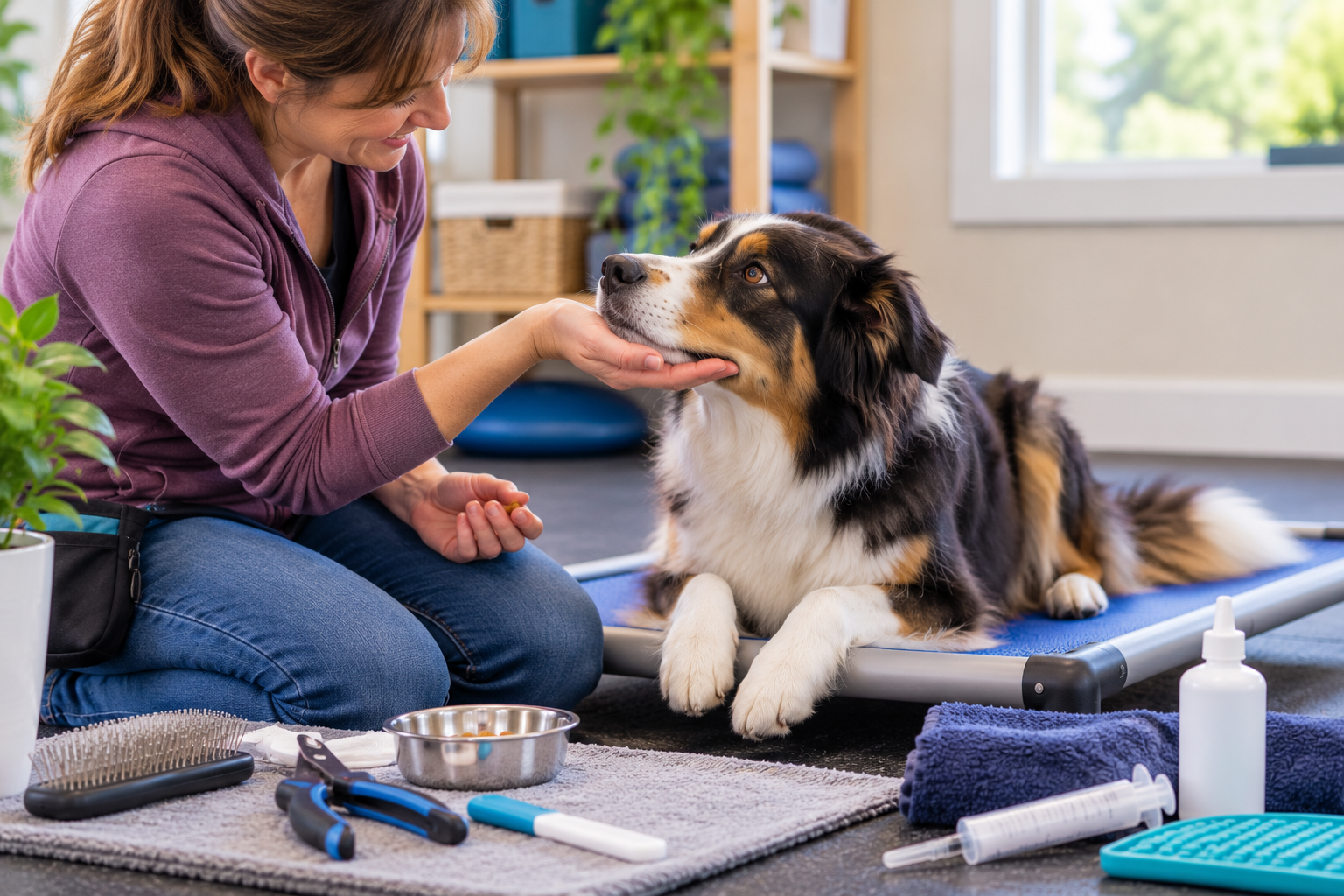
Dog voluntarily resting its chin in its owner's hand during cooperative care training.
Quick Answer
Cooperative care is an approach to everyday handling, grooming and veterinary care that teaches your dog to actively participate in the process rather than simply being restrained while things happen to them.
Instead of waiting until your dog needs their nails trimmed, ears cleaned or medication administered, we can teach skills that make those procedures more predictable.
Your dog might learn to:
Rest their chin in your hand while being examined.
Stand on a designated mat for grooming.
Offer a paw for nail care.
Allow their ears to be examined.
Accept gentle handling around their eyes and mouth.
Remain still while equipment is introduced.
Participate in nail filing.
Take liquid medication from a syringe.
Communicate when they need a brief pause.
The goal isn't necessarily to make your dog love every procedure.
The goal is to help them understand what's happening, develop useful skills and feel as safe and comfortable as reasonably possible while necessary care takes place.
Why Does Cooperative Care Matter?
Think about how many times throughout your dog's life someone may need to handle their body.
There will likely be:
Nail trims.
Veterinary examinations.
Vaccinations.
Ear checks.
Eye examinations.
Dental checks.
Grooming.
Brushing.
Baths.
Medications.
Blood draws.
Injury examinations.
Tick removal.
Paw inspections.
Coat clipping.
Temperature checks.
For many dogs, these procedures involve unfamiliar people touching sensitive areas of their body while they're expected to remain still.
That's a lot to ask.
And yet, we often don't practise these skills until we urgently need them.
Cooperative care changes that.
Rather than waiting until something has to happen, we can teach our dogs how to participate before the procedure becomes necessary.
Isn't My Dog Supposed to Let Me Handle Them?
It's common to hear:
"My dog needs to learn that I can touch them anywhere."
But tolerating handling isn't an automatic skill.
Imagine someone suddenly:
Grabbing your foot.
Looking inside your mouth.
Holding your head still.
Examining your ears.
Cutting your nails.
Putting drops into your eye.
Even if the person had good intentions, you'd probably feel more comfortable if you understood what was happening and had some predictability.
Dogs are no different.
Handling is something we can teach.
Cooperative Care Is Training
One of the most important things to understand about cooperative care is that it isn't simply being nice to your dog during grooming.
It's training.
We teach behaviours that help make care easier.
For example, instead of:
Grab paw → trim nail
we might teach:
Dog voluntarily offers paw → paw is briefly handled → reward.
Then:
Dog offers paw → nail is touched → reward.
Then:
Dog offers paw → clipper touches nail → reward.
Eventually:
Dog offers paw → one nail is trimmed → reward.
The final procedure is built from many small skills.
What Is a Start-Button Behaviour?
A start-button behaviour is a behaviour the dog performs that tells us they're ready for the next step.
One common example is a chin rest.
You might teach your dog to rest their chin:
In your hand.
On your lap.
On a towel.
On another designated surface.
Once the behaviour is established, you can gradually introduce handling while the dog's chin remains in position.
For example:
Chin down → ear handling begins.
If your dog lifts their head, you pause.
When they voluntarily return their chin, you're ready to continue.
The dog begins to understand the pattern.
That predictability can make handling much easier.
Does Cooperative Care Mean My Dog Gets to Say "No"?
This deserves a thoughtful answer.
Whenever reasonably possible, cooperative care gives the dog choice and communication within the training process.
If your dog withdraws their paw during a training session, for example, you can pause and ask:
Was that step too difficult?
Maybe you need to go back to simply touching the leg.
But dogs sometimes require procedures that can't safely wait.
A dog with a painful injury can't necessarily decline a veterinary examination indefinitely.
A dog who needs urgent medication still needs treatment.
Medical necessity and training choice aren't the same thing.
Cooperative care doesn't mean necessary healthcare becomes optional.
Instead, it means we build skills ahead of time that may make those necessary procedures easier.
And when urgent care must happen despite the dog's discomfort, veterinarians can determine appropriate handling, medication or sedation strategies when needed.
What Does Consent Mean in Cooperative Care?
You'll sometimes hear the word consent used in cooperative-care training.
It's useful, but it can also create confusion if we interpret it exactly as we would human medical consent.
In dog training, we're really looking for behaviours that communicate:
"I'm comfortable enough to continue."
and:
"I need a pause."
Giving the dog some control over routine training can increase predictability and help us notice discomfort before it escalates.
The important point isn't the terminology.
It's the communication.
We're learning to listen to the dog's behaviour instead of waiting until they need to struggle, growl or snap.
What Skills Can I Teach?
There are many possibilities.
Chin Rest
Your dog rests their chin on your hand or another surface.
This can be useful for:
Ear care.
Eye care.
Facial handling.
Veterinary examinations.
Grooming.
Paw Offer
Your dog voluntarily places their paw in your hand.
This can help with:
Nail trimming.
Nail filing.
Paw inspection.
Cleaning feet.
Checking for injuries.
Stationing
Your dog learns to stand, sit or lie on a particular station.
This might be:
A mat.
A cot.
A grooming platform.
A towel.
The station helps create predictability:
"When I'm here, we're doing this type of activity."
Side-Lying
Some dogs can learn to voluntarily lie on their side for certain examinations or grooming procedures.
Muzzle Training
A properly conditioned basket muzzle can be another valuable cooperative-care skill.
Dogs don't have to be "aggressive" to benefit from muzzle training.
A muzzle can provide an additional layer of safety during painful procedures or emergencies.
Ideally, the dog learns to voluntarily put their nose into the muzzle before they ever urgently need to wear one.
Cooperative Care Starts Before the Equipment Appears
Suppose your dog hates nail clippers.
It may be tempting to begin by trying to trim a nail.
That's probably too difficult.
Instead:
Clippers appear → treat.
Then the clippers disappear.
Later:
Clippers move toward dog → treat.
Then:
Clippers touch paw → treat.
Eventually:
Clippers touch nail → treat.
Only after those pieces are comfortable do we need to think about actually trimming.
The same principle applies to:
Brushes.
Combs.
Ear-cleaning bottles.
Eye-drop containers.
Syringes.
Nail grinders.
Towels.
Grooming equipment.
Muzzles.
The equipment itself can become part of the training.
Why Do We Break Procedures Into Tiny Pieces?
Because the finished behaviour can hide how complicated the task actually is.
Consider cleaning a dog's ear.
From our perspective:
"I'm just cleaning your ear."
From the dog's perspective, the procedure may involve:
Person approaches.
Person reaches toward head.
Ear is touched.
Ear flap is lifted.
Bottle appears.
Bottle moves toward ear.
Ear is held.
Liquid enters ear.
Strange sensation occurs.
Ear may be massaged.
Dog wants to shake.
That's not one behaviour.
That's a sequence of experiences.
When we identify the individual pieces, we can train them separately.
What Role Does Food Play?
Food is a powerful training tool.
We can use reinforcement to help dogs learn which behaviours we'd like them to repeat.
But cooperative care isn't simply:
"Distract the dog with peanut butter while I quickly trim the nails."
There can certainly be situations where food helps a dog remain comfortably occupied during a procedure.
But ideally, we're also teaching the dog what is happening.
The dog learns:
Offer paw → handling happens → reinforcement.
Or:
Chin rest → examination happens → reinforcement.
That's different from simply hoping the dog doesn't notice what we're doing.
What If My Dog Walks Away?
If you're doing a routine training session and your dog walks away, consider it information.
Ask:
Did I move too quickly?
Was the session too long?
Was the equipment scary?
Did I restrain the dog?
Was my dog already tired or stressed?
Is this area of the body sensitive?
Could something be painful?
You don't necessarily need to coax the dog straight back and try again.
Sometimes the best choice is to finish the session and make the next one easier.
Watch for the Whisper Before the Shout
Dogs rarely begin communication with a bite.
They may first communicate discomfort through much subtler behaviour.
You might notice:
Turning the head away.
Lip licking.
Pulling a paw back.
Leaning away.
Freezing.
Becoming unusually still.
Closing the mouth.
Showing the whites of the eyes.
Refusing food.
Moving away.
Avoiding the equipment.
If those signals don't work, communication may escalate.
That can eventually include:
Growling.
Snapping.
Biting.
Cooperative care encourages us to notice the whispers, so the dog doesn't need to shout.
Don't Punish the Warning
If your dog growls during handling, don't punish the growl.
A growl provides important information:
"I'm uncomfortable with what's happening."
Punishing the warning doesn't necessarily change the dog's underlying discomfort.
It may simply make the warning less likely next time.
Instead, stop when it's safe to do so and assess what made the situation too difficult.
If handling is becoming unsafe, seek qualified professional help.
What If My Dog Suddenly Doesn't Want to Be Touched?
Take sudden changes seriously.
A dog who previously enjoyed brushing but suddenly moves away may be communicating something important.
A dog who suddenly objects to:
Having a paw touched.
Being brushed.
Having a harness put on.
Having ears handled.
Being lifted.
Being touched in a particular area.
...may be experiencing pain or discomfort.
Training isn't a substitute for veterinary assessment.
When behaviour changes suddenly, particularly around handling, consider speaking with your veterinarian.
Can Puppies Learn Cooperative Care?
Absolutely.
Puppyhood is a wonderful time to introduce these skills.
You don't need to wait until your puppy needs a procedure.
You can practise:
Brief paw handling.
Looking in ears.
Touching the mouth.
Gentle brushing.
Chin rests.
Standing on a mat.
Introducing nail-care equipment.
Wearing a muzzle.
Being gently examined.
Keep sessions short, positive and appropriate for the puppy.
Your puppy is learning:
"Handling is predictable, and I know what to do."
Those early experiences can create valuable foundations for adulthood.
Can Older Dogs Learn Cooperative Care?
Yes.
You're not too late simply because your dog already dislikes handling.
But if your dog has a long history of fear around grooming or veterinary procedures, you'll need realistic expectations.
You may begin much farther away from the final goal.
For a dog terrified of nail clippers, the first training session might simply be:
Clippers sitting on the floor across the room.
That's okay.
Progress is determined by the learner—not by where we wish they were.
What About Nail Care?
Nail care is one of the most common reasons people discover cooperative care.
Instead of holding the dog down to trim every nail, we can teach skills such as:
Paw offering.
Paw handling.
Individual toe handling.
Clipper conditioning.
Grinder conditioning.
Nail filing.
Scratch-board use.
Chin rests or stationing during nail care.
And remember:
You don't necessarily need to trim every nail in one session.
One comfortable nail is often better training than completing every nail while your dog struggles.
Can Cooperative Care Help at the Veterinarian?
Yes.
You can't reproduce every veterinary procedure at home, but you can teach many of the foundation behaviours that make examinations easier.
For example:
Standing still.
Chin rests.
Paw handling.
Ear handling.
Mouth examination.
Body handling.
Wearing a muzzle comfortably.
Stepping onto a scale.
Remaining on a mat.
Tolerating equipment approaching the body.
You can even practise simple "pretend examinations" at home.
Touch an ear.
Reward.
Briefly lift a lip.
Reward.
Touch a leg.
Reward.
The goal isn't to play veterinarian.
It's to make common types of handling more familiar.
Does Cooperative Care Replace Restraint?
Not always.
There will be circumstances where restraint is necessary for safety or medical care.
The purpose of cooperative care is to reduce unnecessary struggle and build skills that may decrease how much restraint is required.
When restraint is medically necessary, veterinary professionals can determine the safest approach.
In some cases, medication or sedation may actually be the kinder and safer choice than physically overpowering a terrified animal.
What If My Dog Already Needs a Procedure?
This is an important distinction.
Training and urgent care operate on different timelines.
Suppose your dog's nails are severely overgrown and causing problems.
You may not have months to condition nail trimming before something needs to be done.
Talk with your veterinarian or an appropriate professional about how to safely complete the necessary care now.
Then begin cooperative-care training separately so future procedures can become easier.
You don't have to solve today's urgent problem entirely through training.
Cooperative Care Isn't About Perfection
Your dog doesn't need to enthusiastically love every procedure.
Success might look like:
"My dog voluntarily offers their paw for nail filing."
Or:
"My dog can comfortably stand while I brush them."
Or:
"My dog used to hide when the ear cleaner appeared, and now they can remain relaxed while I handle their ear."
Or simply:
"My dog can tell me they need a break, and I notice before they panic."
Those are meaningful improvements.
Frequently Asked Questions
Is cooperative care only for dogs who are afraid of grooming?
No.
Cooperative care is useful for puppies, adult dogs and seniors whether or not they currently have handling concerns.
Teaching the skills before they're needed is ideal.
Do I have to use treats forever?
Reinforcement is part of how we build and maintain behaviour.
How frequently you reinforce may change as a behaviour becomes well established, but there's nothing wrong with continuing to make necessary care worthwhile for your dog.
What if my dog won't take food during grooming?
A dog who normally loves food but suddenly won't eat may be telling you the situation is too difficult.
Increase distance, reduce the difficulty or stop the session.
If the behaviour is unusual or you suspect pain, speak with your veterinarian.
Can I teach cooperative care if my dog has bitten during handling?
Potentially, but this isn't a situation I'd recommend tackling casually on your own.
If your dog has bitten, snapped or shown significant fear during handling, seek professional guidance so an appropriate safety and training plan can be developed.
Veterinary involvement may also be necessary to rule out pain.
Is cooperative care the same as force-free grooming?
They share many principles, but cooperative care specifically emphasizes teaching the animal behaviours that allow them to participate in care and communicate during the process.
How long does cooperative-care training take?
It depends on the dog, the procedure and their previous experiences.
A puppy learning a new chin rest may progress quickly.
A dog with years of fear associated with nail trimming may require much more gradual training.
Don't measure progress against another dog.
Measure it against where your dog started.
Should I practise even when my dog doesn't need grooming?
Yes.
That's actually one of the best times to practise.
If nail clippers only appear when you're determined to trim nails, they can become a very reliable predictor of something the dog dislikes.
Short practice sessions when nothing difficult needs to happen can help change that association.
Key Takeaways
Cooperative care helps dogs become active participants in everyday handling and husbandry.
Remember:
✔ Handling is a skill that can be taught.
✔ Practise before procedures become necessary.
✔ Break complicated procedures into very small steps.
✔ Teach useful behaviours such as chin rests, paw offers and stationing.
✔ Introduce equipment separately.
✔ Reinforce cooperation generously.
✔ Pay attention when your dog asks for a pause.
✔ Don't punish growling or other warnings.
✔ Sudden changes in handling tolerance may warrant veterinary attention.
✔ Necessary medical care is still necessary.
✔ Cooperative care doesn't require your dog to love every procedure.
✔ Progress should be measured against your individual dog's starting point.
Most importantly:
Cooperative care changes the question from "How do I make my dog let me do this?" to "What can I teach my dog that will help us do this together?"
That shift can make an enormous difference to everyday care.
How Paus-n-Train Can Help
At Paus-n-Train, cooperative care fits naturally with our rewards-based, do no harm approach to training.
Rather than waiting until a dog is struggling through nail trims, grooming or routine handling, we can teach the skills that make those experiences more predictable.
Our Cooperative Care OnDemand course allows you to work through cooperative-care exercises at home and at your dog's individual pace.
Training can include skills such as:
Chin rests.
Stationing.
Paw handling.
Nail filing.
Preparing for ear and eye care.
Preparing for medications such as liquids delivered by syringe.
Building positive associations with everyday handling.
Using predictable training patterns to make care easier.
These skills aren't only useful for dogs who already dislike handling.
They're also valuable foundations for puppies and young dogs who are still learning what grooming, veterinary care and everyday husbandry mean.
Cooperative care won't guarantee that your dog will love every procedure they'll ever experience.
But it can give both of you something extremely valuable:
Better communication, more predictability and a set of skills you can use throughout your dog's life.