How Do I Stop Demand Barking?
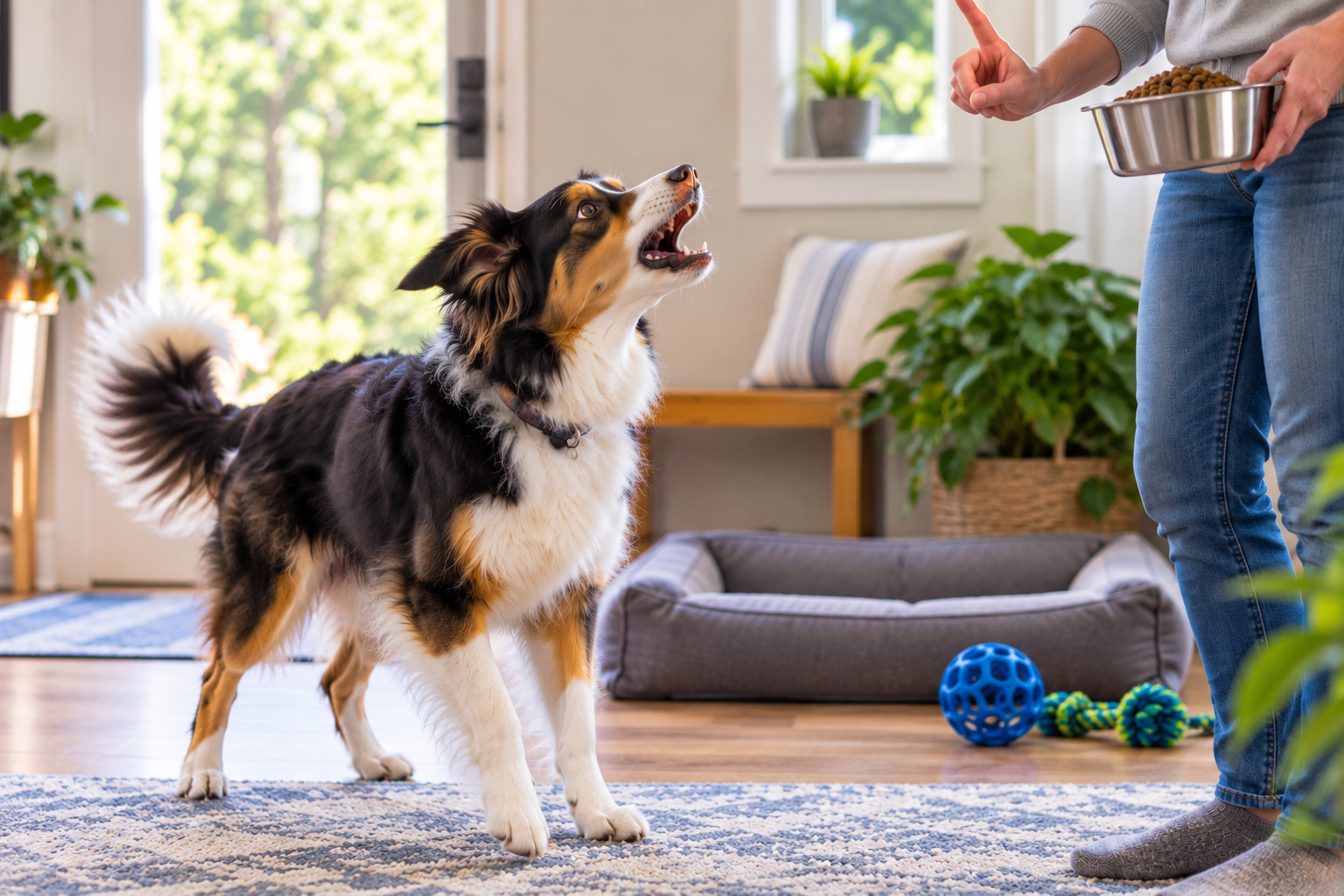
Dog barking at owner to lower it’s food bowl
Quick Answer
Demand barking happens when a dog barks because they want something to happen.
Your dog might bark because they want you to:
Throw the ball.
Give them food.
Open the door.
Pay attention to them.
Continue playing.
Put down their dinner.
Let them out of a crate or pen.
Give them access to something they want.
If barking has worked in the past—even occasionally—your dog has a good reason to try it again.
The solution isn't simply to tell your dog "QUIET!"
Instead:
Identify what your dog wants.
Prevent barking from repeatedly achieving that outcome.
Teach your dog another behaviour that does work.
Reinforce the alternative before barking begins.
Make sure your dog's physical, social and enrichment needs are being met.
Be consistent.
Most importantly, make sure you're actually dealing with demand barking.
A dog barking because they're frightened, anxious, frustrated, need to toilet or are experiencing separation-related distress requires a different approach.
What Is Demand Barking?
Demand barking is communication.
Your dog has learned:
"When I bark, something I want might happen."
Perhaps your dog brings you a ball.
You don't respond.
WOOF!
You throw the ball.
From your perspective, you may have thrown it because you wanted the barking to stop.
From your dog's perspective:
Barking made the human throw the ball.
Training happened.
Just perhaps not the training you intended.
Why Does My Dog Demand Bark?
Behaviour that works tends to be repeated.
If barking has resulted in something your dog values, barking may become part of the strategy they use to obtain it.
That reinforcement doesn't have to happen every time.
In fact, sometimes barking works and sometimes it doesn't.
Your dog may learn:
"Keep trying. Eventually it pays."
Demand barking can develop around many everyday situations.
For example:
Bark → dinner bowl goes down.
Bark → door opens.
Bark → toy gets thrown.
Bark → person looks at me.
Bark → person talks to me.
Bark → I get invited onto the couch.
Bark → training starts again.
Once we understand the pattern, we can begin changing it.
Is All Barking "Demand Barking"?
No.
This distinction is extremely important.
A barking dog may be:
Excited.
Frustrated.
Frightened.
Alerting to something.
Reacting to another dog.
Experiencing separation distress.
Seeking social contact.
Needing to toilet.
Uncomfortable.
In pain.
Under-stimulated.
Overstimulated.
Overtired.
Before trying to stop the barking, ask:
"Why is my dog barking?"
The sound may be the same.
The reason may be completely different.
And different causes require different solutions.
How Do I Know If My Dog Is Demand Barking?
Look at what happens immediately before and after the barking.
Ask yourself:
What does my dog appear to want?
Then:
What happens when they bark?
For example:
You stop petting your dog.
They bark.
You resume petting.
That's a fairly clear pattern.
Or:
You pick up their dinner bowl.
They begin barking.
You continue preparing the meal and eventually put the bowl down.
Again, barking has occurred while something valuable is being delivered.
Keeping track of the circumstances can help you identify patterns you hadn't noticed before.
Why Doesn't Saying "Quiet!" Work?
It can sometimes interrupt barking, but it doesn't necessarily teach your dog what you'd like them to do instead.
There's another complication.
For a dog who wants attention:
You turning toward them and saying "QUIET!" is attention.
Even negative attention can sometimes keep attention-seeking behaviour going.
Your dog barks.
You look at them.
You speak to them.
You walk toward them.
From the dog's perspective, barking successfully made you engage.
Instead of focusing entirely on stopping barking, ask:
"What would I like my dog to do instead?"
That's a much more useful training question.
Don't Wait for the Bark
One of the most effective changes you can make is to stop waiting for your dog to make a mistake.
Suppose your dog regularly barks while you prepare dinner.
You already know when barking is likely.
That gives you an opportunity to train before it starts.
Perhaps your dog can:
Settle on a bed.
Sit quietly.
Lie down.
Wait on a mat.
Engage with an enrichment activity.
Then reinforce that behaviour while you're preparing dinner.
Instead of:
Bark → human reacts
we begin building:
Settle quietly → good things happen.
Teach Your Dog What Works
Simply removing reinforcement for barking leaves an important question unanswered:
"What should my dog do instead?"
Give them an answer.
The alternative behaviour should be something realistic for the situation.
For example:
Instead of...Teach...Barking while dinner is preparedSettle on a bedBarking for the ballBring the toy and waitBarking to go outsideWait quietly at the doorBarking for attentionSit or settle nearbyBarking while you talk to someoneRelax on a matBarking during trainingPause calmly before the next repetition
Then make those behaviours worthwhile.
Settling on a Bed Can Be a Powerful Skill
One of our favourite everyday skills is teaching a dog to settle on a bed or cot.
Why?
Because "don't bark" isn't very specific.
"Go relax on your bed" gives the dog something concrete to do.
Once the behaviour is established, you can use it during situations such as:
Preparing meals.
Eating dinner.
Greeting visitors.
Working at your desk.
Watching television.
Talking on the phone.
Helping children with homework.
The bed becomes a predictable place where calm behaviour is reinforced.
Should I Ignore Demand Barking?
Sometimes removing attention can be part of the solution—but "just ignore it" isn't a complete training plan.
First, you need to be confident that the barking really is maintained by your attention.
Second, you need to consider what happens next.
If your dog barks for 10 minutes and you finally say:
"FINE!"
and throw the ball, you may have accidentally taught:
"Ten minutes of barking works."
Instead, combine thoughtful management with teaching and reinforcing an appropriate alternative.
Don't make your entire strategy dependent on seeing whether you can outlast your dog.
Why Can Barking Get Worse When I Stop Responding?
Sometimes a behaviour that previously worked becomes more persistent when it suddenly stops working.
Your dog may essentially try:
"Maybe I need to do it harder."
So barking might temporarily become:
Louder.
Faster.
More persistent.
Combined with pawing or jumping.
This is one reason prevention and teaching an alternative behaviour are so important.
Rather than repeatedly setting up situations where your dog practises increasingly intense barking, try to arrange the environment so you can reinforce the behaviour you want before the barking begins.
Be Careful Not to Reward the Barking Chain
Here's a common scenario:
Dog barks.
Owner says:
"Quiet."
Dog stops.
Owner gives a treat.
Repeat.
Soon:
BARK → quiet → treat.
The dog may learn the entire sequence.
This doesn't mean you should never reinforce quiet behaviour.
It means timing matters.
We want to increasingly reinforce quiet before barking happens, rather than requiring barking to start the interaction.
Look for those moments when your dog is already making a good choice.
Catch them being quiet.
Reinforce Calm Behaviour You Didn't Ask For
This is one of the simplest changes many families can make.
Your dog is lying quietly while you make coffee?
Drop a treat onto their bed.
Your dog watches you pick up their leash without barking?
Great.
Your dog waits quietly while you open the back door?
Excellent.
Your dog brings a toy and stands quietly instead of shouting at you?
That's an opportunity.
We tend to notice dogs when they're doing something we don't like.
Start deliberately noticing them when they're doing nothing problematic at all.
Quiet behaviour needs reinforcement history too.
What If My Dog Barks at Me to Throw the Ball?
Don't make barking the cue that starts the game.
Instead, establish a predictable way for your dog to ask appropriately.
For example:
Your dog brings the ball.
You ask for a simple behaviour such as a sit or brief wait.
Then you throw it.
Over time, the pattern becomes:
Bring toy → wait calmly → game continues.
If barking begins, pause rather than immediately throwing the toy.
Resume when your dog is able to offer the behaviour you're teaching.
Even better, reinforce calm toy presentation frequently enough that your dog doesn't need to experiment with barking.
What If My Dog Barks While I'm Preparing Food?
Food preparation is a perfect situation for proactive training.
Before you begin, send your dog to their bed.
Then periodically reinforce them for remaining there.
At first, you may need to reward frequently.
Gradually increase the amount of time between rewards as your dog becomes more successful.
You can also provide an appropriate enrichment activity while you cook.
Remember:
If your dog has spent years following you around the kitchen barking, expecting them to suddenly lie quietly for 30 minutes is unrealistic.
Build the skill gradually.
What If My Dog Demand Barks During Training?
This is common with enthusiastic dogs.
The dog may be saying:
"Come on! Give me another cue!"
or:
"Where's my treat?"
Look carefully at your training session.
You may need to adjust:
Your reinforcement rate.
The difficulty of the exercise.
How long the session lasts.
How clearly you're communicating.
How long your dog is waiting between repetitions.
Sometimes barking during training isn't simply a dog being "bossy."
It can indicate frustration or confusion.
If the dog doesn't understand how to earn reinforcement, make the exercise easier.
Could My Dog Be Bored?
Possibly.
A dog whose needs aren't being met may continually attempt to get their person to provide activity.
That doesn't mean you have to entertain your dog every waking minute.
Dogs also need to learn how to rest.
But consider whether your dog is receiving appropriate opportunities for:
Physical activity.
Sniffing.
Chewing.
Exploring.
Training.
Play.
Social interaction.
Problem-solving.
Rest and sleep.
Sometimes the answer isn't simply more exercise.
A dog can be physically exhausted and still have difficulty settling.
Balance matters.
Can Dogs Demand Bark Because They're Overtired?
Yes.
Puppies in particular can become louder, mouthier and more frantic when they're tired.
If your puppy has been awake and busy for a long time, another game or walk may not be what they need.
They may need help settling and sleeping.
This is why it's useful to consider the whole dog, rather than treating every bark as a training problem.
Should I Use a Bark Collar, Spray Bottle or Other Correction?
At Paus-n-Train, we don't recommend using pain, fear or startling to suppress demand barking.
These approaches focus on stopping the sound rather than teaching the dog what behaviour will be successful.
They also don't address situations where barking is caused by fear, frustration or another underlying emotional need.
Instead, focus on:
Why is the barking happening?
What is reinforcing it?
What behaviour would I rather reinforce?
Those questions give you a training plan.
Make Sure Everyone in the Household Is Consistent
Demand barking can be surprisingly resistant to change when different people respond differently.
Imagine:
One person ignores barking.
Another tells the dog to stop.
Another gives the dog a biscuit.
Another opens the door.
Another throws the toy because:
"I couldn't listen to it anymore."
From the dog's perspective, barking still works.
Everyone doesn't need to interact with the dog identically, but the household should agree on the basic plan:
What behaviour are we trying to reinforce instead?
Consistency makes learning much clearer.
What If My Dog Barks to Go Outside?
Be careful before labelling this demand barking.
Your dog may genuinely need to toilet.
If your dog needs to go out, meet that need.
You can still develop calmer door behaviour separately.
For example, teach your dog to:
Approach the door.
Sit or stand quietly.
Wait while the door opens.
Exit when released.
Don't ignore genuine communication simply because you'd prefer it to be quieter.
What If My Dog Barks From Their Crate?
Again, determine why before deciding how to respond.
Crate barking can occur because a dog:
Needs to toilet.
Hasn't been properly conditioned to the crate.
Is frustrated.
Is frightened.
Is experiencing isolation or separation distress.
Has learned that barking results in release.
Those situations shouldn't all receive the same training plan.
A puppy who desperately needs to toilet shouldn't be ignored because you're worried about "rewarding barking."
Context matters.
When Should I Get Professional Help?
Consider getting help if:
The barking is becoming more intense.
You're not sure why your dog is barking.
Your dog appears anxious or distressed.
Barking is accompanied by growling, snapping or other concerning behaviour.
Your dog cannot settle.
Barking occurs primarily when your dog is left alone.
Your dog's behaviour has suddenly changed.
Your training plan isn't improving the behaviour.
Sudden behaviour changes can sometimes have a medical component, so speak with your veterinarian when appropriate.
Frequently Asked Questions
How long does it take to stop demand barking?
There isn't a universal timeline.
A behaviour that has worked for months or years may take longer to change than a newly developing habit.
Consistency, management and reinforcement of alternative behaviours all matter.
Should I say "No" when my dog demand barks?
Saying "No" doesn't tell your dog what behaviour you'd like instead.
For some dogs, your response may also provide exactly what they wanted: attention.
Focus on teaching and reinforcing a specific alternative.
Should I turn my back when my dog barks?
Removing attention can be useful when attention is maintaining the barking, but it shouldn't be your entire training strategy.
Teach your dog how they can successfully request interaction.
Should I reward my dog when they stop barking?
You can reinforce quiet behaviour, but be thoughtful about timing.
If every reward follows bark → stop → treat, barking may become the first step in the sequence.
Look for opportunities to reinforce quiet behaviour before barking begins.
Is demand barking the same as attention barking?
They can overlap.
Attention itself can be what the dog is demanding, but dogs can also demand bark for food, toys, access, movement or other outcomes.
Why does my dog demand bark at one person but not another?
Dogs learn patterns with individual people.
If barking has historically worked with one family member, the dog may use it more frequently with that person.
Is my puppy too young to learn not to demand bark?
No—but keep expectations appropriate.
Rather than expecting prolonged silence, teach your puppy simple, achievable behaviours and reinforce calm choices frequently.
Prevention is particularly useful with puppies because you can avoid building a long history of barking successfully producing rewards.
Key Takeaways
If your dog is demand barking:
✔ First determine whether it really is demand barking.
✔ Identify what your dog wants.
✔ Look at what happens immediately after the bark.
✔ Prevent barking from repeatedly achieving the desired outcome.
✔ Teach a clear alternative behaviour.
✔ Reinforce calm behaviour before barking begins.
✔ Use management to prevent repeated rehearsal.
✔ Consider your dog's physical, mental and social needs.
✔ Make sure your dog is getting adequate rest.
✔ Avoid punishment and startling techniques.
✔ Get everyone in the household following the same basic plan.
✔ Seek professional help if you're unsure what's driving the behaviour.
Most importantly:
Don't focus only on stopping the bark.
Ask:
"What would I like my dog to do instead?"
Then teach your dog that behaviour and make it worth choosing.
That's how we move from simply suppressing unwanted behaviour to actually teaching our dogs how to succeed.
How Paus-n-Train Can Help
At Paus-n-Train, we don't look at demand barking as simply a dog being "bad," "bossy" or "stubborn."
We look at what the behaviour is accomplishing for the dog.
Then we help owners change the pattern.
Our training approach uses positive reinforcement, thoughtful management and clear communication to teach dogs the behaviours we'd like to see instead.
For puppies, Puppy Prep School provides an opportunity to begin developing important foundations such as settling, calm observation and learning that they don't need immediate access to everything they want.
For adolescent and adult dogs, our Dog Manners program builds practical everyday skills including settling on a bed, polite behaviour around people and learning to work with their handler around distractions.
The goal isn't to create a dog who never communicates.
It's to help your dog discover better ways to communicate with you—and give you better ways to listen.