Puppy Training Classes vs Private Lessons: Which Is Right for My Puppy?
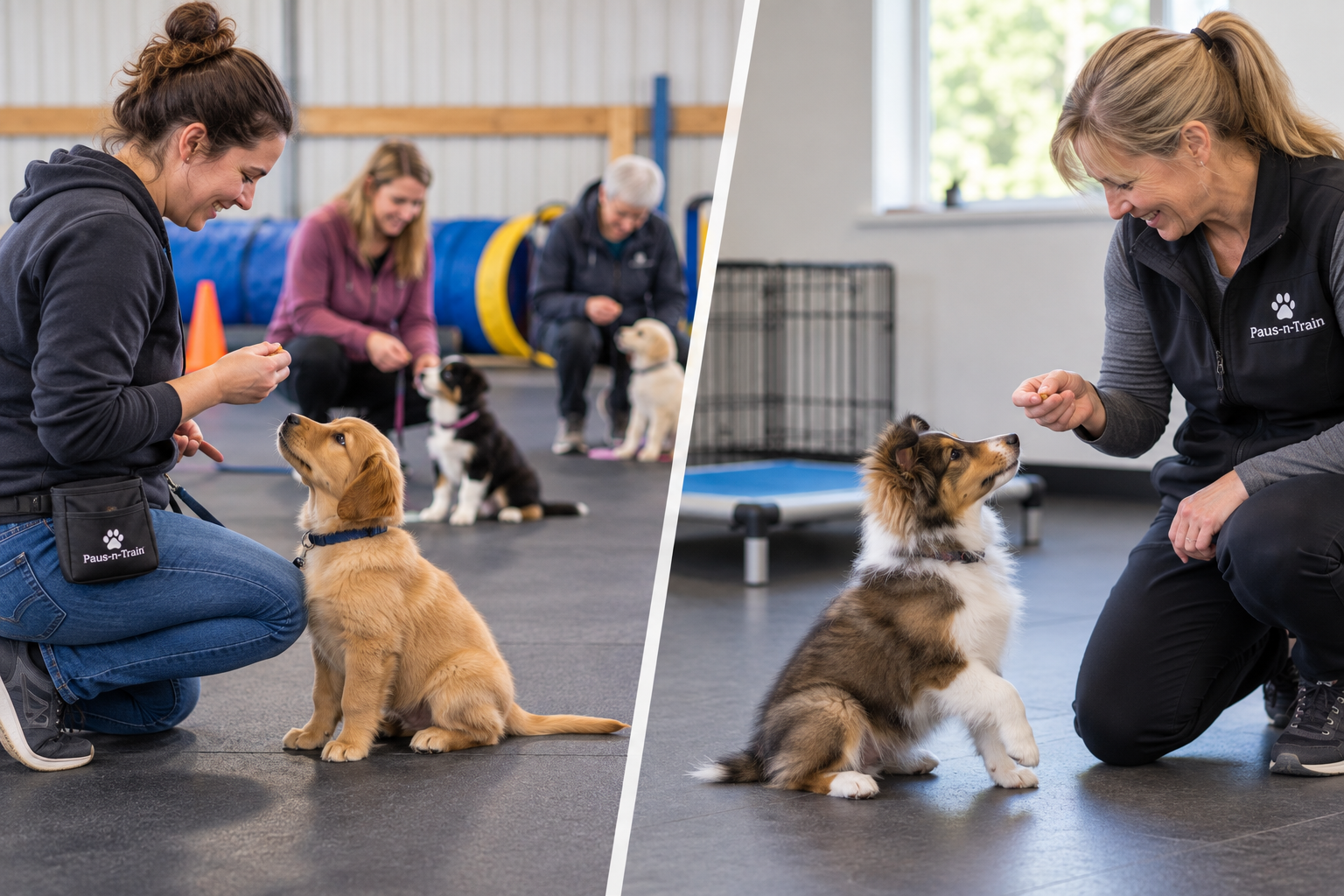
Puppy working with its owner and positive reinforcement trainer during a small group puppy training class and another puppy working in a private class setting.
Quick Answer
Should you enrol your puppy in a group puppy training class or book private lessons?
For many puppies, a well-run puppy class provides benefits that are difficult to recreate in a private lesson. Your puppy gets to practise learning around other dogs and people, experience new sights and sounds, and develop the ability to focus on you even when interesting things are happening nearby.
Private lessons offer something different: individual attention and training tailored specifically to you and your puppy.
Neither option is automatically better.
The best choice depends on:
Your puppy's age.
Their confidence and comfort around other dogs and people.
The skills you want to develop.
Your family's individual challenges.
Your puppy's ability to learn in a group environment.
Whether you need individualized coaching.
Your schedule and learning preferences.
And sometimes, the best answer is:
Both.
What's the Difference Between a Puppy Class and a Private Lesson?
The biggest difference isn't simply the number of dogs in the room.
It's the learning environment.
In a private lesson, the trainer can focus entirely on you and your puppy.
In a puppy class, your puppy is learning skills while other puppies, people, sounds, movement and distractions are present.
Those are two very different—and valuable—training experiences.
Think of it this way:
Private lessons provide individualization.
Group classes provide structured opportunities to learn around the world.
What Are the Benefits of a Group Puppy Class?
A thoughtfully designed puppy class should be about much more than teaching SIT.
Early puppyhood is an important period for helping puppies learn about their environment and develop the skills they'll need as they grow.
A good puppy program can provide controlled opportunities for your puppy to experience:
Other puppies.
Different people.
Movement.
Novel objects.
Unusual surfaces.
New sounds.
Training equipment.
Handling.
Waiting and observing.
Learning while distractions are present.
Most importantly, your puppy can learn that seeing another dog doesn't necessarily mean they get to interact with them.
That's an incredibly useful life skill.
Isn't Puppy Class Mainly for Socialization?
Socialization is an important part of puppy training—but socialization is often misunderstood.
It doesn't mean:
"Let my puppy meet and play with as many dogs as possible."
Good socialization is about helping your puppy develop positive or neutral associations with the things they'll encounter throughout life.
Sometimes that means interacting.
Sometimes it means observing.
Sometimes it means learning:
"There's another dog over there, and I can still relax with my person."
A puppy who learns that every dog predicts play can eventually become frustrated when they aren't allowed to greet.
That's why structured puppy training can be so valuable.
We're not simply teaching puppies how to interact.
We're also teaching them how to coexist.
Why Is Learning Around Other Puppies Helpful?
Training at home can feel surprisingly easy.
Your puppy may respond beautifully when you're standing in your kitchen holding treats.
Then you go outside and suddenly appear to own a puppy who has never heard their name before.
That's normal.
Dogs don't automatically understand that a behaviour learned in one environment applies everywhere.
They need opportunities to practise skills in different situations.
A puppy class provides a carefully managed environment where puppies can begin learning:
"I can listen to my person even when something interesting is happening nearby."
That skill becomes important later when you encounter:
Dogs on walks.
Visitors.
Children playing.
People passing by.
Veterinary waiting rooms.
Training classes.
Community environments.
Learning around appropriate distractions is part of building real-world skills.
Does My Puppy Need to Play With the Other Puppies?
No.
Puppy training does not need to involve unrestricted puppy play.
In fact, more puppy play isn't automatically better socialization.
Some puppies love wrestling with other dogs.
Some are overwhelmed by it.
Some become so excited that they struggle to disengage.
Some puppies would benefit more from learning that another puppy can be nearby without anything happening at all.
The goal isn't to create a puppy who believes:
"DOG! I HAVE TO GO SAY HELLO!"
We'd rather help develop a puppy who can think:
"There's a dog. That's fine. What are we doing?"
What Are the Benefits of Private Puppy Lessons?
Private training gives you something a group class can't provide to the same degree:
Individual attention.
The lesson can be built around your puppy, your household and your priorities.
You might spend an entire lesson working on:
Crate training.
Housetraining.
Puppy biting.
Settling.
Leash skills.
Handling.
Recall.
Grooming preparation.
Family routines.
Introducing your puppy to another household pet.
A specific behaviour you're concerned about.
You also have more time to ask questions about your individual situation.
When Might Private Lessons Be the Better Choice?
There are situations where private training may be particularly useful.
For example:
Your Puppy Is Overwhelmed in a Group Environment
Some puppies aren't ready to learn comfortably around several dogs and people.
If your puppy is extremely worried, shuts down or can't recover from the environment, adding more exposure isn't necessarily helpful.
Training should happen at a level where learning is possible.
You Have a Very Specific Problem
Perhaps everything is going well except for one issue.
Maybe your puppy:
Screams when left alone.
Won't tolerate their crate.
Is struggling with handling.
Is biting intensely.
Is having unusual housetraining difficulties.
Individual coaching may allow more time to explore what's happening.
Your Household Has Unique Needs
Maybe you have:
Young children.
An older dog.
Cats.
Mobility considerations.
A complicated household schedule.
Specific accessibility needs.
A private lesson can focus on making training practical for your actual home.
You Learn Better One-on-One
Human learning matters too.
Some people simply learn better when they can ask questions, practise skills and receive immediate individual feedback without the activity of a group class around them.
That's completely valid.
When Is a Group Puppy Class Particularly Valuable?
Group training can be especially useful when your puppy is comfortable enough to learn around other dogs and people.
It gives you opportunities that can be difficult to manufacture at home.
For example:
Your puppy sees another dog.
You reward calm observation.
Your puppy returns their attention to you.
Later, another puppy moves across the room.
Your puppy learns to stay engaged with you.
Someone enters through a door.
Your puppy practises settling rather than rushing toward them.
These moments may look small.
But they're rehearsals for everyday life.
What If My Puppy Is Distracted During Class?
That's not necessarily a problem.
In fact, learning to work around distractions is one reason you're there.
A puppy who can perform every exercise perfectly because nothing interesting is happening isn't necessarily learning the same skills as a puppy who notices something exciting and then successfully re-engages with their person.
The goal isn't perfection.
We want to help your puppy learn:
Notice → process → reconnect.
If your puppy is so distracted or overwhelmed that they can't eat, settle or engage at all, however, the environment may currently be too difficult.
That's useful information too.
Will My Puppy Learn Faster in Private Lessons?
Not necessarily.
Private lessons may allow your trainer to cover certain skills more efficiently because there's less distraction and more individualized coaching.
But faster isn't always the same as better prepared.
If your puppy learns loose-leash walking beautifully in a quiet training space, you'll still eventually need to practise around:
Dogs.
People.
Smells.
Movement.
Wildlife.
Traffic.
New environments.
Reducing distractions helps when initially teaching a behaviour.
Eventually, however, we need to carefully add them back.
What If I Have Never Trained a Dog Before?
Both options can work well for first-time puppy owners.
A structured puppy class can be particularly helpful because it gives you a curriculum to follow rather than leaving you wondering:
"What should I be teaching this week?"
Private lessons can provide extra support when you need more help with a particular skill.
Remember that puppy training isn't simply about teaching the puppy.
We're teaching the human too.
Understanding timing, reinforcement, body language, management and how dogs learn will help you far beyond puppyhood.
Should I Wait Until My Puppy Has a Problem Before Booking a Private Lesson?
No.
Private lessons aren't only for behaviour problems.
They can also be used proactively.
For example, you might book a lesson to work on:
Preparing for your puppy's first grooming appointment.
Introducing a Gentle Leader.
Cooperative nail care.
Building recall.
Preparing for adolescence.
Improving leash skills.
Setting up a successful household routine.
Sometimes a small amount of individualized coaching early prevents frustration later.
Can I Do Puppy Classes and Private Lessons Together?
Absolutely.
In many cases, this gives families the best of both worlds.
Your puppy can benefit from a structured group learning environment while a private lesson provides additional help with individual needs.
For example:
In puppy class:
Your puppy practises settling while another puppy moves nearby.
In your private lesson:
You troubleshoot why your puppy can't settle when guests arrive at your house.
The underlying skill may be similar, but the individual application is different.
What About Online Puppy Training?
Online training can also be valuable, particularly when:
You're preparing before your puppy arrives.
Your puppy is too young or unable to attend a particular class.
You want to revisit demonstrations.
You need information immediately.
You prefer learning at your own pace.
Digital learning is particularly useful when paired with real-life practice.
Watching a video teaches you what to do.
Practising teaches your puppy.
How Do I Choose a Puppy Training Class?
Not all puppy classes are the same.
Before enrolling, ask about the trainer's approach.
Look for a program that:
Uses positive reinforcement.
Provides appropriate space between puppies.
Doesn't force interactions.
Allows puppies to opt out when they're uncomfortable.
Includes practical everyday skills.
Teaches owners how dogs learn.
Provides controlled socialization opportunities.
Doesn't use fear, intimidation or painful equipment.
Helps owners understand canine body language.
Keeps class sizes manageable.
A puppy class should feel like a learning environment, not puppy chaos.
What Should I Look for in a Private Puppy Trainer?
The same principles apply.
Look for someone who:
Uses evidence-based, positive reinforcement methods.
Explains why they're recommending a training strategy.
Coaches you rather than simply taking over your puppy.
Recognizes fear, stress and discomfort.
Adapts training to the individual puppy.
Provides realistic expectations.
Has appropriate education and credentials.
Knows when a concern should be referred to a veterinarian or other professional.
Ultimately, you're the person who will live with and train your puppy every day.
A trainer's job should be to give you the skills to succeed when they aren't standing beside you.
Group Puppy Class vs Private Lesson: At a Glance
Group Puppy TrainingPrivate Puppy LessonsStructured curriculumIndividualized curriculumPractise around other puppiesLower-distraction environmentControlled socialization opportunitiesFocus on specific concernsLearn around real-world distractionsMore individual trainer attentionObserve other teams learningMore time for personal questionsDevelop focus around dogs and peopleAdapt training to household needsOften excellent for general puppy foundationsExcellent for troubleshooting and specialized goals
Neither column is the winner.
They simply provide different training opportunities.
Frequently Asked Questions
Should my puppy attend group classes?
If your puppy is comfortable enough to learn in a group environment, a well-run puppy class can provide valuable opportunities for training, controlled socialization and learning around distractions.
Individual puppies vary, however, so group training isn't automatically the best environment for every puppy.
Is private puppy training better than group classes?
Not necessarily.
Private lessons provide more individualized attention, while group classes provide opportunities to practise around other dogs, people and distractions.
The better option depends on what you and your puppy need.
Does my puppy need basic training before attending puppy class?
A beginner puppy class should be designed for puppies who are just beginning their training.
Your puppy shouldn't need to arrive already knowing the curriculum.
My puppy already knows SIT. Do we still need puppy class?
Puppy training should involve much more than SIT.
Learning to settle, focus around distractions, explore new environments, tolerate handling, develop confidence and communicate with their person can be far more important than collecting obedience behaviours.
What if my puppy barks during class?
Occasional barking doesn't automatically mean group training isn't appropriate.
The important questions are why the puppy is barking, whether they're able to recover and whether they're still capable of learning.
A qualified trainer can help assess what your puppy's behaviour is communicating.
Is one private lesson enough?
Sometimes.
A single lesson may be enough to troubleshoot a relatively straightforward issue and give you a training plan.
Other goals require ongoing coaching.
The number of lessons should depend on what you're trying to accomplish rather than an arbitrary package size.
When should puppy training start?
Training starts the moment your puppy comes home.
Every interaction teaches something.
Formal training sessions can be extremely short, but routines around toileting, sleeping, handling, chewing, settling, play and attention are already creating learning from day one.
Key Takeaways
When deciding between puppy classes and private lessons, remember:
✔ Group puppy training provides structured opportunities to learn around dogs, people and distractions.
✔ Private lessons provide individualized attention.
✔ Puppy socialization is about much more than puppy play.
✔ Puppies need to learn that they don't have to greet every dog they see.
✔ Private lessons can be useful proactively—not only when something has gone wrong.
✔ A puppy doesn't need perfect behaviour to attend a beginner class.
✔ Learning in a quiet environment and learning around distractions are different skills.
✔ Some puppies benefit from using both group and private training.
✔ The quality and training philosophy of the program matter more than simply choosing "group" or "private."
Most importantly:
Choose the learning environment that helps both you and your puppy succeed.
The goal isn't to complete puppy training as quickly as possible.
It's to build the skills, confidence and communication that will support you through adolescence and into adulthood.
How Paus-n-Train Can Help
At Paus-n-Train, we believe puppy training should prepare families for life with their dog, not simply teach puppies a list of obedience behaviours.
Our Puppy Prep School is a 10-week program designed to give young puppies a strong start through positive, structured learning.
Puppies work on skills such as:
Appropriate early socialization.
Calm observation.
Novel surfaces, sights and sounds.
Settling on a bed.
Recall foundations.
Beginning leash skills.
Learning around other puppies and people.
Our class sizes are kept small so teams have space to learn while still benefiting from the presence of other puppies.
Puppy Prep School also includes a prepaid private lesson.
We intentionally combine these two types of learning because they serve different purposes.
The group environment allows your puppy to develop skills around carefully managed distractions, while your private lesson gives you an opportunity to focus on the needs of your individual puppy and household.
Students also receive access to our digital homework resources so you can review lessons and continue practising between classes and well beyond graduation.
For puppies who aren't able to attend Puppy Prep School, our Puppy Prep School OnDemand program provides another way to work through important puppy foundations at home.
Our goal isn't to make every puppy fit exactly the same training plan.
It's to help you understand your puppy, teach them effectively and build the foundation for the dog they'll become.