What Is Hoopers? A Beginner’s Guide to This Fun Dog Sport
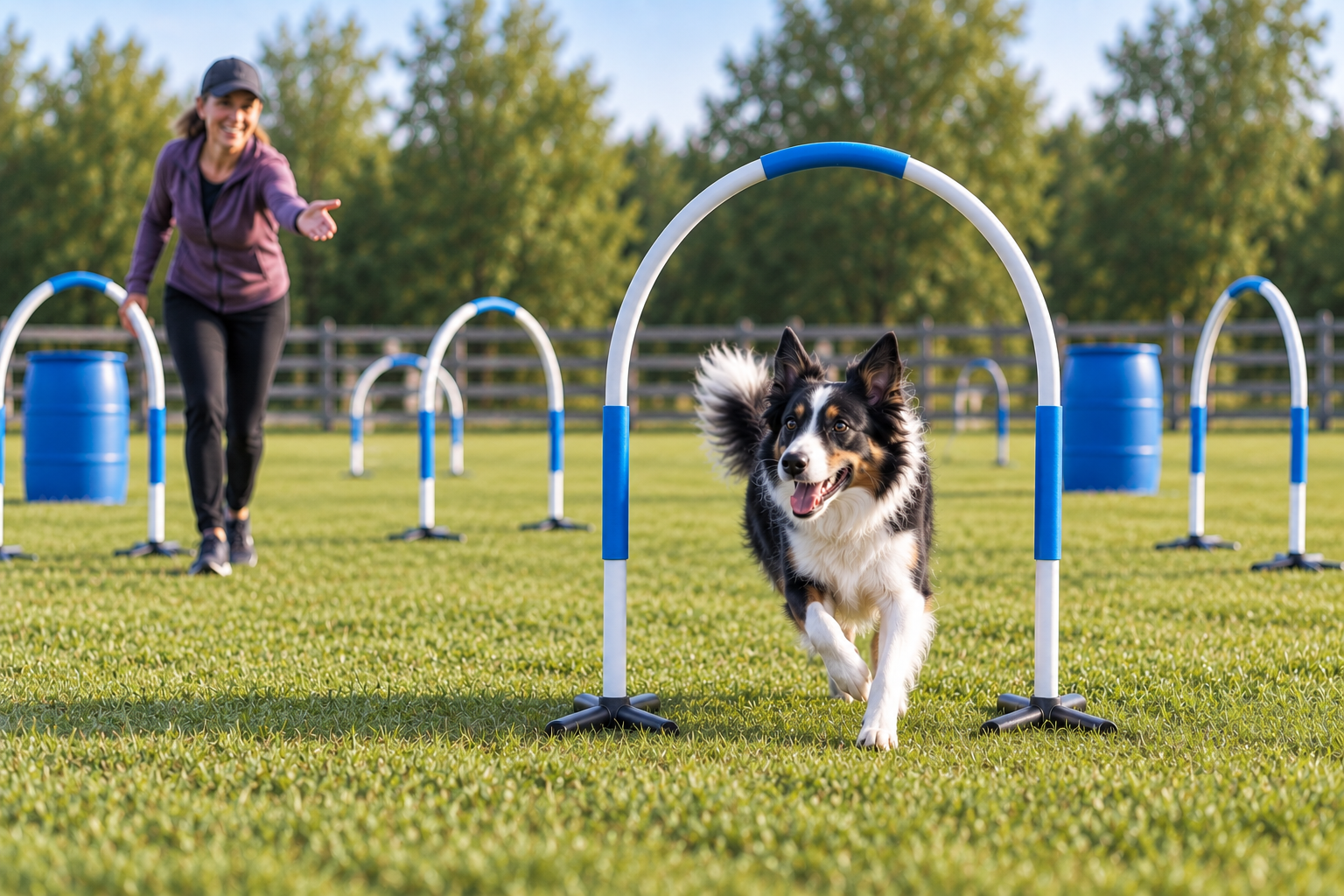
Dog running through a hoop on a Hoopers course with barrels and ground-level equipment.
Quick Answer
Hoopers is a fun, flowing dog sport where dogs navigate a course of hoops, barrels, tunnels and gates while being directed by their handler.
Unlike agility, there are no jumps, weave poles or contact equipment such as teeters and A-frames. The equipment is designed to encourage smooth, flowing lines with the dog remaining primarily at ground level.
One of the most interesting parts?
The handler doesn't necessarily have to run beside the dog.
As training progresses, handlers learn to direct their dogs around the course using verbal cues and body language from a distance.
This makes Hoopers an exciting activity for many different dogs and people—including those who may find traditional agility physically challenging.
What Exactly Is Hoopers?
If you've watched dog agility, you're probably familiar with dogs racing over jumps, through tunnels, across contact equipment and through weave poles.
Hoopers looks a little different.
Instead of jumping over obstacles, the dog travels through or around them.
A Hoopers course can include:
Hoops.
Barrels.
Short tunnels.
Gates.
The obstacles are arranged to create flowing courses that the handler guides the dog through in the correct sequence.
While speed can certainly develop, Hoopers isn't simply about running fast.
Dogs and handlers need to learn:
Directional cues.
Obstacle understanding.
Distance skills.
Handler focus.
Independent movement.
Course navigation.
It's very much a team sport.
What Does a Hooper Look Like?
The obstacle that gives the sport its name is the hoop.
Despite the name, the dog doesn't jump through a suspended ring.
A Hoopers hoop sits directly on the ground and forms a large arch.
The dog simply runs through the opening.
Because the dog doesn't need to jump over a bar, their movement can remain smooth and relatively natural.
What Other Equipment Is Used?
One of the appealing things about Hoopers is its relatively simple equipment.
Hoops
Dogs learn to travel confidently through hoops and eventually seek them out independently when directed by their handler.
Barrels
Dogs travel around barrels rather than over them.
Barrels help teach turning, directional skills and obstacle commitment.
Tunnels
Hoopers uses tunnels that allow the dog to travel through without jumping.
Dogs learn to enter independently and continue forward to the next obstacle.
Gates
Gates provide another visual obstacle that helps define the dog's path through the course.
Together, these obstacles can create surprisingly challenging courses despite their simple appearance.
Is Hoopers the Same as Agility?
No—but the two sports share some skills.
Both involve a dog and handler navigating a numbered course while communicating about where the dog should go next.
However, traditional agility commonly includes:
Jumps.
Weave poles.
A-frames.
Dog walks.
Teeters.
Tunnels.
Hoopers focuses on ground-level obstacles and flowing paths.
Another major difference is distance handling.
In agility, handlers often run much of the course with their dogs.
In Hoopers, the handler can learn to direct the dog from farther away.
That creates a different handling challenge.
Instead of relying primarily on running with the dog, the handler develops increasingly clear communication.
Is Hoopers Lower Impact Than Agility?
Generally, Hoopers is designed as a lower-impact dog sport because dogs aren't repeatedly jumping over obstacles or negotiating elevated contact equipment.
Courses are intended to encourage flowing movement rather than tight, repetitive physical manoeuvres.
That can make Hoopers appealing for dogs and handlers who enjoy training and course work but would prefer an activity with fewer jumping demands.
However, lower impact doesn't mean no physical demands.
Dogs are still:
Running.
Turning.
Accelerating.
Decelerating.
Navigating obstacles.
If your dog has an injury, mobility limitation or medical condition, speak with your veterinarian or appropriate canine rehabilitation professional before beginning a new physical activity.
Does My Dog Need Agility Experience?
Absolutely not.
Your dog doesn't need to know anything about agility before starting Hoopers.
Beginner training starts by teaching the individual pieces.
Your dog can learn:
"Go through this hoop."
Then:
"Go through that hoop even when I'm a little farther away."
Then:
"Follow my cue toward the next obstacle."
Eventually those individual skills begin coming together into sequences and courses.
What Will My Dog Learn in Hoopers?
Hoopers develops far more than the ability to run through equipment.
Dogs can learn:
To work independently from their handler.
Directional cues.
Forward focus.
Obstacle commitment.
Distance skills.
Body awareness.
Confidence.
Listening while moving.
Responding to verbal and physical cues.
Handlers develop skills too.
You'll learn how your:
Position.
Movement.
Body orientation.
Timing.
Verbal cues.
...affect the path your dog takes.
One of the fascinating things about dog sports is discovering just how much information we're communicating to our dogs—even when we don't realize we're doing it.
What Does Distance Handling Mean?
Imagine standing in one area while your dog moves farther away from you to complete part of a course.
Instead of running directly beside them, you communicate:
Go forward.
Turn this direction.
Take that obstacle.
Continue ahead.
Those skills are built gradually.
We don't place a beginner dog at one end of a field, point toward a complicated course and hope for the best.
First, dogs learn to understand the equipment and cues while their handler is nearby.
As their understanding and confidence grow, distance is gradually added.
Do I Have to Run?
One of the reasons many people become interested in Hoopers is that the sport can require less running from the handler than traditional agility.
As distance skills develop, handlers can direct their dogs without having to race alongside them throughout the entire course.
That's particularly appealing for people who:
Have mobility limitations.
Find running difficult.
Have previous injuries.
Simply don't want to sprint around an agility field.
However, handlers still need to move and communicate effectively.
Hoopers isn't necessarily a stationary activity—especially during the learning stages.
The goal is to develop the dog's ability to work increasingly independently.
What Dogs Can Do Hoopers?
Hoopers can be suitable for a wide variety of dogs.
You don't need a Border Collie.
You don't need the fastest dog in your neighbourhood.
You don't even need previous dog-sport experience.
Depending on the individual, Hoopers may appeal to:
Young dogs learning sport foundations.
Adult companion dogs.
Dogs new to dog sports.
Experienced agility dogs.
Retired or semi-retired agility dogs.
Dogs whose owners are looking for lower-impact activities.
Dogs who enjoy working at a distance.
What matters most is whether the activity is appropriate for your individual dog.
Is Hoopers Good for Older Dogs?
It can be an enjoyable option for some older dogs because there are no jumps or elevated contact obstacles.
An experienced agility dog who no longer needs the physical demands of traditional agility may still enjoy:
Learning courses.
Working with their handler.
Responding to directional cues.
Running through tunnels and hoops.
Solving training challenges.
But "senior" doesn't automatically mean a dog should—or shouldn't—participate.
Your dog's physical condition matters more than their birthday.
If your older dog has arthritis, an injury or another health condition, speak with your veterinarian about what level of activity is appropriate.
Is Hoopers Good for Young Dogs?
Hoopers can provide young dogs with useful foundation skills without requiring repetitive jumping.
Young dogs can work on:
Focus.
Confidence.
Directional understanding.
Following handler cues.
Working around equipment.
Independence.
Training should still be appropriate for the dog's age and physical development.
Young dogs don't need to run long, complicated courses to benefit.
Short, thoughtful training sessions are often more valuable.
Is Hoopers Only for Competition Dogs?
Not at all.
This is one of my favourite things about dog sports.
You don't have to compete to participate.
Some people love working toward titles and trials.
Others simply want:
Something fun to do with their dog.
A weekly activity together.
Mental stimulation.
A new training challenge.
Better communication.
A reason to get out and play.
Both are completely valid.
Your dog doesn't know whether there's a ribbon involved.
They're enjoying the activity with you.
Can You Compete in Hoopers?
Yes.
For people who enjoy competition, Hoopers provides opportunities to develop course skills and work toward increasingly challenging levels.
At Paus-n-Train, our Hoopers training follows Canadian Hoopers of Canada (CHC).
Handlers who become interested in the competitive side of the sport can explore trial opportunities as their skills develop.
But competition is always optional.
You can enjoy Hoopers simply because you and your dog have fun doing it.
Is Hoopers Easy?
The equipment may look simple.
The training can be wonderfully challenging.
Getting your dog through one hoop?
Fairly straightforward.
Teaching your dog to confidently travel away from you, take the correct obstacle, respond to a directional cue and continue through a course while you're several metres away?
That's where things become interesting.
Hoopers challenges handlers to develop clear communication rather than relying entirely on physical proximity.
It can look deceptively easy when an experienced team does it well.
That's usually a sign of good training.
Why Is Hoopers Good Mental Enrichment?
Physical exercise is only one part of meeting a dog's needs.
Dogs also benefit from opportunities to:
Think.
Learn.
Problem-solve.
Communicate.
Explore.
Work toward reinforcement.
Hoopers combines movement with learning.
The dog isn't simply running.
They're continually processing information:
Where is my handler?
Which obstacle am I taking?
Which direction am I turning?
Do I continue forward?
That combination of physical activity and mental problem-solving can make dog sports particularly satisfying.
What If My Dog Makes a Mistake?
Then we have information.
Perhaps:
Your cue was late.
Your body position accidentally indicated another obstacle.
The dog doesn't understand the skill yet.
You added too much distance.
The sequence was too difficult.
The reinforcement history for another obstacle was stronger.
Dog sports give us wonderful opportunities to practise an evidence-based training mindset.
Rather than asking:
"Why did my dog get it wrong?"
We can ask:
"What does that response tell me about what we need to practise?"
Then we adjust the training.
What Should I Bring to My First Hoopers Class?
Your training facility will provide specific instructions, but you'll generally want:
Your dog.
A comfortable collar or harness.
A regular leash.
Plenty of small, high-value treats.
A favourite toy if your dog enjoys toy rewards.
Water.
Appropriate footwear and clothing for yourself.
Most importantly, bring realistic expectations.
Your dog doesn't need to understand Hoopers on day one.
That's why you're coming to class.
Frequently Asked Questions
Does my dog need to be off leash?
At Paus-n-Train, we set up individual training quadrants so your dog can remain off leash for the entire class while staying safely within a designated space using barriers. This setup allows dogs to focus on their handlers and training without interacting directly with one another.
Does my dog need perfect obedience?
No.
Your dog doesn't need military precision before trying a dog sport.
However, basic engagement with the handler and the ability to work around reasonable distractions make learning easier.
Those skills can also continue developing through Hoopers itself.
Can small dogs do Hoopers?
Yes.
Hoopers isn't reserved for large or fast dogs.
Training and course expectations should always be appropriate for the individual dog.
Can large dogs do Hoopers?
Absolutely.
The ground-level, flowing nature of the sport can make it appealing for many different sizes of dogs.
Can my retired agility dog do Hoopers?
Potentially, yes.
Many agility handlers are attracted to Hoopers because their dogs can continue enjoying course work and teamwork without jumping.
Whether it's appropriate will depend on why the dog retired and their current physical condition.
Can I do both agility and Hoopers?
Yes.
The sports can complement each other.
Hoopers can strengthen:
Distance skills.
Verbal directionals.
Obstacle commitment.
Handler awareness.
Independent movement.
Experienced agility teams may find those skills useful in their agility training as well.
Is Hoopers suitable if I have limited mobility?
It may be.
One of the appealing features of Hoopers is the emphasis on teaching the dog to work at increasing distances from the handler.
That can reduce how much running the handler needs to do compared with some other dog sports.
Individual circumstances vary, so talk with your instructor about what accommodations may be appropriate.
Key Takeaways
Hoopers is a fun, accessible dog sport built around communication, distance and flowing movement.
Remember:
✔ Dogs travel through or around ground-level obstacles.
✔ There are no jumps or weave poles.
✔ Equipment includes hoops, barrels, tunnels and gates.
✔ Dogs gradually learn to work at increasing distances from their handlers.
✔ You don't need agility experience.
✔ You don't need to be able to run fast.
✔ Dogs of many breeds and sizes can participate.
✔ It can provide both physical activity and mental enrichment.
✔ Competition is optional.
✔ Experienced agility teams can also use Hoopers to develop valuable distance skills.
Most importantly:
Hoopers gives you another opportunity to learn, communicate and have fun with your dog.
And ultimately, that's what dog sports should be about.
How Paus-n-Train Can Help
At Paus-n-Train, our goal isn't simply to teach dogs to navigate Hoopers equipment.
We want to help dogs and handlers learn how to communicate clearly, develop confidence and build skills together.
Our Intro to Hoopers program is a six-week introduction to the sport following Canadian Hoopers of Canada (CHC).
During the program, teams begin learning the foundation skills needed for Hoopers, including working with hoops, barrels, tunnels and gates while developing directional cues and the beginnings of distance handling.
Because the sport doesn't use jumps or weave poles, Hoopers can also provide an exciting option for people looking for a different type of dog sport, handlers who may find traditional agility physically demanding, and some dogs who would benefit from a lower-impact activity.
For experienced agility teams, Hoopers can provide an entirely new challenge: learning to communicate effectively without always needing to run directly beside your dog.
And if you discover that you love it?
You can continue developing your skills through our Beginners Hoopers training and explore the competitive side of Canadian Hoopers of Canada.
Whether your goal is competition or simply spending an hour each week doing something fun with your dog, you're welcome.
Because you don't need to have the fastest dog or the biggest competitive goals to enjoy dog sports—you just need a dog, a willingness to learn and a desire to have some fun together.