How Do I Trim My Dog's Nails?
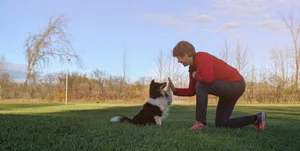
Dog calmly offering a paw to their owner during positive cooperative nail-trimming training.
Quick Answer
Successful nail trimming isn't just about knowing where to cut. It's also about teaching your dog to feel comfortable having their paws handled and participating in the process.
For many dogs, the easiest approach is to break nail care into small steps:
Get your dog comfortable with paw handling.
Introduce the nail clippers or grinder separately.
Pair each step with high-value food.
Learn where the quick is before trimming.
Take off very small amounts at a time.
Stop before your dog becomes overwhelmed.
Consider alternatives such as a nail file or scratch board if traditional clipping is difficult.
You don't have to trim every nail in one session.
One successful nail is better training than forcing your way through all 18.
Why Does My Dog Need Their Nails Trimmed?
Regular nail care isn't simply cosmetic.
Overgrown nails can affect how your dog stands and moves. Very long nails may contact the ground continuously, change how the paw bears weight, catch or tear, and become uncomfortable.
Dewclaws require particular attention because they may not contact the ground enough to wear naturally.
How often your dog's nails need attention depends on:
How quickly their nails grow.
The surfaces they regularly walk on.
Their activity level.
Their age.
Their individual anatomy.
A dog who regularly walks on pavement may naturally wear their nails more than a dog who spends most of their time on grass or soft surfaces.
Instead of relying on one universal schedule, check your dog's nails regularly.
Why Are So Many Dogs Afraid of Nail Trims?
From the dog's perspective, nail trimming can be a strange experience.
Someone:
Holds their leg.
Restrains their paw.
Separates their toes.
Approaches with an unfamiliar tool.
Applies pressure to a nail.
Makes a clipping or grinding sound.
And sometimes, at some point in the dog's history, a nail was cut too short.
That can hurt.
Dogs can quickly learn:
"When the nail clippers appear, uncomfortable things happen."
This is why simply holding a struggling dog more tightly can make nail trims increasingly difficult.
Instead, we want to change what nail care predicts.
Start With Paw Handling
Before worrying about the clippers, ask:
Is my dog comfortable having their feet touched?
If the answer is no, start there.
During a short training session:
Briefly touch your dog's shoulder.
Give a treat.
Touch farther down the leg.
Give a treat.
Briefly touch the paw.
Give a treat.
Gradually progress toward:
Holding the paw.
Touching individual toes.
Separating the toes gently.
Touching individual nails.
Holding the paw for slightly longer periods.
Keep sessions short.
If your dog pulls their paw away, don't immediately grab it again.
That's useful information.
Make the next repetition easier.
Introduce the Nail Clippers Separately
Don't wait until you're holding your dog's paw to introduce the clippers.
Start with:
Clippers appear → treat.
Then the clippers disappear.
Repeat.
Once your dog is comfortable seeing them, you can gradually progress to:
Moving the clippers toward the dog.
Touching the dog's leg with them.
Touching the paw.
Touching a nail.
Holding the clippers around a nail without cutting.
You can also introduce the sound separately.
Clip something such as a dry piece of uncooked pasta away from your dog.
Clip → treat.
This allows your dog to learn that the sound predicts something good before the sound happens beside their foot.
What Is the Quick?
Inside each nail are blood vessels and nerves commonly referred to as the quick.
Cutting into the quick can cause:
Pain.
Bleeding.
Increased sensitivity about future nail trims.
With light-coloured nails, you may be able to see the pink quick through the nail.
With dark nails, you usually can't.
That's why it's safer to remove small amounts at a time rather than trying to take off a large portion in one cut.
How Do I Trim a Light-Coloured Nail?
Light nails can make the process easier because the quick may be visible.
Look for the pink area inside the nail.
Trim the nail in front of the quick, leaving a small safety margin rather than trying to cut as close as possible.
Remember:
You can always remove a little more.
You can't put nail back on.
Small, conservative cuts are safer.
How Do I Trim Black Dog Nails?
Dark nails require a little more caution because you can't see the quick from the outside.
Take off very small slices.
After each cut, look at the centre of the freshly cut nail.
As you work farther back, the appearance of the centre changes as you approach the living tissue.
When you're uncertain, stop.
You don't need to achieve the shortest possible nail in one session.
If your dog's nails are very overgrown, gradual maintenance is particularly important.
What If My Dog's Nails Are Already Very Long?
When nails have been allowed to grow long for an extended period, the quick may also extend farther down the nail.
That means you generally can't safely restore a very long nail to an ideal length with one large cut.
Instead, trim or file small amounts regularly.
With appropriate ongoing maintenance, the quick may gradually recede, allowing the nail to become shorter over time.
Think in terms of progress over weeks rather than fixing everything in one afternoon.
Clippers or Grinder: Which Is Better?
Neither is automatically better.
Nail Clippers
Advantages can include:
Quick.
Quiet.
Relatively inexpensive.
No motor vibration.
Some dogs dislike:
Pressure on the nail.
The clipping sensation.
The sudden sound.
Nail Grinder
A rotary grinder removes small amounts of nail gradually.
Advantages can include:
More gradual nail removal.
Smoother edges.
Greater control over how much nail is removed.
Some dogs dislike:
Noise.
Vibration.
The sensation on the nail.
If using a grinder, introduce the sound, movement and sensation separately before attempting a full nail trim.
Also be aware that grinding generates heat. Use brief contact rather than holding the grinder continuously against one nail.
Don't Forget About Hair
For dogs with long hair around their paws, be careful when using a rotary grinder.
Loose hair can become caught in rotating equipment.
Move or secure the hair safely away from the nail before beginning.
This is especially important around feathered paws.
Teach a Start-Button Behaviour
Cooperative care can give your dog a way to communicate:
"I'm ready."
One example is a chin rest.
You might teach your dog to rest their chin:
In your hand.
On your lap.
On a towel.
On another designated surface.
Once the behaviour is established, the chin rest can become your dog's way of participating in handling.
For example:
Chin down = handling continues.
Chin lifts = handling pauses.
This doesn't mean your dog gets to avoid nail care forever.
It means you're creating communication and predictability around the process.
Dogs who feel they have some control over what's happening may become much more comfortable participating.
Use a 1-2-3 Pattern Game
A predictable pattern can also help your dog understand when a break and reward are coming.
The 1-2-3 pattern game is simple:
Say "one."
Say "two."
Say "three."
Give your dog a treat and pause the handling.
Practise the pattern away from nail trimming first so your dog learns that "one, two, three" predicts a reward and a brief break.
Once your dog understands the pattern, you can use it during nail care.
For example:
Say "one" while touching the paw.
Say "two" while holding the paw.
Say "three" as you prepare to handle one nail.
Give a treat and pause.
As your dog becomes more comfortable, you might gradually include a small part of the nail trim within the pattern.
The exact steps will depend on your dog's comfort level.
The important part is that the pattern remains predictable.
Your dog learns:
"When I hear one, two, three, a reward and break are coming."
This can make the process easier to understand and help your dog stay engaged without needing to guess how long the handling will continue.
The pattern game works especially well alongside a start-button behaviour.
For example:
Chin down = handling continues.
One, two, three = reward and break.
If your dog lifts their chin before the pattern is complete, pause and reassess. You may have progressed too quickly, or your dog may need a longer break.
The goal isn't to use the pattern to rush through nail trims.
It's to create a clear, reliable rhythm that helps your dog feel informed and supported during the process.
You Don't Have to Do Every Nail
This is one of the biggest changes I'd encourage owners to make.
We often think:
"It's nail-trimming day, so I have to finish all the nails."
You don't.
Perhaps today's session is:
One nail.
Treat.
Finished.
Tomorrow you do two.
The next day you do another paw.
If your dog remains relaxed, you may eventually be able to complete all the nails at once.
But completing the task shouldn't come at the expense of your dog's future comfort.
What About a Scratch Board?
A scratch board can be an excellent cooperative option for some dogs.
A scratch board is essentially a board covered with an appropriate abrasive surface.
The dog learns to scratch the board with their paws, naturally filing the nails.
Advantages include:
The dog actively participates.
Little or no restraint is required.
It can become an enjoyable training game.
It's particularly useful for dogs who dislike clippers.
Scratch boards are especially effective for the front nails.
Rear nails may require different training or additional maintenance.
Dewclaws also won't be adequately maintained through scratching and still need attention.
Can I Use a Regular Nail File?
Yes.
A manual nail file can be useful for:
Smoothing sharp edges.
Removing very small amounts.
Dogs who dislike clipping sounds.
Gradual cooperative-care training.
It takes longer than clipping, but for some dogs that trade-off is worthwhile.
The best method is the one that allows nail care to happen safely and comfortably enough to be maintained regularly.
Use High-Value Food
Nail trimming isn't the time to become stingy with reinforcement.
Use something your dog genuinely values.
Depending on the dog, that might include:
Small pieces of meat.
Cheese.
Soft training treats.
A lickable food.
A food-stuffed toy.
For some dogs, a lickable food or food puzzle can provide a continuous positive activity while you handle their paws.
But remember:
Food shouldn't be used simply to distract a terrified dog while we force our way through the procedure.
We're trying to change how the dog feels about the process, not just keep their mouth occupied while something frightening happens.
Watch Your Dog's Body Language
Don't wait for growling or struggling before deciding your dog is uncomfortable.
Earlier signs can include:
Turning the head away.
Pulling the paw back.
Lip licking.
Suddenly refusing treats.
Freezing.
Becoming very still.
Trying to leave.
Panting unrelated to temperature.
Avoiding the equipment.
These are valuable pieces of information.
Your dog is telling you:
"This is becoming difficult."
Respond by making the exercise easier.
What If My Dog Growls During Nail Trimming?
Don't punish the growl.
A growl is communication.
Your dog is telling you they're uncomfortable and need the situation to change.
Punishing the warning doesn't necessarily make the dog more comfortable.
It may simply make them less likely to warn you next time.
Stop, reassess your approach and seek qualified professional help if needed.
What If I Accidentally Cut the Quick?
Even experienced people occasionally quick a nail.
Stay calm.
Have a styptic powder or another veterinarian-recommended clotting product available before you begin nail trimming.
Apply it according to the product directions.
If bleeding doesn't stop appropriately, the nail appears significantly injured or you're concerned about your dog, contact your veterinarian.
Afterward, consider making your next few nail-care sessions particularly easy.
You don't necessarily need to immediately continue trimming the remaining nails.
Should I Hold My Dog Down to Trim Their Nails?
Routine nail care shouldn't become a wrestling match.
Forcing a frightened dog through nail trimming can make the next session even more difficult.
There are situations where veterinary staff may need to complete necessary procedures using appropriate restraint or medication for safety.
That's different from repeatedly overpowering your dog at home.
If nail trimming has reached the point where your dog is panicking, snapping or requires several people to restrain them, speak with your veterinarian and a qualified positive-reinforcement trainer about developing a safer plan.
What If My Dog Is Terrified of Nail Trims?
Start by changing the goal.
The first goal isn't:
"Trim the nails."
The first goal might simply be:
"Dog sees nail clippers and remains relaxed."
Then:
"Dog allows paw touch."
Then:
"Dog allows one nail to be touched with the clipper."
Eventually:
"One nail gets trimmed."
If your dog has a significant fear history, this process may take time.
That's okay.
For dogs who urgently require nail care, your veterinarian can discuss appropriate options for safely completing necessary care while you work separately on cooperative training.
Common Nail-Trimming Mistakes
Trying to trim every nail in one session.
Cutting too much at once.
Waiting until nails are extremely long.
Grabbing the dog's paw without conditioning handling first.
Introducing the clippers only when it's time to trim.
Holding a struggling dog more tightly.
Punishing growling.
Ignoring early signs of discomfort.
Forgetting dewclaws.
Using a grinder continuously enough to heat the nail.
Failing to secure long paw hair around a grinder.
Focusing on completing the task instead of the dog's long-term comfort.
Frequently Asked Questions
How often should I trim my dog's nails?
There's no universal schedule.
Check your dog's nails regularly and maintain them before they become excessively long.
Individual growth rate, activity and walking surfaces all influence how often nail care is required.
Should my dog's nails touch the floor?
Nail length depends partly on the dog's individual anatomy, so there isn't one perfect visual rule for every dog.
Your veterinarian, groomer or qualified professional can help you assess an appropriate length for your individual dog.
How do I know where the quick is in a black nail?
You can't see the quick through a dark nail the way you often can with a light nail.
Remove tiny amounts and examine the cut surface after each trim.
If you decide to purchase a nail grinder, consider choosing one with a built-in light designed to shine through the nail. This may help make the quick be more visible, although you should still remove small amounts gradually and work cautiously.
When you're unsure, stop.
Is a nail grinder safer than clippers?
A grinder allows nail to be removed gradually, which some owners find easier to control.
However, it still requires appropriate technique and can generate heat.
The best option depends on both the dog and the person doing the nail care.
Why does my dog suddenly hate having their nails trimmed?
Consider whether something has changed.
Perhaps:
A nail was previously quicked.
The dog has developed paw, joint or back pain.
Their handling sensitivity has changed.
The equipment has changed.
A recent experience frightened them.
Sudden changes in handling tolerance can sometimes indicate pain, so veterinary assessment may be appropriate.
Can I train my dog to enjoy nail care?
Many dogs can learn to participate willingly and become considerably more comfortable with nail care.
The goal doesn't necessarily have to be:
"My dog loves nail trims!"
A very successful outcome may simply be:
"My dog understands what's happening, feels safe and can comfortably participate."
Key Takeaways
Successful nail care combines good technique with cooperative training.
Remember:
✔ Handle paws positively before introducing nail trimming.
✔ Introduce clippers or grinders gradually.
✔ Use valuable reinforcement.
✔ Remove small amounts of nail at a time.
✔ Learn to recognize the quick.
✔ Keep styptic powder available.
✔ Don't insist on trimming every nail in one session.
✔ Consider scratch boards and filing as alternatives.
✔ Watch your dog's body language.
✔ Don't punish growling or resistance.
✔ Seek veterinary help if nail handling suddenly becomes painful or difficult.
Most importantly:
Don't measure success by how many nails you managed to trim.
Measure success by whether your dog is becoming more comfortable with the process over time.
That is what makes future nail care easier for everyone.
How Paus-n-Train Can Help
At Paus-n-Train, we approach nail care as more than simply getting the dog's nails cut.
We want dogs to learn that handling is predictable, safe and something they can actively participate in.
Our approach to cooperative care can include teaching skills such as paw handling, chin rests, stationing and nail filing so owners can gradually build their dog's confidence with everyday husbandry.
For puppies, introducing these skills early through positive experiences can help establish a foundation for a lifetime of handling and veterinary care.
For dogs who already find nail trimming difficult, training can break the process into smaller, achievable steps rather than repeatedly forcing the dog through an experience they fear.
Our Cooperative Care OnDemand course provides owners with practical training strategies they can work through at home at their dog's individual pace.
Because the ultimate goal isn't simply:
"I got my dog's nails trimmed."
It's:
"My dog and I have the skills to make necessary care easier, safer and less stressful throughout their life."