How Do I Stop My Dog From Counter Surfing?
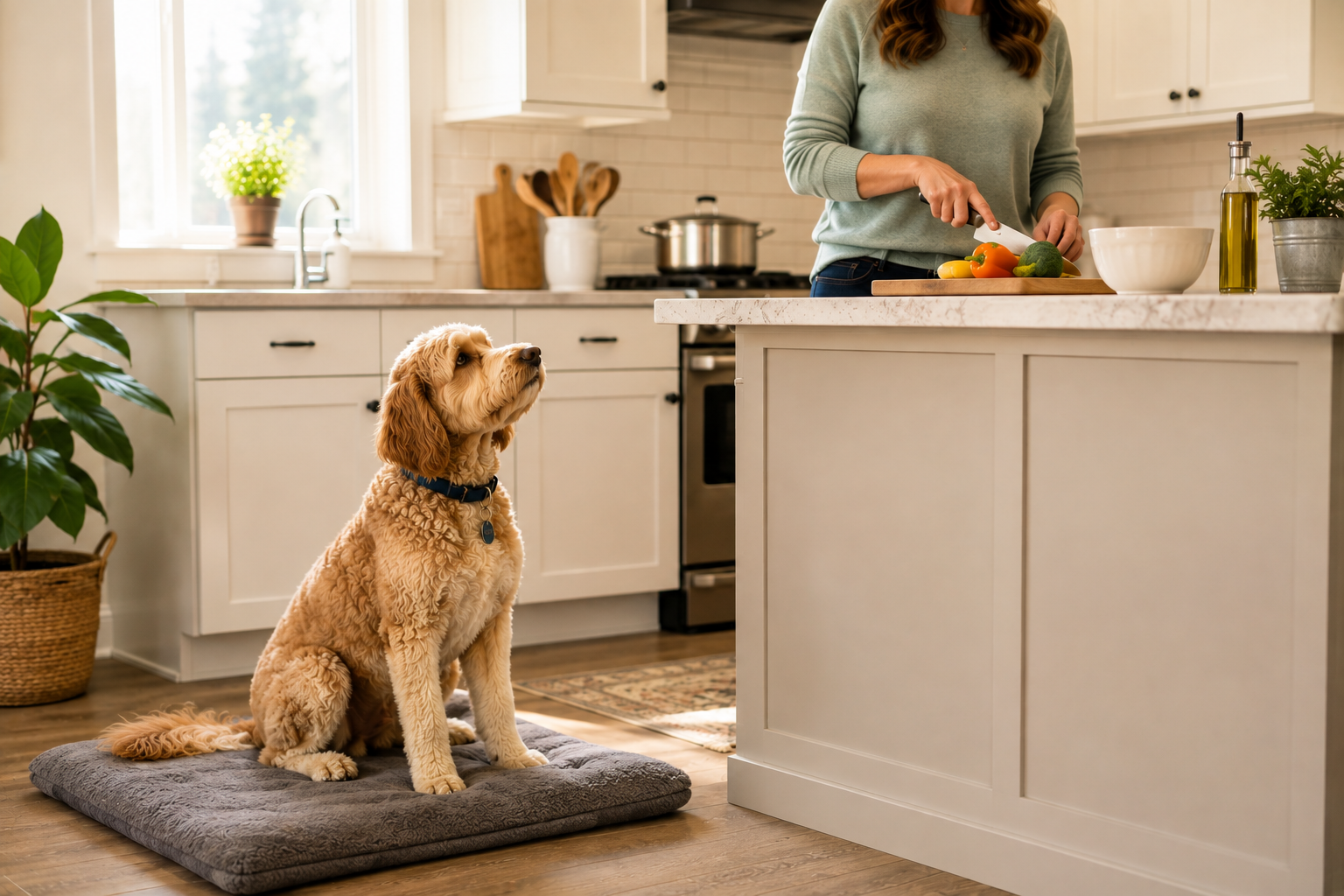
Dog sitting calmly on its bed on the kitchen floor food is prepared on the counter.
Quick Answer
If your dog keeps stealing food from the kitchen counter, the most effective solution isn't waiting until they jump up and then correcting them.
It's making sure counter surfing stops paying off while teaching your dog what you'd like them to do instead.
Counter surfing is incredibly rewarding.
Your dog puts their paws on the counter.
Nothing.
They try again tomorrow.
Nothing.
Then one day...
Half a roast chicken!
From your dog's perspective, checking the counter just became very worthwhile.
To change the behaviour:
Keep counters clear.
Prevent access when you can't supervise.
Stop your dog from repeatedly practising the behaviour.
Reward four paws on the floor.
Teach an alternative behaviour such as settling on a bed.
Give your dog something appropriate to do while you're preparing food.
Make sure everyone in the household follows the same rules.
Management prevents counter surfing from paying off. Training teaches your dog what works better.
Why Does My Dog Counter Surf?
The simplest answer?
Because sometimes it works.
Dogs are naturally interested in food and investigating their environment.
Your kitchen is filled with fascinating smells, and your counters may occasionally contain extremely valuable rewards.
A dog doesn't need to find something every time they check.
One successful discovery can be enough to encourage them to keep trying.
Think about what your dog might have discovered on your counters:
Sandwiches.
Meat.
Cheese.
Bread.
Dirty dishes.
Food wrappers.
Butter.
Leftovers.
Crumbs.
Your dog isn't plotting to break the kitchen rules.
They've simply learned:
"Sometimes there is really good stuff up there."
Counter Surfing Is Self-Rewarding
This is one of the reasons counter surfing can become such a persistent habit.
Many behaviours require another individual to provide the reward.
Counter surfing doesn't.
Your dog jumps up, finds food and eats it.
The behaviour has rewarded itself.
You don't even need to be in the room.
In fact, dogs can become very good at learning:
Human in kitchen = don't jump up.
Human leaves kitchen = check the counters!
That's why simply telling your dog "off" every time you catch them rarely solves the underlying problem.
We need to change what happens when you're not watching too.
Step 1: Make Counter Surfing Unprofitable
This is the most important part of your training plan.
For now, assume your dog will check the counter whenever they have an opportunity.
That means:
Keep the counter clear.
Not mostly clear.
Not "there's only a loaf of bread at the back."
Clear.
Put food:
In cupboards.
In the refrigerator.
In sealed containers.
Somewhere your dog genuinely cannot access it.
Don't forget other surfaces either.
Dogs who counter surf may also investigate:
Kitchen tables.
Coffee tables.
Islands.
Desks.
Children's highchairs.
Stovetops.
Every successful theft strengthens the behaviour.
Our first job is to stop providing jackpots.
Step 2: Think Beyond Food
Food isn't the only thing that can reinforce counter surfing.
Your dog may steal:
Paper towels.
Oven mitts.
Dishcloths.
Food packaging.
Wooden utensils.
Children's toys.
Plastic containers.
Some dogs simply enjoy grabbing interesting objects.
Others discover that stealing something makes humans immediately engage with them.
Dog grabs dish towel.
Human notices.
Human runs toward dog.
Dog runs away.
Suddenly the dog has invented a fantastic game.
Keep tempting objects out of reach too.
Step 3: Prevent Access When You Can't Supervise
You can't train while you're:
Upstairs.
In the shower.
Sleeping.
Outside.
Away from home.
That's where management becomes essential.
Depending on your home, you might use:
Baby gates.
Exercise pens.
Closed doors.
A crate if your dog is comfortable being crated.
Another dog-safe room.
If your dog has a long history of counter surfing, don't rely on them suddenly deciding not to do it simply because you've started training.
Preventing rehearsal gives your training a chance to work.
Step 4: Reward Four Paws on the Floor
Here's something owners often overlook.
You're preparing dinner.
Your dog walks into the kitchen.
They stand quietly beside you with all four paws on the floor.
Nothing happens.
Then they put their front paws on the counter.
Suddenly:
"OFF!"
They get your attention.
Instead, start noticing the behaviour you want.
If your dog is calmly standing or sitting with all four paws on the floor:
Reward them.
We want your dog discovering:
"Keeping my feet down works too."
Over time, reinforce this in increasingly challenging situations.
Step 5: Teach Your Dog to Settle on a Bed
For many dogs, this is my preferred long-term solution.
Instead of constantly teaching:
"Don't go there."
We teach:
"Go here."
Place a cot or dog bed somewhere that allows your dog to be part of what's happening without being directly underfoot.
Initially, practise when you're not cooking.
Reward your dog for:
Looking at the bed.
Moving toward it.
Stepping onto it.
Remaining on it.
Lying down.
Relaxing there.
Gradually build duration.
Only once your dog understands the behaviour should you begin adding the distraction of food preparation.
Don't Start With a Roast Chicken
This sounds obvious, but it's an easy training mistake.
Your dog has learned to settle beautifully on their bed in the kitchen.
Excellent.
Then you put a roast on the counter and expect them to remain there for 45 minutes while you prepare dinner.
That's an enormous increase in difficulty.
Instead, gradually introduce distractions.
You might progress from:
Empty counter
to:
Low-value food
to:
Food preparation
to:
More interesting food
to:
Family meal preparation.
Build the skill before testing it.
Step 6: Reward Your Dog on Their Bed
Where you deliver reinforcement matters.
If your dog is lying on their bed while you cook, take the reward to the bed or toss it onto the bed when appropriate.
That reinforces the location as well as the behaviour.
Your dog begins learning:
"Good things arrive over here."
This can make the bed considerably more valuable than hovering underneath the kitchen counter waiting for something to fall.
Step 7: Give Your Dog Something Else to Do
Sometimes management doesn't have to mean doing nothing.
While you're preparing dinner, your dog might enjoy:
A food-stuffed toy.
An appropriate chew.
A lickable enrichment activity.
A food puzzle.
A scatter search.
Relaxing on their bed with reinforcement.
This is particularly useful for young dogs who don't yet have the skills to settle for long periods around food preparation.
You're not "bribing" your dog.
You're providing an appropriate activity while preventing practice of an unwanted one.
What About Teaching "Leave It"?
A good "leave it" cue is a valuable life skill.
It can certainly be useful if your dog notices something they shouldn't have.
But I wouldn't make "leave it" the entire counter-surfing plan.
Why?
Because you need to be present to give the cue.
The kitchen counter still needs to be safe when you're not there.
Teach "leave it," but combine it with:
Management.
Environmental setup.
Four paws on the floor.
Bed or station training.
Should I Tell My Dog "Off"?
You can teach an "off" cue to mean:
"Put all four paws back on the floor."
But consider what you're actually teaching.
If the pattern becomes:
Jump on counter → human says OFF → get treat
some clever dogs may discover that jumping up is the first step in the reward sequence.
That's why I prefer putting much more reinforcement into the behaviour that happens before the jump.
Four paws already on the floor?
Great.
Reward that.
Dog chooses their bed instead of approaching the counter?
Even better.
Reward that.
What Should I Do If I Catch My Dog Counter Surfing?
Stay calm.
If your dog has simply put their paws on the counter, calmly redirect them back to the floor or their bed.
Then ask yourself:
"How did I allow this opportunity to happen?"
That question isn't about blame.
It's useful information.
Perhaps:
Food was too close to the edge.
Your dog had too much freedom.
The distraction was too difficult.
You weren't able to supervise.
Their bed behaviour isn't strong enough yet.
Adjust the environment or training plan for next time.
What If My Dog Already Has Food?
This becomes a different situation.
Don't create a confrontation over a stolen item.
If it's safe to do so, trade your dog for something valuable.
If your dog frequently runs away with stolen items, freezes, stiffens, growls or guards food when approached, don't repeatedly practise taking things from them.
Resource guarding deserves its own thoughtful training plan.
If your dog has taken something dangerous, contact your veterinarian promptly for advice.
Counter Surfing Can Be Dangerous
Counter surfing isn't simply inconvenient.
Kitchens can contain things dogs should never consume.
Depending on what's available, dogs may steal:
Foods that are toxic to dogs.
Cooked bones.
Medication.
Food packaging.
Plastic wrap.
Wooden skewers.
Sharp utensils.
Hot food.
Items that could cause choking or intestinal obstruction.
There may also be hot pans, stovetops and boiling liquids nearby.
Management is therefore not simply about protecting your dinner.
It's a safety strategy.
Why Punishment Isn't the Solution
Imagine your dog jumps onto the counter.
You yell.
The dog jumps down.
It looks as though the punishment worked.
But what did the dog actually learn?
Potentially:
"Don't check the counter when that person is standing there."
That doesn't solve the behaviour that occurs when you leave.
Punishment can also create:
Avoidance.
Fear.
Sneakier behaviour.
Conflict around food or stolen items.
Instead of trying to make approaching the counter unpleasant, make counter surfing consistently unsuccessful while making appropriate behaviours worthwhile.
Don't Use Booby Traps
You may encounter advice suggesting:
Stacking cans that fall.
Making loud noises.
Spraying the dog.
Using startling devices.
Setting up unpleasant surfaces.
These strategies are designed to make approaching the counter surprising or unpleasant.
But they don't teach the dog what you actually want.
And for sensitive dogs, unexpected startling events can create additional fear or anxiety.
I'd rather spend that training time teaching:
"When food is being prepared, your bed is a fantastic place to be."
Is My Dog Counter Surfing Because They're Hungry?
Possibly—but not necessarily.
A well-fed dog may still happily steal a hamburger.
Counter surfing can simply be opportunistic.
However, if your dog suddenly develops an unusually intense interest in food, appears constantly hungry, is losing weight, drinking excessively or shows other physical or behavioural changes, talk with your veterinarian.
A sudden change in appetite deserves investigation.
What About Puppies?
Prevention is particularly valuable with puppies because we have an opportunity to stop the habit from developing in the first place.
Your puppy doesn't need to discover that counters contain food.
Use:
Baby gates.
Exercise pens.
Supervision.
A puppy-safe area.
Bed training.
Keep counters boring from day one.
It's much easier to prevent a strong reinforcement history than to undo one later.
What About Large Dogs?
Large dogs often discover counter surfing simply because the counter is conveniently at nose height.
They don't even need to jump.
That means keeping food away from the edge may not be enough.
A tall dog may be able to reach surprisingly far.
If you're unsure, assume:
If I can smell it, my dog will probably try to figure out how to reach it.
Store food securely rather than testing your dog's reach.
Consistency Matters
This is a household project.
If one person keeps the counters clear but another regularly leaves food unattended, your dog continues to receive occasional rewards.
Similarly, if one family member rewards the dog for staying on their bed while another feeds them scraps from the counter, the expectations become much less clear.
Decide together:
Where food will be stored.
Whether the dog is allowed in the kitchen during food preparation.
Where you'd like the dog to settle.
Which cues you'll use.
What behaviours you'll reinforce.
Clear, predictable expectations make learning easier.
Common Counter-Surfing Mistakes
Leaving food unattended.
Assuming pushing food toward the back of the counter is enough.
Only correcting the dog when they're caught.
Allowing occasional successful thefts.
Giving too much freedom too soon.
Waiting for the dog to jump before interacting with them.
Forgetting to reward four paws on the floor.
Expecting a new bed behaviour to work immediately around high-value food.
Using "leave it" as the entire training plan.
Chasing the dog when they steal something.
Using punishment or startling devices.
Having different rules among family members.
Frequently Asked Questions
Will my dog eventually grow out of counter surfing?
Don't count on it.
If counter surfing continues to produce rewards, your dog has a good reason to continue checking.
Preventing access and teaching alternative behaviours is more reliable than waiting for maturity.
Why does my dog only counter surf when I'm gone?
Because your dog may have learned that counter surfing isn't successful—or isn't safe—when you're present.
When you leave, the opportunity changes.
This is exactly why environmental management is so important.
Why does my dog keep checking when there's nothing there?
Because sometimes there has been something there.
Behaviours that occasionally produce a very valuable reward can become persistent.
Consistently keeping counters clear is therefore important, even after the behaviour begins improving.
Can I teach my dog to stay out of the kitchen completely?
Yes.
For some households, teaching a boundary at the kitchen entrance is an excellent alternative.
Build the behaviour gradually and reinforce your dog generously for remaining outside the kitchen.
How long will it take to stop counter surfing?
That depends on the individual dog, how long they've been practising the behaviour and how consistently the environment can be managed.
A dog who has been stealing food successfully for years may continue checking for quite some time.
Focus less on a deadline and more on preventing reinforcement while building a strong alternative behaviour.
Should I feed my dog from the kitchen counter?
If counter surfing is already a problem, I'd avoid creating an association between approaching the counter and receiving food directly from it.
When rewarding your dog, deliver reinforcement where you want your dog to be—such as on their bed or with all four paws on the floor.
Key Takeaways
Successful counter-surfing training is built around prevention and teaching your dog a better option.
Remember:
✔ Keep counters genuinely clear.
✔ Prevent access when you can't supervise.
✔ Don't allow occasional counter-surfing jackpots.
✔ Reward four paws on the floor.
✔ Teach a strong settle-on-a-bed behaviour.
✔ Build difficulty gradually.
✔ Provide appropriate enrichment during food preparation.
✔ Teach "leave it" as an additional skill—not your entire solution.
✔ Avoid chasing, yelling and startling techniques.
✔ Make sure everyone in the household follows the same plan.
Instead of continually asking:
"How do I stop my dog from getting onto the counter?"
Try asking:
"What would I like my dog to do while I'm working in the kitchen?"
Now you have something you can actually teach.
How Paus-n-Train Can Help
At Paus-n-Train, we believe everyday dog training becomes much easier when we stop focusing exclusively on correcting unwanted behaviour and start teaching dogs what we'd like them to do instead.
Counter surfing is a perfect example.
Rather than spending your dog's lifetime saying "OFF!" every time there's food in the kitchen, we can teach practical skills such as settling on a cot, keeping four paws on the floor, responding to cues around distractions and making better choices when food is present.
Our Puppy Prep School helps families establish these habits early, before behaviours such as counter surfing have had months or years to become well practised.
Our Dog Manners program works on practical everyday skills including settling on a bed, polite greetings, loose-leash walking and recall while helping owners understand how reinforcement and management influence behaviour.
Because good training isn't simply about stopping your dog from doing things.
It's about giving them the skills to know what to do instead.