Owner-Trained Service Dogs: What’s Involved and How Professional Training Can Help
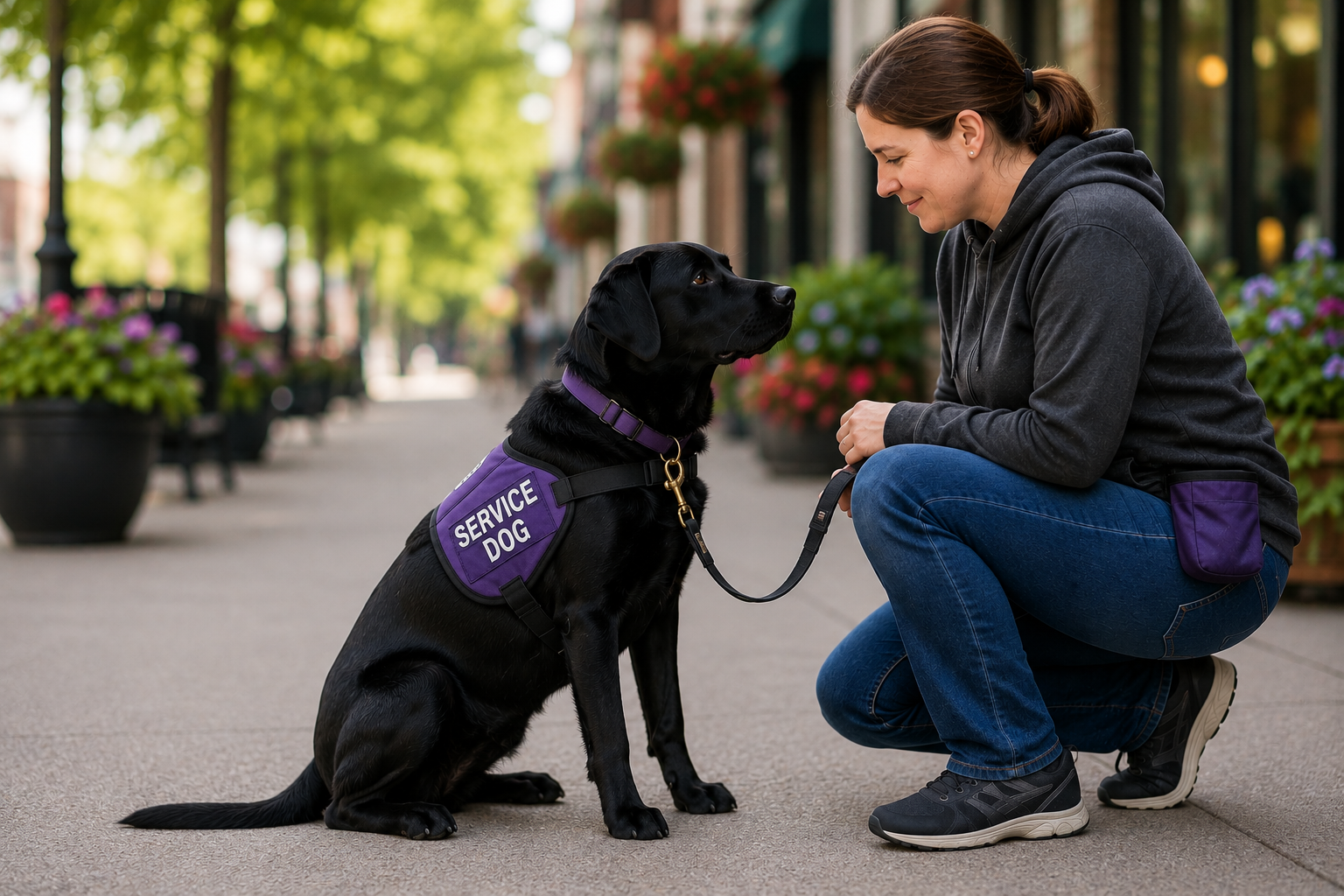
Woman and service dog on sidewalk
Choosing to train your own service dog can be an incredibly rewarding experience, but it is also a significant commitment. An owner-trained service dog needs much more than good manners and a few specialized tasks. The process involves developing a reliable working partnership, strong foundation behaviours, public-access skills, disability-related tasks, and the handler's own training skills.
At Paus-n-Train, we specialize in owner-trained psychiatric and PTSD service dogs. Our service-dog training is provided through individual one-to-one lessons, allowing training to be tailored to the needs of each handler-and-dog team.
If you're considering an owner-trained service dog, here's what you should know about the process.
What Is an Owner-Trained Service Dog?
An owner-trained service dog is a dog whose handler takes an active role in training the dog to perform work or tasks related to their disability.
The term owner-trained doesn't necessarily mean that the person has to train entirely on their own.
Many owner-trainers work with a professional dog trainer who can provide guidance, develop an appropriate training plan, assess progress, troubleshoot challenges, and help prepare the team for working in increasingly complex environments.
The goal isn't simply to train the dog. The handler also needs to learn how to communicate with, train, support, and advocate for their dog.
At Paus-n-Train, we often describe this as training both ends of the leash.
Service-Dog Training Is More Than Task Training
When people think about service dogs, they often think first about the specialized tasks the dog performs.
Those tasks are certainly important, but they are only one part of service-dog training.
A successful service-dog team generally needs to develop three broad areas:
Foundation skills, public-access skills, and disability-related tasks.
Each area supports the others.
A dog may know an excellent task at home, for example, but if they cannot remain comfortable and responsive to their handler in a busy public environment, they may not yet be ready to perform that task reliably outside the home.
Building Strong Foundation Skills
Before expecting a dog to work reliably in public, we need strong everyday skills.
Depending on the individual dog, foundation training may include:
settling calmly for extended periods;
loose-leash walking;
responding reliably to cues;
maintaining connection with the handler;
ignoring distractions;
remaining neutral around unfamiliar people and dogs;
calmly navigating new environments;
developing impulse control; and
recovering appropriately after something unexpected happens.
Many of these behaviours sound like skills we would teach any companion dog—and they are.
The difference is the level of reliability eventually expected from a working service dog.
A pet dog might occasionally become distracted in a store or pull toward someone they recognize. A working service dog needs a much stronger ability to remain focused and responsive because their handler may be depending upon them.
Developing Public-Access Skills
Public-access training is another significant part of developing an owner-trained service dog.
Consider everything a dog may encounter while accompanying their handler:
Automatic doors, shopping carts, elevators, crowds, children, food on the floor, unfamiliar dogs, unusual surfaces, loud noises, tight spaces, restaurants, people attempting to interact with them, and countless unexpected situations.
We want the dog to be able to navigate these environments safely while remaining responsive to their handler.
Just as importantly, we want the dog to be comfortable doing it.
Public-access training shouldn't involve repeatedly overwhelming a dog until they learn to tolerate an environment.
Instead, we can gradually increase difficulty.
A team might begin working outside a store, progress to a quiet entrance, make a short visit inside, and gradually introduce busier or more complicated environments as the dog's skills and confidence develop.
The goal is genuine confidence and reliability.
Training Disability-Related Tasks
A service dog's trained tasks should be directly connected to the individual handler's disability-related needs.
For psychiatric and PTSD service dogs, those needs can vary considerably from one person to another.
Depending upon the individual, trained tasks might include behaviours such as:
deep pressure therapy;
interrupting a specific behaviour;
retrieving a particular item;
creating space for the handler;
responding to specific changes in the handler's behaviour; or
assisting the handler in moving toward an exit or predetermined location.
Task selection should be individualized rather than based on a standard list of behaviours that every psychiatric service dog is expected to perform.
This is one of the reasons individualized training can be particularly valuable for owner-trained teams.
Why We Provide One-to-One Service-Dog Training
At Paus-n-Train, our service-dog training is now provided exclusively through one-to-one private lessons.
Every service-dog team is different.
Two people with similar disabilities may require completely different tasks. Their dogs may also have different temperaments, previous training experiences, strengths, and areas requiring additional development.
Individual training allows us to focus on what that particular team needs.
It also gives us greater flexibility to work on skills in appropriate real-world environments as the team progresses.
Instead of moving through a predetermined group curriculum, we can continually evaluate progress and adjust the training plan.
Is Every Dog Suitable for Service Work?
One of the most important—and sometimes most difficult—parts of owner-training is determining whether a particular dog is suited to service work.
A dog can be a wonderful family companion and still not enjoy being a service dog.
Service dogs encounter an extraordinary variety of people, dogs, environments, sounds, movement, and unexpected situations.
Some of the qualities we consider include a dog's:
overall confidence;
comfort around people and other dogs;
ability to concentrate around distractions;
response to unfamiliar environments;
ability to recover from unexpected events; and
overall comfort with the demands of the work.
Service dogs aren't robots. They can notice something unusual and they can be startled.
An important question is what happens afterward.
Can the dog recover?
Can they reconnect with their handler?
Can they comfortably continue working?
Throughout an owner-trained service dog's development, we need to continue assessing the individual dog rather than assuming that because the original goal was service work, that must remain the dog's eventual career.
Can You Choose a Puppy to Become a Service Dog?
Careful puppy selection can improve the likelihood of success, but no puppy can be guaranteed to become an adult service dog.
Prospective handlers can research appropriate breeds, breeders and bloodlines, consider parental temperament, thoughtfully evaluate puppies, provide positive early socialization, and invest considerably in training.
Even with all of those pieces in place, puppies develop and change as they mature.
An ethical owner-training program needs to leave room for the possibility that a puppy originally intended for service work may eventually demonstrate that another lifestyle would be more appropriate.
How Long Does It Take to Train an Owner-Trained Service Dog?
There isn't one timeline that applies to every dog-and-handler team.
As a general guideline, teams working through our program should expect the process to take approximately 18 to 24 months, although some teams may require longer.
The timeline can depend on factors including:
the dog's age;
previous training;
temperament;
the complexity of required tasks;
the handler's training experience;
opportunities for appropriate practice; and
how the dog progresses as they mature.
The goal shouldn't be to reach certification as quickly as possible.
The goal is to develop a safe, comfortable, reliable working partnership.
Training Doesn't End With Public-Access Assessment
Reaching the point of public-access assessment is an important milestone, but it isn't the end of training.
Service-dog skills need to be maintained throughout the dog's working life.
Dogs change, handlers' circumstances can change, and skills that aren't regularly practised can deteriorate.
Ongoing training provides an opportunity to maintain existing skills, address new challenges, and adapt tasks if the handler's needs change.
At Paus-n-Train, our service-dog teams are recertified annually for the first three years and every two years thereafter.
Remember: There Are Two Members of the Team
Service-dog training needs to consider the needs of both ends of the leash.
The handler has legitimate disability-related needs that the dog is being trained to assist with.
At the same time, we have an ethical responsibility to consider the dog's welfare.
Sometimes that means slowing down.
Sometimes it means changing the training plan.
Sometimes it means revisiting foundation skills before progressing.
And occasionally it means recognizing that service work isn't the right career for a particular dog.
Successful owner-training isn't simply about producing a dog that can perform particular behaviours. It's about developing a sustainable partnership in which the handler's needs are supported while the dog's physical and emotional wellbeing are protected.
How Paus-n-Train Can Help
At Paus-n-Train Agility & Obedience, we specialize in supporting people training their own psychiatric and PTSD service dogs.
Our service-dog program is provided through individual one-to-one training, allowing us to build a training plan around the needs of each handler and their dog.
Depending upon where you are in your training journey, we can help with:
evaluating existing foundation skills and identifying training priorities;
manners, settling, leash skills, and handler engagement;
confidence and neutrality around everyday distractions;
gradually developing public-access skills;
individualized disability-related task training;
practising skills in appropriate real-world environments;
Public Access Test preparation and assessment;
troubleshooting challenges as they arise; and
ongoing training and recertification.
We currently specialize in psychiatric and PTSD service dogs rather than mobility assistance or guide-dog training.
Whether you're considering a potential service-dog prospect, have already started training your dog, or are preparing for more advanced public-access work, we can meet you where you are and develop a plan based on your individual needs.
Owner-trained doesn't have to mean training alone.
Professional guidance can help you understand what skills to prioritize, recognize when your dog is ready to progress, identify areas that need additional work, and develop the training skills you'll need throughout your partnership.
If you're interested in learning more about owner-trained psychiatric or PTSD service-dog training with Paus-n-Train, contact us to tell us a little about you, your dog, where you currently are in your training journey, and what you're hoping to accomplish.