Are Head Collars Effective for Dogs—and How Do I Introduce One?
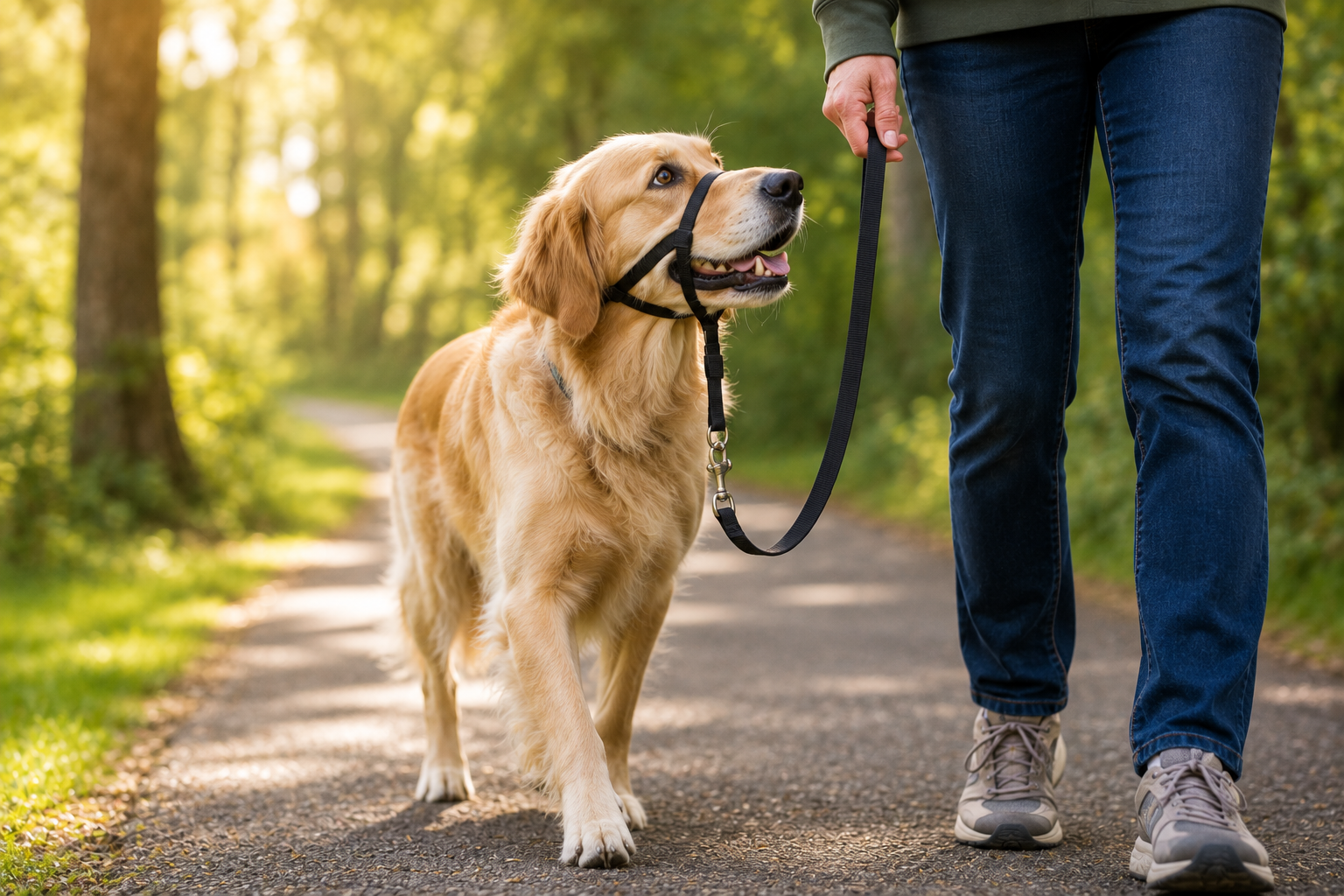
Dog calmly wearing a properly fitted head collar while walking beside their handler.
Quick Answer
A properly fitted head collar can be a useful tool for some dogs and their handlers, particularly when a dog is physically strong or pulling makes walking difficult or unsafe.
Because the leash attaches beneath the dog's chin, a head collar can provide the handler with greater mechanical control over the direction of the dog's head and body than a traditional collar alone.
But there's an important distinction:
A head collar can help you manage pulling. It doesn't automatically teach your dog how to walk on a loose leash.
And because many dogs initially find the sensation of something around their muzzle unfamiliar, a head collar should be introduced gradually and positively rather than simply putting it on and heading out for a walk.
What Is a Head Collar?
A head collar—sometimes called a head halter—is a piece of walking equipment designed specifically for dogs.
Depending on the design, it generally consists of:
A strap around the dog's neck.
A loop that fits around the muzzle.
A leash attachment beneath the chin.
Although it sits around the dog's muzzle, a head collar is not the same thing as a muzzle.
A correctly fitted head collar should still allow your dog to:
Open their mouth.
Pant.
Drink.
Take treats.
Sniff.
Its purpose is to provide additional control while walking, not to prevent the dog from opening their mouth.
How Does a Head Collar Work?
Think about walking a large animal such as a horse.
We don't typically attach a leash to the middle of the horse's chest and try to overpower them.
We guide the head.
A head collar uses a similar mechanical principle.
When a dog pulls into a traditional collar or back-clip harness, much of their body weight can move directly forward.
With a head collar, the leash attachment is positioned closer to the dog's head. This gives the handler more ability to redirect the dog's movement rather than competing directly against their full body strength.
For some people, that difference can be significant.
Are Head Collars Effective for Dogs That Pull?
They can be.
A head collar may make a strong pulling dog physically easier to manage, particularly while you're simultaneously working on loose-leash walking skills.
That can be valuable for:
Large or powerful dogs.
Dogs who suddenly accelerate toward interesting things.
Handlers who have difficulty physically managing their dog's strength.
Situations where additional control improves safety.
However, equipment and training shouldn't be confused.
If your dog walks beside you only because the equipment physically prevents them from pulling as effectively, they haven't necessarily learned loose-leash walking.
Ideally, we use the head collar to help create a manageable training environment while also reinforcing:
"Walking with a loose leash is worthwhile."
A Head Collar Is a Management Tool
This distinction is important.
Suppose your dog pulls you down the street every morning.
A head collar may immediately make those walks easier.
That's useful.
But if you never reinforce the behaviours you actually want—checking in, staying within leash range, slowing when you slow, responding to directional cues—your dog may remain dependent on the equipment.
Think of the head collar as something that can help manage the behaviour while training happens alongside it.
Management and training work together.
Is a Head Collar Right for Every Dog?
No.
There isn't one piece of walking equipment that's ideal for every dog.
Some dogs adapt to a head collar very easily.
Others find facial equipment much more difficult.
A dog's:
Temperament.
Previous experiences.
Sensitivity to handling.
Physical structure.
Walking behaviour.
Medical history.
...can all influence whether a head collar is an appropriate choice.
A dog who becomes highly distressed by equipment around their face may benefit from a different management option while you work on leash skills.
The goal shouldn't be:
"My dog has to wear this."
The goal should be:
"What equipment allows this particular dog and handler to walk safely while we build better skills?"
Why Do Some Dogs Hate Head Collars?
Imagine someone suddenly putting an unfamiliar strap across your face and expecting you to carry on normally.
Your first reaction might be:
"What is THAT?"
Dogs may initially:
Paw at the head collar.
Rub their face against the ground.
Freeze.
Shake their head.
Avoid having it put on.
Try to remove it.
These behaviours don't necessarily mean your dog can never wear a head collar.
They often mean:
We've introduced too much, too quickly.
Instead of immediately fastening the collar and waiting for the dog to "get used to it," we can teach them that interacting with and wearing the head collar predicts good things.
How Do I Introduce a Head Collar?
Step 1: Start With the Head Collar in Your Hand
Don't put it on yet.
Show your dog the head collar.
Then provide a treat.
Head collar appears → food appears.
Head collar disappears → food stops.
Repeat several times.
We're beginning to change what the sight of the equipment predicts.
Instead of:
"Oh no, they're going to put that thing on my face."
We want:
"Oh! That thing makes good stuff happen."
Step 2: Teach Your Dog to Put Their Nose Through the Loop
Hold the nose loop open.
Place a treat so your dog can reach it by putting their nose through the opening.
Let them voluntarily place their nose through.
Then allow them to move away.
At this stage:
Don't fasten the head collar.
Repeat until your dog is willingly moving their nose toward and through the loop.
As your dog becomes comfortable, you can gradually position the food so they need to keep their nose inside for slightly longer.
Step 3: Build Duration Before Fastening It
Once your dog is eagerly putting their nose into the head collar, begin increasing the amount of time they remain there.
Think in seconds.
Nose in.
Treat.
Another treat.
Release.
Gradually build:
One second.
Two seconds.
Three seconds.
Five seconds.
There's no prize for progressing quickly.
We want the dog choosing to keep their nose in the equipment rather than trying to escape from it.
Step 4: Introduce the Neck Strap Separately
The sound and sensation of the buckle can be another part of the process.
Practise:
Touching the neck strap.
Moving it behind the dog's head.
Briefly touching the dog's neck.
Making the buckle sound away from the dog.
Fastening and immediately unfastening it.
Pair each new step with food.
Breaking the process into small pieces makes learning much easier.
Step 5: Fasten It Briefly
Once your dog is comfortable putting their nose through the loop and having the neck strap handled, fasten the head collar.
Immediately provide several treats.
Then remove it.
Your first successful session might be:
Head collar on → treat, treat, treat → head collar off.
That's enough.
Gradually increase how long your dog wears it while they're doing something enjoyable.
Step 6: Let Your Dog Wear It Without a Leash
Before heading outside, allow your dog to experience wearing the head collar in a familiar environment.
Keep sessions short.
You might:
Feed treats.
Practise easy behaviours.
Scatter food on the floor.
Walk around the room together.
Give your dog something enjoyable to do.
Supervise throughout.
If your dog begins frantically pawing or rubbing at the head collar, redirect them to an easy activity and consider whether you've progressed too quickly.
Step 7: Introduce the Leash
Once your dog is comfortable wearing the head collar, attach the leash indoors.
At first, avoid adding leash pressure.
Walk together.
Reward your dog for following you.
Reward check-ins.
Reward a loose leash.
Practise gentle changes of direction.
We want the dog learning how to respond to the equipment before encountering the distractions of a neighbourhood walk.
Step 8: Practise in an Easy Outdoor Environment
Don't make the first real test a busy sidewalk filled with dogs, squirrels, bicycles and people.
Begin somewhere relatively quiet.
Perhaps:
Your driveway.
Your yard.
A quiet section of your property.
A calm street at a quieter time of day.
Continue reinforcing loose-leash walking.
Once your dog is comfortable and successful, gradually increase environmental difficulty.
Don't Jerk on a Head Collar
This is extremely important.
A head collar shouldn't be used to deliver leash corrections.
Avoid:
Jerking the leash.
Snapping the dog's head around.
Giving sharp leash corrections.
Allowing the dog to hit the end of the leash at speed.
Because the equipment acts on the dog's head and neck, leash handling should remain gentle and controlled.
Your goal is guidance—not correction.
Be Careful With Long Leashes
A dog wearing a head collar shouldn't be allowed to accelerate to full speed and suddenly hit the end of a long leash.
That can create an abrupt force on the head and neck.
If you're using a long line for sniffing, recall practice or exploration, a properly fitted harness is generally a more appropriate attachment point.
Different pieces of equipment serve different purposes.
Consider Using a Backup Attachment
Depending on the head collar design, you may be able to use a safety connector between the head collar and your dog's regular collar or harness.
This provides backup if:
The head collar comes loose.
A buckle fails.
The dog manages to remove it.
Follow the manufacturer's fitting and safety recommendations for the specific equipment you're using.
Proper Fit Matters
Head collars should be fitted according to the manufacturer's instructions.
Too loose and your dog may be able to remove it.
Too tight and it may be uncomfortable or interfere with normal movement.
Check regularly for:
Rubbing.
Hair loss.
Redness.
Irritation around the muzzle.
Pressure behind the ears.
Changes in your dog's willingness to wear it.
Growing puppies may need their equipment adjusted frequently.
What If My Dog Keeps Pawing at the Head Collar?
First, don't assume they need to "get over it."
Occasional attempts to investigate unfamiliar equipment can happen during early training.
But persistent pawing, frantic rubbing, freezing or avoidance tells you your dog isn't yet comfortable.
Go back several steps.
You might return to:
Nose through → treat → remove.
Build positive associations again before increasing duration.
Training at your dog's pace may feel slower initially, but it can save considerable time later.
What If My Dog Won't Put Their Nose Through?
Make the exercise easier.
Don't push the head collar toward your dog's face.
Instead, allow them to approach it.
You might begin by simply rewarding:
Looking at the head collar.
Moving toward it.
Sniffing it.
Touching it with their nose.
Placing the tip of their nose through the opening.
Gradual progress is still progress.
Can I Use a Head Collar With a Reactive Dog?
Sometimes—but this requires additional thought.
A head collar may provide a handler with greater physical control of a strong dog, but it doesn't address the emotional reason the dog is reacting.
If your dog is barking or lunging because they're frightened, frustrated or overwhelmed, physically controlling their head doesn't change how they feel about the trigger.
Behaviour modification still needs to address:
Distance.
Trigger intensity.
Emotional response.
Reinforcement.
Recovery.
The dog's ability to remain under threshold.
For reactive dogs, careful leash handling is especially important because sudden lunging into a head collar can place force on the head and neck.
Head Collar vs Harness: Which Is Better?
Neither is automatically "better."
They do different things.
A harness distributes force across the dog's body and may be an excellent choice for many dogs.
A head collar provides greater directional control of the dog's head and can make some powerful dogs easier for their handlers to manage.
Some handlers even use both, depending on the situation.
The best equipment is equipment that:
Fits correctly.
Is comfortable for the individual dog.
Allows safe handling.
Supports rather than replaces training.
Will My Dog Always Need the Head Collar?
Not necessarily.
For some teams, the head collar is a temporary management tool while loose-leash walking skills develop.
For others, it remains useful in particular environments.
If your long-term goal is to transition away from it, don't wait until the day you remove it to teach leash skills.
Practise loose-leash walking while your dog is wearing the head collar.
Reward:
Staying near you.
Checking in.
Responding to changes of direction.
Walking without leash tension.
Slowing when you slow.
Then gradually practise those same skills using your preferred long-term walking equipment.
Common Head Collar Mistakes
Putting it on for the first time immediately before a walk.
Forcing the dog's nose through the loop.
Fastening it before the dog is comfortable.
Assuming persistent pawing should simply be ignored.
Using leash corrections.
Allowing a dog to hit the end of a long leash.
Using the equipment instead of teaching loose-leash walking.
Failing to check the fit.
Using it with a dog who is clearly distressed by it.
Expecting equipment alone to solve reactivity.
Progressing according to a timetable instead of the dog's comfort.
Frequently Asked Questions
Is a head collar cruel?
A head collar itself is a piece of equipment. How it is fitted, introduced and used matters enormously.
A properly fitted head collar that has been gradually conditioned and is handled without leash corrections may be a useful management tool for some dog-handler teams.
If a dog remains highly distressed despite careful conditioning, however, another equipment option may be more appropriate.
Is a head collar the same as a muzzle?
No.
A properly fitted head collar is designed to allow a dog to open their mouth, pant, drink and take food.
A muzzle serves a different purpose and requires its own appropriate conditioning and fitting.
Will a head collar stop my dog from pulling?
It may make pulling considerably easier to manage, but it doesn't automatically teach loose-leash walking.
Training should happen alongside the use of the equipment.
How long does it take for a dog to accept a head collar?
There's no universal timeline.
Some dogs are comfortable very quickly. Others need many short conditioning sessions over days or weeks.
Let your dog's behaviour determine your pace.
Can my puppy wear a head collar?
Potentially, but fit, age, individual comfort and the reason for using one should all be considered.
For puppies especially, I'd focus heavily on teaching loose-leash walking skills rather than relying on equipment to control pulling.
Key Takeaways
A head collar can be an effective management and safety tool, particularly when a dog's physical strength makes walking difficult.
Remember:
✔ A head collar manages pulling—it doesn't automatically teach loose-leash walking.
✔ Introduce it gradually.
✔ Let your dog voluntarily put their nose through the loop.
✔ Pair the equipment with things your dog enjoys.
✔ Build duration in very small increments.
✔ Introduce the leash in an easy environment.
✔ Never use leash jerks or corrections.
✔ Don't allow a dog to hit the end of a long leash while attached by the head collar.
✔ Check fit and comfort regularly.
✔ Listen when your dog's behaviour tells you they're uncomfortable.
✔ Continue teaching loose-leash walking while using the equipment.
The goal isn't simply:
"My dog lets me put the head collar on."
A much better goal is:
"My dog sees the head collar and willingly participates in putting it on because we've taught them that wearing it is safe and predictable."
That's the difference between simply using equipment and training your dog to be comfortable with it.
How Paus-n-Train Can Help
At Paus-n-Train, we believe walking equipment should support training—not replace it.
A head collar can provide some dog-handler teams with additional control and safety while they develop the skills needed for comfortable everyday walks. We encourage the use of head collars such as the Gentle Leader when they're appropriate for the individual dog, while helping owners work toward reliable leash skills rather than simply depending on the equipment.
Our Dog Manners program teaches practical everyday skills including loose-leash walking, attention around distractions, polite greetings, recall and settling.
Just as importantly, we help owners understand why their dog is behaving the way they are and how reinforcement, management and thoughtful training can create lasting change.
If you're already using a head collar and would eventually like to transition away from it, training can also focus on gradually transferring those walking skills to your preferred equipment.
Because ultimately, the goal isn't to find a piece of equipment that makes your dog behave.
It's to use appropriate management while teaching your dog the skills they need to succeed.