What Can We Learn From Evidence-Based, Positive Reinforcement Dog Training?
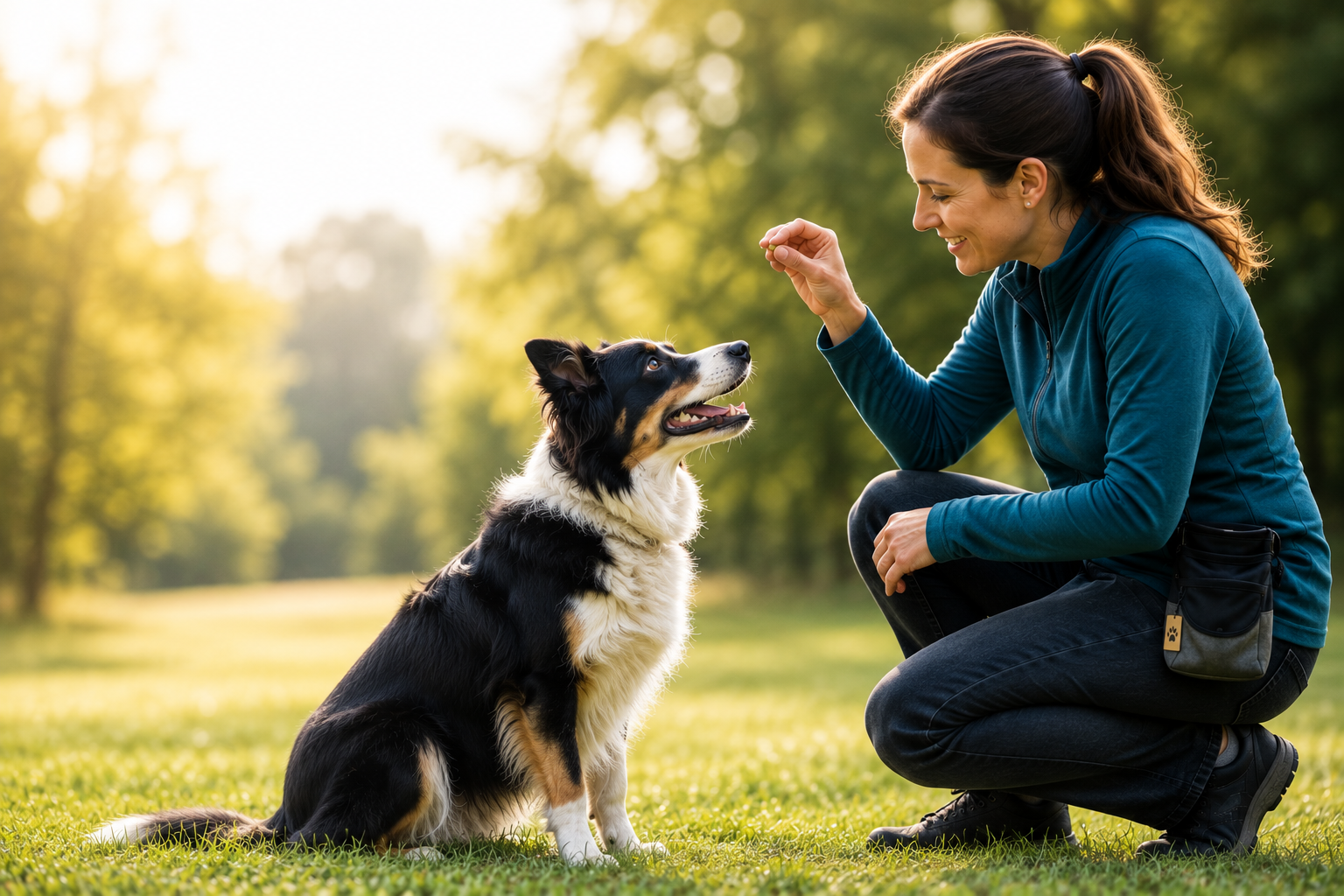
Dog and owner working together during a positive reinforcement training session.
Quick Answer
Positive reinforcement dog training teaches us much more than how to train a dog.
When we understand how behaviour works, we begin asking better questions.
Instead of:
"Why won't my dog listen?"
We ask:
"What is making this difficult for my dog?"
Instead of:
"How do I stop this behaviour?"
We ask:
"What would I like my dog to do instead?"
And instead of waiting for mistakes so we can correct them, we begin looking for opportunities to recognize and reinforce success.
These principles don't just create more effective dog training.
They can change how we communicate, teach, solve problems and respond to mistakes.
What Does "Evidence-Based Dog Training" Actually Mean?
Evidence-based training means our approach is informed by what we know about animal behaviour, learning theory, welfare and the individual dog in front of us.
It means being willing to change our approach when better information becomes available.
Positive reinforcement is an important part of this.
In simple terms, reinforcement means that something happens after a behaviour that makes that behaviour more likely to occur again.
Your dog comes when called.
You reward them.
Coming when called becomes worthwhile.
But positive reinforcement training is about much more than handing dogs treats.
It's about understanding why behaviour happens and how our own actions influence what happens next.
And there are some surprisingly valuable lessons in that for humans too.
Lesson 1: Behaviour Is Information
One of the most important things dog training teaches us is to become curious about behaviour.
Imagine your dog won't lie down during training.
It's easy to think:
"They're being stubborn."
But an evidence-based approach encourages us to investigate.
Perhaps:
The floor is slippery.
Their hips hurt.
They're worried about the environment.
They don't understand the cue.
The reward isn't valuable enough.
They're distracted.
They're tired.
We've progressed too quickly.
The behaviour is giving us information.
This doesn't mean unwanted behaviour should simply be ignored.
It means understanding the cause helps us choose a better solution.
That's a useful habit far beyond dog training.
Before judging behaviour, get curious about it.
Lesson 2: Reinforce What You Want More Of
Humans are remarkably good at noticing mistakes.
The dog jumps.
We notice.
The dog barks.
We notice.
The dog steals a sock.
We definitely notice.
But what happened during the previous 20 minutes when the dog was quietly lying on their bed?
Probably nothing.
One of the biggest shifts positive reinforcement training creates is learning to notice success.
Your dog walks past another dog without barking?
Notice it.
Your puppy chooses their chew toy instead of your shoe?
Notice it.
Your dog settles quietly while you're eating dinner?
Notice it.
Behaviours that are reinforced are more likely to happen again.
And there's a broader lesson here:
Don't only communicate when something has gone wrong.
Notice what is going right.
Lesson 3: Set the Learner Up for Success
Imagine teaching a child to swim by dropping them into the deep end.
Technically, you've provided an opportunity to swim.
You just haven't provided a very good learning environment.
Dog training is similar.
If your dog can walk calmly past another dog from 30 metres away but reacts at 3 metres, repeatedly walking them within 3 metres isn't necessarily productive practice.
It's simply making the exercise too difficult.
Good training asks:
"At what level can my learner succeed?"
Then we begin there.
As confidence and skill improve, we gradually increase the challenge.
Good teachers don't continually test learners at the edge of failure.
They create opportunities to succeed and then build from there.
Lesson 4: Break Big Problems Into Small Pieces
One of the most valuable skills in dog training is learning to break behaviour down.
Suppose you want your dog to remain calmly on their bed while visitors enter your home.
That's actually a complicated task.
Your dog needs to cope with:
A vehicle arriving.
Someone walking toward the house.
A knock or doorbell.
You approaching the door.
The door opening.
A new person entering.
Excited voices.
The desire to greet them.
Instead of expecting the entire behaviour immediately, we can train those pieces individually.
Complex goals become much more manageable when we ask:
"What's the smallest piece I can teach first?"
That applies to an enormous number of challenges in life.
Lesson 5: Motivation Matters
If I offered you 25 cents to spend your Saturday cleaning my garage, how motivated would you be?
Probably not very.
Dogs also make choices based partly on what is valuable to them.
Food is commonly used in training because it is convenient, easy to deliver and highly motivating for many dogs.
But dogs can also be reinforced by:
Toys.
Play.
Sniffing.
Going outside.
Access to the environment.
Social interaction.
Chasing.
Movement.
Distance from something uncomfortable.
Good training asks:
"What does this individual find rewarding?"
Not:
"What should they find rewarding?"
That's an important distinction.
Lesson 6: The Learner Decides What Is Reinforcing
You may enthusiastically pat your dog on the head and think:
"Good dog! I'm rewarding you!"
But if your dog ducks away from your hand, they may disagree.
We don't get to decide that something is reinforcing simply because we intended it to be.
The learner's behaviour tells us whether our reinforcement is working.
If the behaviour increases, our consequence may be functioning as reinforcement.
If it doesn't, we may need to reconsider our strategy.
Intent matters.
But outcome matters too.
Lesson 7: Management Isn't Failure
Suppose your puppy loves stealing shoes.
You could leave 12 pairs scattered around the house and spend the entire day correcting them.
Or...
You could put the shoes away.
Management sometimes gets dismissed as avoiding the problem.
It isn't.
Management prevents unwanted behaviours from being repeatedly practised while better habits are developing.
We use:
Baby gates.
Exercise pens.
Leashes.
Fences.
Crates.
Closed doors.
Distance.
Carefully arranged environments.
A well-designed environment can make the correct behaviour dramatically easier.
Sometimes the smartest training decision isn't changing the learner.
It's changing the environment.
Lesson 8: Mistakes Are Feedback
Your dog doesn't perform a behaviour correctly.
What happens next?
Traditional thinking may focus on correcting the error.
Evidence-based training encourages another question:
"What does this mistake tell me about my training plan?"
Perhaps:
The distraction was too difficult.
We increased distance too quickly.
The dog doesn't understand the cue as well as we thought.
The reinforcement isn't strong enough.
The environment has changed.
The dog is tired or overwhelmed.
Mistakes aren't evidence that learning has failed.
They're information that helps us decide what to change next.
Lesson 9: Emotions Affect Learning
Behaviour doesn't happen independently of emotion.
A frightened dog may struggle to respond to a familiar cue.
An extremely excited puppy may have difficulty settling.
A frustrated dog may bark, jump or grab the leash.
This is why we can't always solve behavioural challenges by simply demanding more obedience.
Sometimes the dog's emotional state needs to change before effective learning can happen.
If the learner feels unsafe, overwhelmed or frustrated, adding more pressure may make learning harder—not easier.
Lesson 10: Communication Is a Two-Way Conversation
We spend a lot of time teaching dogs what our words and gestures mean.
Sit.
Come.
Wait.
This way.
But successful training also requires us to learn their language.
Dogs communicate through:
Body posture.
Facial expression.
Movement.
Distance.
Vocalization.
Changes in behaviour.
They may tell us:
"I'm worried."
"I need more space."
"I don't understand."
"I'm too excited."
"I'm tired."
"I'm ready."
Good communication isn't simply making ourselves understood.
It's also becoming better at listening.
Lesson 11: Don't Wait for Perfection
Imagine your puppy is learning to walk beside you.
They manage three lovely steps.
You think:
"Great! Let's see if they can do 20."
By step seven, they've lost focus.
By step 10, they're pulling.
By step 15, you're frustrated.
Sometimes we miss the opportunity to reinforce success because we're waiting for something bigger.
Good training rewards progress.
Three excellent steps can become five.
Five can become 10.
Ten can eventually become a walk around the neighbourhood.
Reinforce the behaviour you have while you're building the behaviour you want.
Lesson 12: Everyone Learns at a Different Pace
Two puppies from the same litter can experience the same training and progress very differently.
One may be confident with new environments but struggle with impulse control.
Another may learn behaviours quickly but need more time to feel comfortable around unfamiliar people.
Learning isn't a race.
Comparing one learner's progress with another can create unrealistic expectations.
A better question is:
"Is this individual making progress from where they started?"
Lesson 13: Trust Makes Learning Easier
Trust doesn't mean a dog gets everything they want.
It means interactions are predictable and the learner feels safe enough to participate.
When dogs understand that:
Mistakes aren't dangerous.
Their communication will be noticed.
Training predicts good things.
Humans are consistent.
They can safely experiment with behaviour.
...they often become more willing to engage.
That's when training becomes something we do with our dogs rather than something we do to them.
Positive Reinforcement Doesn't Mean "No Boundaries"
This is an important misconception.
Positive reinforcement training doesn't mean dogs simply do whatever they want.
Dogs still need:
Boundaries.
Predictability.
Safety.
Structure.
Management.
Clear expectations.
The difference is how we teach those expectations.
We can prevent access to unsafe situations.
We can interrupt behaviour when necessary.
We can manage environments.
And we can teach behaviours that work better.
Kindness and boundaries aren't opposites.
Neither are compassion and effective training.
What Does This Look Like in Everyday Life?
Imagine your dog jumps on guests.
Instead of waiting for the jump and correcting it, you might:
Prevent the dog from rushing the doorway.
Teach them to settle on a bed.
Practise when no real visitors are arriving.
Reward calm behaviour.
Gradually introduce more realistic visitor situations.
Or perhaps your puppy keeps chewing your shoes.
Instead of repeatedly saying "NO," you might:
Put the shoes away.
Provide appropriate chews.
Rotate enrichment items.
Supervise your puppy.
Reward them when they choose their own toys.
The principle is the same.
Prevent the behaviour you don't want to rehearse and make the behaviour you do want easier and more rewarding.
Frequently Asked Questions
Does positive reinforcement mean I have to use treats forever?
No.
Food is an extremely useful teaching tool, but reinforcement can come from many sources.
As behaviours become well established, we can use real-life rewards and different reinforcement schedules.
However, there's also nothing inherently wrong with rewarding your dog throughout their life.
We all continue doing things because they produce worthwhile outcomes.
Is positive reinforcement training scientifically supported?
Modern animal training draws heavily from established principles of learning and behaviour.
Positive reinforcement is one of the fundamental processes through which behaviour is learned and maintained.
Evidence-based training also considers factors such as welfare, emotion, environment, motivation and the individual animal rather than relying solely on one training technique.
Can positive reinforcement work with difficult behaviours?
Yes, but complex behavioural problems require more than simply giving treats.
Fear, aggression, separation-related distress and other significant behavioural concerns require careful assessment, management and an appropriate behaviour modification plan.
Some cases may also require collaboration with a veterinarian or veterinary behaviour professional.
Does reward-based training mean ignoring unwanted behaviour?
No.
We may manage the environment, prevent rehearsal, interrupt behaviour when necessary and teach an alternative response.
The goal isn't to pretend unwanted behaviour isn't happening.
It's to address it in a way that actually helps the dog learn.
Key Takeaways
Evidence-based positive reinforcement training teaches us to:
✔ Become curious about behaviour before judging it.
✔ Notice and reinforce success.
✔ Set learners up to succeed.
✔ Break difficult goals into manageable pieces.
✔ Understand what motivates the individual.
✔ Remember that the learner determines what is rewarding.
✔ Use management strategically.
✔ Treat mistakes as information.
✔ Consider emotions as part of behaviour.
✔ Communicate in both directions.
✔ Reward progress rather than waiting for perfection.
✔ Respect individual learning speeds.
✔ Build trust while maintaining clear boundaries.
Perhaps the biggest lesson is this:
Effective teaching isn't about finding better ways to correct mistakes.
It's about creating better opportunities for success.
And that's a lesson that extends far beyond dog training.
How Paus-n-Train Can Help
At Paus-n-Train, our training philosophy is based on positive reinforcement, current knowledge of animal learning and behaviour, and a commitment to helping both ends of the leash understand one another.
We don't simply want to teach your dog a collection of commands.
We want to help you become a better teacher for your dog.
That means learning how to recognize behaviour, understand motivation, manage the environment, reinforce the choices you'd like to see again and adjust your training when something isn't working.
These principles are incorporated throughout our programs—from Puppy Prep School and Dog Manners to agility, dog sports and our specialized owner-trained psychiatric service dog training.
Because the most valuable thing we can give you isn't a perfectly trained dog at the end of a class.
It's the knowledge and skills to continue teaching, communicating and problem-solving with your dog long after your classes with us are finished.
When we change the way we look at behaviour, we change the way we teach.