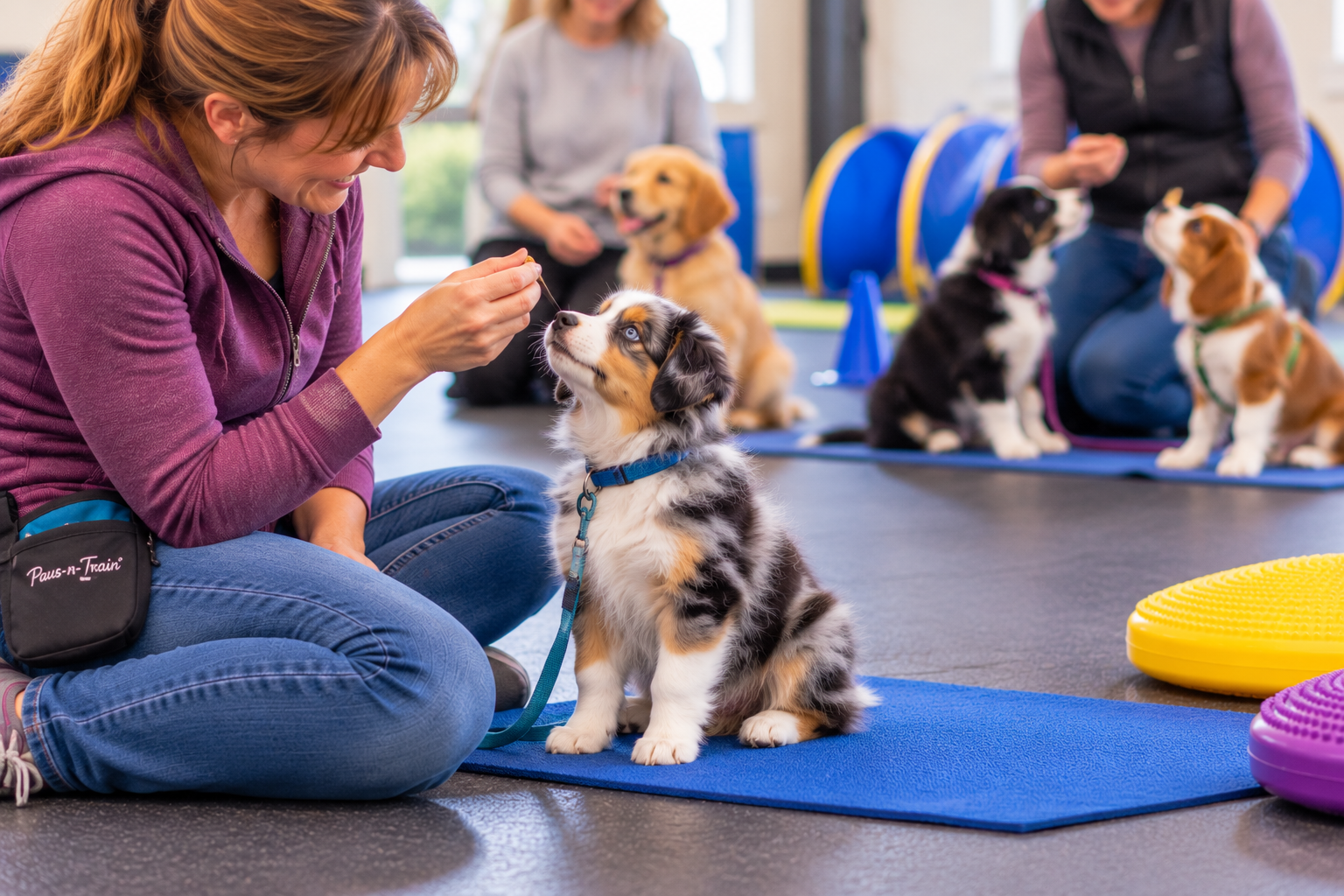
Young puppy learning calmly with its owner during a positive reinforcement puppy preschool class.
Quick Answer
You don't need to wait until your puppy is six months old to begin training.
Your puppy is learning from the moment they come home:
How to interact with people.
Whether new things are safe.
How to settle.
Where to toilet.
How to walk on a leash.
What happens when they're handled.
Whether their crate is comfortable.
How to respond to other dogs and people.
What behaviours get reinforced.
A thoughtfully managed puppy preschool gives you an opportunity to intentionally guide that learning during an important developmental period.
Waiting until six months doesn't mean your puppy hasn't been learning. It simply means they've had several additional months to develop habits without the benefit of structured training support.
Why Do People Think Puppies Should Wait?
Some people grew up with the idea that formal obedience training shouldn't begin until a dog is older. Others worry that young puppies can't concentrate or need to finish all their vaccinations first.
But puppy preschool shouldn't look like military obedience training.
We're not expecting a 10-week-old puppy to maintain a perfect heel.
Age-appropriate puppy training is about:
Short sessions.
Simple skills.
Socialization.
Confidence.
Communication.
Reinforcement.
Learning how to live successfully with humans.
Your puppy can absolutely still be a puppy while they're learning.
What Is Puppy Preschool Really For?
A good puppy preschool is much more than teaching SIT.
It should help owners understand how puppies learn while developing practical foundations such as:
Appropriate socialization.
Calm observation.
Confidence around new things.
Handling.
Crate comfort.
Settling.
Recall.
Beginning leash skills.
Appropriate play.
Learning around other puppies and people.
Just as importantly, puppy preschool trains the human end of the leash.
Owners learn how to recognize behaviour, reinforce good choices and prevent unwanted behaviours from becoming established habits.
What Does Puppy Socialization Really Mean?
Socialization doesn't mean:
“My puppy needs to meet as many dogs and people as possible.”
Good socialization helps puppies develop positive or neutral associations with the world around them.
That might include:
Different people.
Known, appropriate dogs.
Surfaces.
Sounds.
Vehicles.
Household equipment.
Grooming and handling.
Different environments.
Novel objects.
Sometimes the best socialization experience is simply:
“I noticed something new, nothing bad happened, and I carried on with my day.”
Your puppy doesn't need to greet every dog or person.
Learning to notice another dog and remain connected with you is an important skill too.
Why Start Socialization Early?
Puppies go through important developmental periods when they're particularly receptive to learning about the world.
They're gathering information about:
What's safe?
What's normal?
What should I pay attention to?
Learning certainly doesn't stop after puppyhood, but waiting until six months before intentionally introducing your puppy to the world can mean missing valuable early opportunities.
What About Vaccinations?
This is where owners often receive conflicting advice.
You may hear:
“Don't let your puppy leave home until all vaccinations are complete.”
At the same time, trainers emphasize early socialization.
The goal is to balance disease prevention with behavioural development.
Your veterinarian can advise you about infectious-disease risk for your puppy and your local area.
Socialization also doesn't require taking your puppy to high-risk environments.
It can include:
Watching the world from a safe location.
Car rides.
Meeting known, healthy and appropriate dogs.
Exploring different surfaces at home.
Hearing household sounds.
Seeing people from a comfortable distance.
Participating in a thoughtfully managed puppy class.
The goal isn't maximum exposure.
It's appropriate exposure.
More Socialization Isn't Always Better
Puppies can become overwhelmed.
Watch for behaviours such as:
Hiding.
Freezing.
Refusing food they would normally take.
Trying to escape.
Continually moving away.
Being unable to recover.
If your puppy is struggling, make the experience easier.
Increase distance, reduce the intensity, allow your puppy to observe or leave the situation.
Quality matters more than quantity.
What Can a Young Puppy Learn?
Quite a lot.
Young puppies can begin learning:
Their name.
Hand targets.
Recall.
Settling on a bed.
Beginning leash skills.
Crate comfort.
Calm handling.
Appropriate play.
Engagement with their person.
Relaxing after activity.
We aren't looking for perfection.
We're creating foundations.
Training can happen in tiny moments throughout everyday life.
Puppy looks at you → reward.
Puppy follows you → reward.
Puppy voluntarily enters the crate → reward.
Puppy settles quietly → reward.
Training doesn't always need to look like a formal training session.
Early Training Can Help Prevent Problems
It's usually easier to teach what you want before an unwanted behaviour becomes well practised.
You can begin teaching:
Four paws on the floor before jumping becomes a habit.
Leash engagement before your puppy learns to pull everywhere.
Settling before demanding behaviour becomes established.
Cooperative handling before nail care becomes a struggle.
Recall before your puppy becomes increasingly interested in the environment.
Prevention isn't about controlling every puppy behaviour.
It's about helping the behaviours you want to see grow stronger.
What Happens If I Wait Until Six Months?
Six months isn't too late.
Dogs can learn throughout their lives.
But by six months, your puppy has already had months to practise behaviour.
They may have learned:
Pulling gets them somewhere.
Jumping earns attention.
Barking makes people respond.
Coming when called is optional.
Seeing another dog means pulling toward them.
Stealing things starts a chase game.
Those behaviours can still be changed.
But now you may be changing an established pattern rather than building the desired pattern from the beginning.
Six Months Can Also Mean Adolescence
Around this stage, many owners notice their previously attentive puppy becoming:
More distracted.
More independent.
More interested in the environment.
Less responsive to familiar cues.
More energetic or frustrated.
Development affects behaviour.
This is precisely when having earlier training foundations can be helpful.
That doesn't mean puppy preschool prevents adolescence.
You may still need to increase reinforcement, reduce difficulty, use management and revisit easier versions of familiar skills.
Early training gives you a foundation to return to as your puppy develops.
Puppies Need Rest Too
Puppy preschool shouldn't teach owners that their puppy needs constant activity.
Puppies need plenty of sleep.
An overtired puppy can become:
Bitey.
Wild.
Frantic.
Barky.
Unable to concentrate.
Difficult to settle.
Sometimes a puppy who appears to need more exercise actually needs a nap.
Learning to settle is a valuable puppy skill too.
What About Shy or Very Bold Puppies?
Different puppies need different experiences.
A cautious puppy doesn't necessarily need more exposure. They need experiences at a level they can successfully handle.
For one puppy, success might mean watching a person from a distance.
A very confident puppy has different lessons to learn:
Not every person needs to be greeted.
Not every dog is a playmate.
Waiting can be rewarding.
Calm behaviour works.
Rest is part of life.
Good puppy training responds to the puppy in front of us.
Do Puppies Need to Play Together?
Not necessarily.
Puppy play can be useful when puppies are appropriately matched and interactions are carefully supervised.
But puppy preschool shouldn't simply be puppies turned loose together.
Size, confidence, energy and play styles can differ considerably.
One of the most valuable things a puppy can learn in class is:
“Another puppy can be nearby and I can still focus on my person.”
Socialization is much bigger than puppy play.
Puppy Preschool vs Waiting Until Six Months
Start During Early PuppyhoodWait Until Six MonthsBuild desired habits earlyPuppy practises habits without structured guidanceUse early socialization opportunitiesSome early opportunities have passedIntroduce handling proactivelyHandling habits may already be establishedBuild recall foundationsEnvironment may be increasingly rewardingBegin loose-leash skillsPulling may already be practisedTeach settling and calmnessDemanding habits may be establishedOwners learn preventionHelp may begin after problems appearBuild foundations before adolescenceTraining may begin during adolescence
A six-month-old dog can absolutely learn.
There simply isn't usually a benefit to waiting unnecessarily.
When Should Puppy Training Start?
You can begin teaching your puppy from the moment they come home.
Your first priorities might simply be:
Helping your puppy feel safe.
Establishing a toileting routine.
Creating opportunities for sleep.
Introducing the crate.
Beginning appropriate socialization.
Reinforcing engagement.
Building predictable routines.
Keep training short.
Keep it appropriate.
Keep it rewarding.
What Should I Look for in a Puppy Preschool?
Look for a program that:
✔ Uses positive reinforcement.
✔ Keeps expectations age appropriate.
✔ Teaches owners as well as puppies.
✔ Includes socialization without forcing interaction.
✔ Allows puppies to observe without greeting.
✔ Teaches practical household skills.
✔ Includes calmness and settling.
✔ Helps owners understand body language.
✔ Manages puppy interactions appropriately.
✔ Recognizes when a puppy needs more distance or a break.
A puppy class should help you understand your puppy, not simply teach a list of obedience cues.
Frequently Asked Questions
Is eight weeks too young to train a puppy?
No. Very short, positive and age-appropriate learning can begin as soon as your puppy comes home.
Shouldn't puppies just be allowed to be puppies?
Absolutely. Puppies should play, explore, sleep, chew and investigate. Good puppy training helps them learn how to navigate life with humans while still meeting those developmental needs.
Should I wait until my puppy has all their vaccinations?
Talk with your veterinarian about your puppy's vaccination schedule and local disease risk. Behavioural development and infectious-disease prevention both matter, and socialization can be approached thoughtfully.
What if my puppy is already six months old?
Start now. Six months isn't too late. Dogs continue learning throughout their lives.
Will puppy preschool prevent behaviour problems?
No program can guarantee that. Behaviour is influenced by genetics, health, development, environment and learning. Early training can help build useful skills and prevent some unwanted behaviours from becoming well-established habits.
Does my puppy need to meet lots of dogs?
No. Your puppy needs appropriate experiences, not simply a high number of interactions. Calmly observing another dog without greeting can be extremely valuable.
Key Takeaways
✔ Your puppy is already learning.
✔ You don't need to wait until six months to begin training.
✔ Puppy training should be short, positive and age appropriate.
✔ Socialization is about positive or neutral experiences—not meeting everyone.
✔ More exposure isn't always better.
✔ Puppies don't need to greet every dog.
✔ Early training can help prevent unwanted habits.
✔ Puppies need plenty of sleep and downtime.
✔ Early training doesn't eliminate adolescence.
✔ Six months isn't too late—but there's usually no benefit to waiting unnecessarily.
Most importantly:
Your puppy doesn't wait until six months to start learning about the world.
They're learning from the moment they arrive.
Early puppy training simply gives you the opportunity to become an intentional part of that education.
How Paus-n-Train Can Help
At Paus-n-Train, our Puppy Prep School is designed around the idea that puppy education is about much more than teaching SIT.
Our 10-week program helps young puppies develop foundations including:
Appropriate socialization.
Calm observation.
Novel sights, sounds and surfaces.
Settling on a bed.
Recall.
Beginning leash skills.
Crate comfort.
Handling.
Learning around other puppies and people.
Puppies must be under 16 weeks of age when Puppy Prep School begins, allowing us to support families during this important developmental stage.
The program also includes digital homework resources for continued practice at home and a private training session that can be used for the individual needs of your puppy and family.
If your puppy has already aged out of Puppy Prep School, you haven't missed your opportunity to train. Older puppies can move into an age-appropriate program, while Puppy Prep School OnDemand can provide additional puppy-specific foundations.
The goal isn't to produce a perfectly obedient puppy before adolescence.
It's to give you and your puppy communication skills, positive experiences and useful foundations to continue building on as your puppy grows.