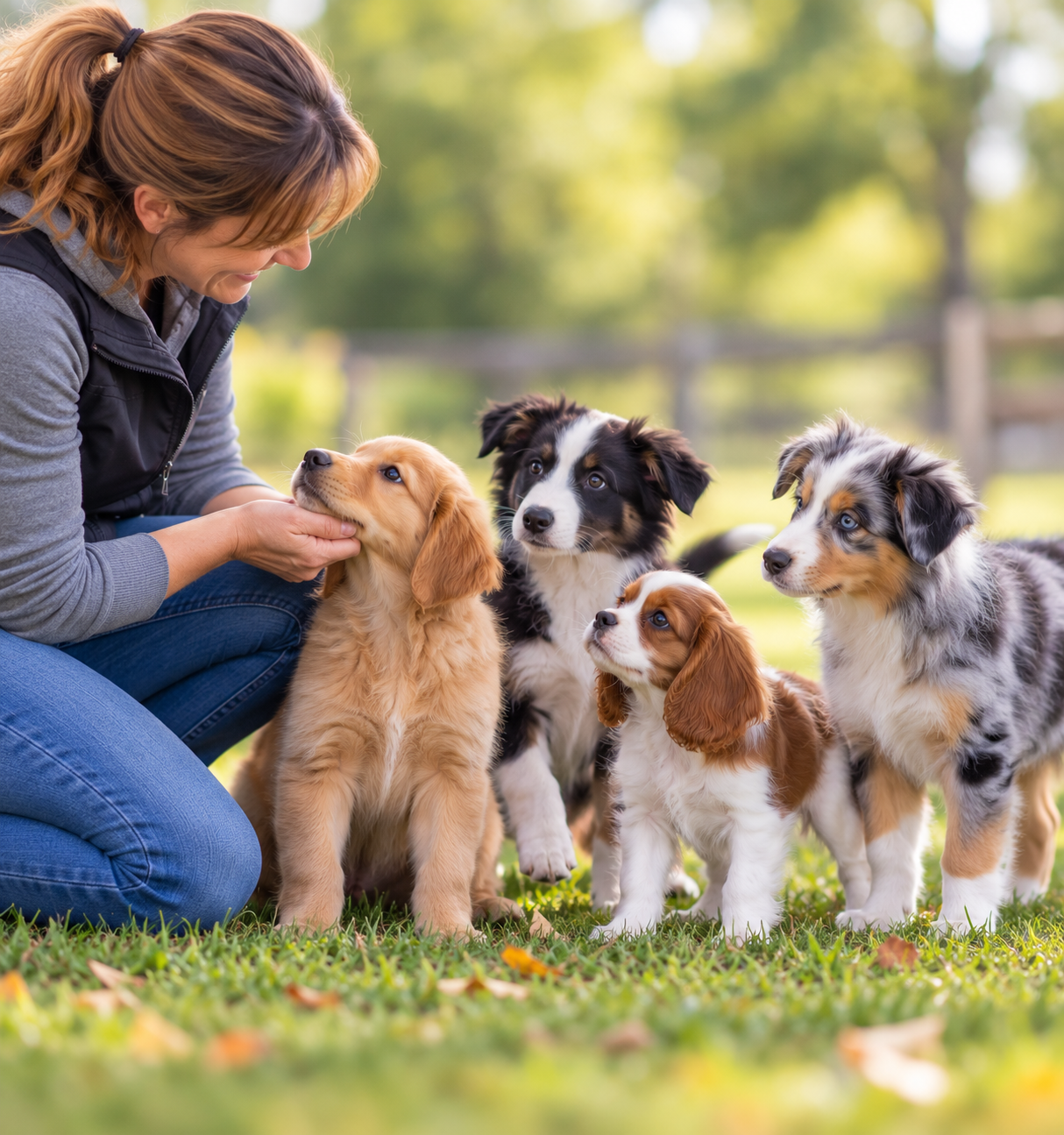
Woman interacting with several different puppies while considering which puppy may be the right match for her lifestyle and family.
Quick Answer
Choosing the right puppy isn't simply about finding the puppy you fall in love with first.
Before choosing an individual puppy, think about the adult dog that puppy is likely to become.
Consider:
Adult size.
Energy and exercise needs.
Temperament.
Sociability.
Grooming requirements.
Trainability.
Breed tendencies.
Health.
Your living situation.
Your work schedule.
Children or other pets in the household.
Activities you'd eventually like to enjoy together.
Then look carefully at where your puppy comes from and how the puppies have been raised.
Finally, consider the individual puppy.
The bold puppy who climbs into your lap first isn't automatically the "best" puppy.
Neither is the quiet puppy sitting at the back.
The goal is to find a puppy whose likely needs and temperament are a good match for your actual life.
Not just the life you imagine having with a dog.
Start With the Adult Dog, Not the Puppy
Puppies are incredibly good at being puppies.
They're small.
They're adorable.
They fall asleep in your arms.
And then they grow up.
Before choosing a puppy, imagine living with the adult version of that dog.
Ask yourself:
What do I want everyday life with my adult dog to look like?
Perhaps you picture:
Relaxed neighbourhood walks.
Hiking.
Dog sports.
Camping.
Visiting family.
Travelling.
Spending quiet evenings at home.
Participating in therapy work.
Training for a particular sport.
Simply having a companion.
Now ask:
Does the dog I'm considering have traits that are likely to fit that life?
That question is often much more useful than:
"Which puppy is the cutest?"
Be Realistic About Your Lifestyle
Try to evaluate the life you actually live—not the one you hope your puppy will motivate you to live.
If you currently enjoy a quiet lifestyle, choosing an extremely high-drive dog because you plan to start hiking two hours every day may create a mismatch.
Likewise, if you want a dog who can participate in sports, long hikes and active adventures, a dog whose physical structure or temperament doesn't suit those activities may not be the best choice.
Think about:
How active you really are.
How much time you have for training.
How long the dog may be alone.
Your tolerance for barking.
Your tolerance for shedding.
Grooming requirements.
Your physical abilities.
Your home and yard.
Your financial resources.
Your experience with dogs.
There's no perfect lifestyle.
There are simply better and worse matches.
Breed Matters—but It Doesn't Tell You Everything
Breed can give us useful information about likely traits.
Dogs have been selectively bred for generations to perform different jobs.
Those jobs may involve:
Herding.
Retrieving.
Guarding.
Hunting.
Tracking.
Working independently.
Working closely with people.
Chasing movement.
Using their voice.
Problem-solving.
Those tendencies don't disappear simply because the dog now lives in a family home.
A behaviour that seems inconvenient in your living room may make perfect sense when you understand what the dog was originally bred to do.
Think About What the Breed Was Designed to Do
Instead of asking only:
"Do I like this breed?"
ask:
"What was this breed developed to do?"
Then consider whether those traits work for your household.
A herding breed may be highly responsive to movement.
A retriever may naturally enjoy carrying things in their mouth.
A terrier may have strong interest in small animals and digging.
A livestock guardian may be more independent and naturally suspicious of unfamiliar things.
A scent hound may find an interesting smell much more compelling than your recall cue.
None of these traits makes a dog "bad."
They're simply part of understanding the animal you're bringing home.
Don't Choose a Dog Based on Appearance Alone
It's completely normal to be attracted to certain dogs.
Maybe you've always loved:
Fluffy dogs.
Tiny dogs.
Giant dogs.
Blue merles.
Long coats.
Short coats.
Particular breeds.
Appearance can certainly be part of your preference.
It just shouldn't be the only consideration.
The dog whose photograph catches your attention still needs to fit your lifestyle for potentially the next 10–15 years or more.
Choose the dog you'll enjoy living with—not only the puppy you enjoy looking at.
Size Matters—but Perhaps Not in the Way You Think
People sometimes assume:
Small home = small dog.
It isn't always that simple.
A dog's ability to live comfortably in a smaller home or apartment depends on much more than physical size.
Consider:
Activity needs.
Barking tendencies.
Ability to settle.
Exercise requirements.
Sensitivity to environmental noise.
Grooming.
Temperament.
Training needs.
A small, extremely busy dog isn't automatically easier to live with than a larger dog who settles readily after appropriate activity.
If you're moving from a larger breed to a smaller one, don't assume the smaller dog will simply be a miniature version of what you're accustomed to.
Different breeds can bring very different behavioural tendencies.
Consider Energy—and the Ability to Settle
People often ask:
"How much exercise does this breed need?"
That's important.
But I'd also ask:
"How easily does this type of dog settle?"
A dog doesn't simply need an ON switch.
They need an OFF switch too.
Living with a dog who continually needs activity can be challenging even for an active household.
Look for a balance that works for you.
And remember that constantly adding more physical exercise isn't always the answer.
Dogs also benefit from:
Sniffing.
Training.
Problem-solving.
Enrichment.
Chewing.
Exploration.
Appropriate social interaction.
Sleep.
Downtime.
Think About Grooming Before You Fall in Love With the Coat
That beautiful coat comes with maintenance.
Depending on the dog, grooming may involve:
Regular brushing.
Combing.
Professional grooming.
Nail care.
Ear care.
Coat clipping.
Drying after wet walks.
Managing mud, burrs and snow.
Ask what maintaining the adult coat realistically involves.
Then ask:
Am I willing and able to do that for the dog's lifetime?
If professional grooming will be required, include that in your budget.
Consider Your Household
The right puppy for one family may be completely wrong for another.
Think about everyone the dog will live with.
Children
Consider:
Children's ages.
Activity level.
How much supervision is available.
The dog's likely adult size.
Breed tendencies.
Whether the puppy has been appropriately exposed to children.
Children and puppies both need teaching and supervision.
A puppy shouldn't be expected to tolerate everything a child might do.
Other Dogs
Consider your existing dog's:
Age.
Health.
Play style.
Social preferences.
Tolerance for puppies.
A senior dog who enjoys occasional canine company may not appreciate living full-time with a relentless puppy.
Cats and Other Animals
Breed tendencies can matter here.
If your household includes cats, rabbits, chickens or other animals, consider the dog's likely interest in chasing or predatory behaviour.
Management and training are still important, but genetics deserve consideration.
Think About Your Future Too
A puppy may be with you for well over a decade.
Obviously, we can't predict everything.
But consider foreseeable changes.
Are you likely to:
Move?
Have children?
Retire?
Travel more?
Change working hours?
Downsize?
Move into an apartment?
Become less physically able to manage a large, powerful dog?
You don't need to predict your entire future.
But if a significant lifestyle change is already on the horizon, it should be part of your decision.
Choosing a Responsible Breeder
If you're purchasing a puppy from a breeder, choosing the breeder is at least as important as choosing the puppy.
A responsible breeder should care deeply about where their puppies go.
Don't be surprised if they ask you lots of questions.
That's a good thing.
They may want to know about:
Your previous dog experience.
Your household.
Children.
Other pets.
Your work schedule.
Your activity level.
Your plans for the puppy.
What you're looking for in an adult dog.
A breeder who understands their dogs should want to make appropriate matches.
Ask About Health Testing
A veterinary checkup of the parents isn't the same thing as breed-appropriate health testing.
Different breeds can be predisposed to different inherited health conditions.
Before purchasing a puppy, investigate what health testing is recommended for that breed and ask the breeder for the results.
Don't be afraid to ask questions.
A puppy is a significant emotional and financial commitment.
Health matters.
Meet the Mother When Possible
If possible, meet the puppy's mother and observe her behaviour.
Consider:
Is she comfortable around people?
Does she appear extremely fearful?
Is she able to settle?
How does she respond to the breeder?
What is her general temperament?
You may not always be able to meet the father because responsible breeders sometimes use a male who lives elsewhere.
Ask about him too.
Temperament has both genetic and environmental influences.
Parents matter.
Ask How the Puppies Are Being Raised
The first weeks of a puppy's life matter.
Ask what the breeder or foster home is doing to introduce puppies appropriately to everyday experiences.
This might include:
Different surfaces.
Household sounds.
People.
Handling.
Grooming foundations.
Crate foundations.
Safe exploration.
Age-appropriate novelty.
Different environments.
More isn't automatically better.
We don't want puppies flooded with overwhelming experiences.
We want thoughtful, positive exposure appropriate to their developmental stage.
What If I'm Adopting a Rescue Puppy?
Many of the same principles apply.
With a rescue puppy, information about genetics, parentage or early experiences may be limited.
That's okay.
Ask what the foster home or rescue has observed.
For example:
How does the puppy respond to new people?
Have they lived with dogs?
Have they encountered cats?
How do they respond to household noises?
How quickly do they recover after being startled?
Do they seek interaction with people?
How do they handle frustration?
Are there known medical concerns?
Remember that behaviour observed in a shelter environment may not perfectly predict how a puppy will behave once settled into a home.
There may simply be more uncertainty.
Should I Pick the Puppy Who Comes to Me First?
Not necessarily.
It's a lovely moment when one puppy races across the room and climbs into your lap.
It feels like:
"They chose me!"
Maybe they did.
Or perhaps they're simply the most socially confident puppy in the litter and would have climbed onto the lap of the next person too.
That confidence might be exactly what you want.
Or it might come with an intensity that isn't ideal for your household.
Likewise, the quiet puppy sitting away from everyone isn't automatically the "calm one."
They could be:
Tired.
Overwhelmed.
Less socially confident.
Having an off moment.
Simply behaving differently at that particular time.
Avoid making a 15-year decision based on 15 minutes of puppy behaviour.
Let the Breeder Help With Matching
A good breeder has spent far more time with the puppies than you have.
They've watched them:
Wake up.
Play.
Explore.
Become frustrated.
Interact with littermates.
Encounter novelty.
Engage with people.
Recover from surprises.
Settle.
They may recognize patterns that aren't visible during your visit.
If you've clearly explained what you're looking for, take their observations seriously.
Sometimes the puppy you're initially drawn to isn't the puppy the breeder believes is the best match.
That's worth considering.
What About Puppy Temperament Testing?
Temperament assessments can provide useful information, but they shouldn't be treated as a crystal ball.
A puppy's behaviour on one day in one situation doesn't perfectly predict their adult personality.
Development continues.
Genetics matter.
Early experiences matter.
Learning matters.
Adolescence matters.
The future environment matters.
Instead of asking:
"Can this test tell me exactly what this puppy will be like as an adult?"
think:
"What additional information does this assessment give us about this puppy right now?"
Use it as one piece of a much larger picture.
Look at Recovery, Not Just Reactions
One quality worth observing is how a puppy responds after something surprising happens.
Puppies will encounter unfamiliar things.
A puppy might notice a new sound and startle.
The question isn't necessarily:
"Did the puppy startle?"
A more useful question may be:
"What happened next?"
Did the puppy:
Investigate?
Re-engage?
Take food?
Return to normal activity?
Remain worried for a long period?
Recovery can give us useful information about how a puppy processes novelty.
The Boldest Puppy Isn't Necessarily the Best Puppy
People often gravitate toward the bold, outgoing puppy.
That puppy may be fantastic.
But boldness can also come with:
Persistence.
High activity.
Intensity.
Strong opinions.
Greater training needs.
Those aren't bad traits.
For the right household, they may be exactly what you're looking for.
But if your goal is a relatively easygoing companion, choosing the busiest puppy because they're the most entertaining during your visit may not produce the match you expected.
The Quietest Puppy Isn't Necessarily the Easiest Puppy
Similarly, don't automatically choose the quietest puppy because you assume they'll be easier.
Quiet behaviour can mean many things.
A puppy may be:
Relaxed.
Sleepy.
Cautious.
Frightened.
Overwhelmed.
Less socially confident.
Context matters.
Ask the person who has been raising the litter whether what you're seeing is typical.
Male or Female?
For most families, I would place much more emphasis on:
Temperament.
Breed tendencies.
Health.
Individual compatibility.
...than on sex alone.
There can be individual and breed-specific differences, but broad statements such as:
"Females are easier."
or:
"Males are friendlier."
aren't reliable enough to choose a puppy by themselves.
Choose the individual who best fits your household.
Purebred or Mixed Breed?
Either can make a wonderful companion.
Purebred dogs can provide somewhat more predictability around characteristics such as:
Adult size.
Coat.
Physical structure.
Breed tendencies.
Some behavioural traits.
Mixed-breed puppies can be less predictable, particularly when parentage is unknown.
That doesn't make one inherently better than the other.
It simply changes how much information you may have when making your decision.
What About Designer Crosses?
Don't assume crossing two breeds automatically gives you the best qualities of both.
Genetics don't work like ordering features from a menu.
A puppy can inherit different combinations of:
Coat characteristics.
Size.
Temperament.
Behavioural tendencies.
Health risks.
If you're considering a deliberate cross, ask the same questions you would ask any breeder:
Why was this breeding chosen?
What health testing was completed?
What are the temperaments of the parents?
How are the puppies raised?
What traits are appearing in previous litters?
How are puppies matched to homes?
The label attached to the puppy matters less than responsible breeding and appropriate matching.
Don't Forget the Financial Commitment
The purchase or adoption fee is only the beginning.
Budget for:
Veterinary care.
Vaccinations.
Food.
Training.
Grooming.
Equipment.
Licensing.
Preventative healthcare.
Emergency veterinary expenses.
Pet insurance if you choose it.
Boarding or pet care.
Dog sports or activities you may want to pursue.
A dog can be with you for many years.
Choose with your long-term resources in mind.
What If I Want a Dog for a Specific Job?
This deserves extra consideration.
If you're looking for a dog for:
Competitive sports.
Therapy work.
Service-dog work.
Detection.
Working roles.
...the consequences of a mismatch can be greater.
Not every wonderful pet dog has the temperament or physical characteristics needed for specialized work.
For example, a potential service dog may eventually need to comfortably:
Work around people.
Ignore dogs.
Recover from unexpected events.
Settle for extended periods.
Work in busy public environments.
Perform trained tasks reliably.
No puppy can be guaranteed to succeed in a future working role.
Choosing carefully can improve the odds, but development, health and training will continue to matter.
Don't Choose a Puppy Because You Feel Sorry for Them
This can be difficult.
You may meet a puppy who seems frightened or withdrawn and think:
"They need me."
Compassion is wonderful.
But compassion and compatibility aren't always the same thing.
If you're prepared for the possibility of additional behavioural or medical support, you may consciously choose a puppy with greater needs.
But make that decision with your eyes open.
Don't assume love alone will automatically resolve fear, genetics, health problems or difficult early experiences.
Red Flags Worth Taking Seriously
Slow down if:
You're pressured to make an immediate decision.
The breeder won't discuss health testing.
You can't get clear information about the parents.
The breeder seems uninterested in your household or goals.
Puppies appear to be raised with little opportunity for appropriate enrichment or human interaction.
You're discouraged from asking questions.
The breeder promises a puppy's adult temperament with absolute certainty.
You're promised that a particular crossbreed is guaranteed to be hypoallergenic, perfectly healthy or to inherit only desirable traits.
Something about the situation simply doesn't feel right.
There will always be another puppy.
You don't have to make a decision because you're standing in front of one.
Before You Say Yes, Ask Yourself...
Take a moment away from the puppy eyes and ask:
Can I meet this dog's exercise and enrichment needs?
Can I manage the adult size?
Can I afford the grooming requirements?
Do the breed tendencies fit my household?
Am I comfortable with the potential barking, shedding, chasing or other natural behaviours?
Does this puppy appear appropriate for my goals?
Am I choosing based on compatibility—or emotion?
Can I provide what this dog is likely to need for the next decade or more?
If the answers make you hesitate, that's useful information.
Frequently Asked Questions
What's the best breed for a first-time dog owner?
There isn't one universally best breed.
Consider the individual's temperament, energy, grooming requirements, size, health, breed tendencies and how well those characteristics match your lifestyle.
Should I choose the calmest puppy in the litter?
Not automatically.
A puppy who appears quiet during one visit may be relaxed, tired, cautious or overwhelmed.
Ask the breeder or foster caregiver what the puppy is typically like across different situations.
Should I choose the puppy who chooses me?
Enjoy the moment—but don't make it your only selection criterion.
Compatibility requires more information than which puppy reaches you first.
Is a smaller dog easier than a large dog?
Not necessarily.
Small dogs take up less physical space, but size doesn't determine energy, barking, grooming, training needs or temperament.
Should I get a high-energy breed if I'm active?
Possibly, but remember that you'll be living with the dog on your non-active days too.
Consider the dog's ability to settle as well as their ability to keep up.
Should I get two puppies so they have company?
Usually, adding two puppies creates considerably more work rather than making puppy raising easier.
Each puppy needs opportunities to develop independence, bond with their humans, train separately and experience the world individually.
For most households, starting with one puppy is much more manageable.
Can a breeder guarantee temperament?
No.
Responsible breeding, genetics, early experiences and thoughtful matching can influence the likelihood of particular traits, but no one can guarantee exactly how an eight-week-old puppy will behave as an adult.
When should I contact a dog trainer?
Ideally, before your puppy comes home.
A trainer can help you think through breed choice, prepare your home, choose equipment and develop a plan for the puppy's first days and weeks.
You don't need to wait until there's a problem.
Key Takeaways
When choosing a puppy:
✔ Start by thinking about the adult dog you want to live with.
✔ Choose for your actual lifestyle—not your imaginary one.
✔ Research what the breed was originally developed to do.
✔ Consider energy and ability to settle.
✔ Think about adult size, grooming and financial needs.
✔ Consider children, dogs, cats and other household members.
✔ Look for responsible breeding and appropriate health testing.
✔ Ask how the puppies have been raised.
✔ Use the breeder or foster caregiver's knowledge of the puppies.
✔ Don't assume the boldest puppy is best.
✔ Don't assume the quietest puppy is easiest.
✔ Temperament testing is information—not a crystal ball.
✔ Consider how a puppy recovers from new experiences.
✔ Don't choose on appearance alone.
✔ Don't allow yourself to be pressured into a decision.
✔ If the dog is intended for specialized work, choose particularly carefully.
Most importantly:
Don't ask only, “Do I want this puppy?”
Also ask:
“Am I the right home for the dog this puppy is likely to become?”
Choosing thoughtfully at the beginning can't guarantee that life with your dog will always be easy.
But it can give both of you a much stronger foundation for the years ahead.
How Paus-n-Train Can Help
At Paus-n-Train, we believe puppy training can begin before you bring your puppy home.
If you're still deciding on a puppy, a private consultation can help you think through considerations such as breed tendencies, lifestyle, training goals and what you'll realistically need from your future dog.
Once your puppy comes home, our Puppy Prep School provides a structured 10-week program for puppies who are under 16 weeks of age when their class begins.
The program helps families build foundations in areas such as:
Appropriate early socialization.
Calm observation.
Novel sights, sounds and surfaces.
Settling on a bed.
Recall foundations.
Beginning leash skills.
Crate comfort.
Handling.
Learning around other puppies and people.
Puppy Prep School also includes a private lesson, allowing you to focus on questions or training needs specific to your individual puppy and household.
For puppies who have aged out of the in-person program, Puppy Prep School OnDemand provides another way to work through important puppy foundations at home.
Choosing the right puppy is an important first step.
But the puppy you choose isn't a finished product.
Genetics give you part of the story. Early experiences, environment, learning, development and the relationship you build together will continue writing it.