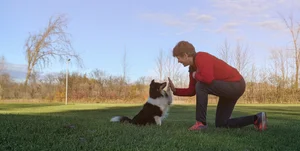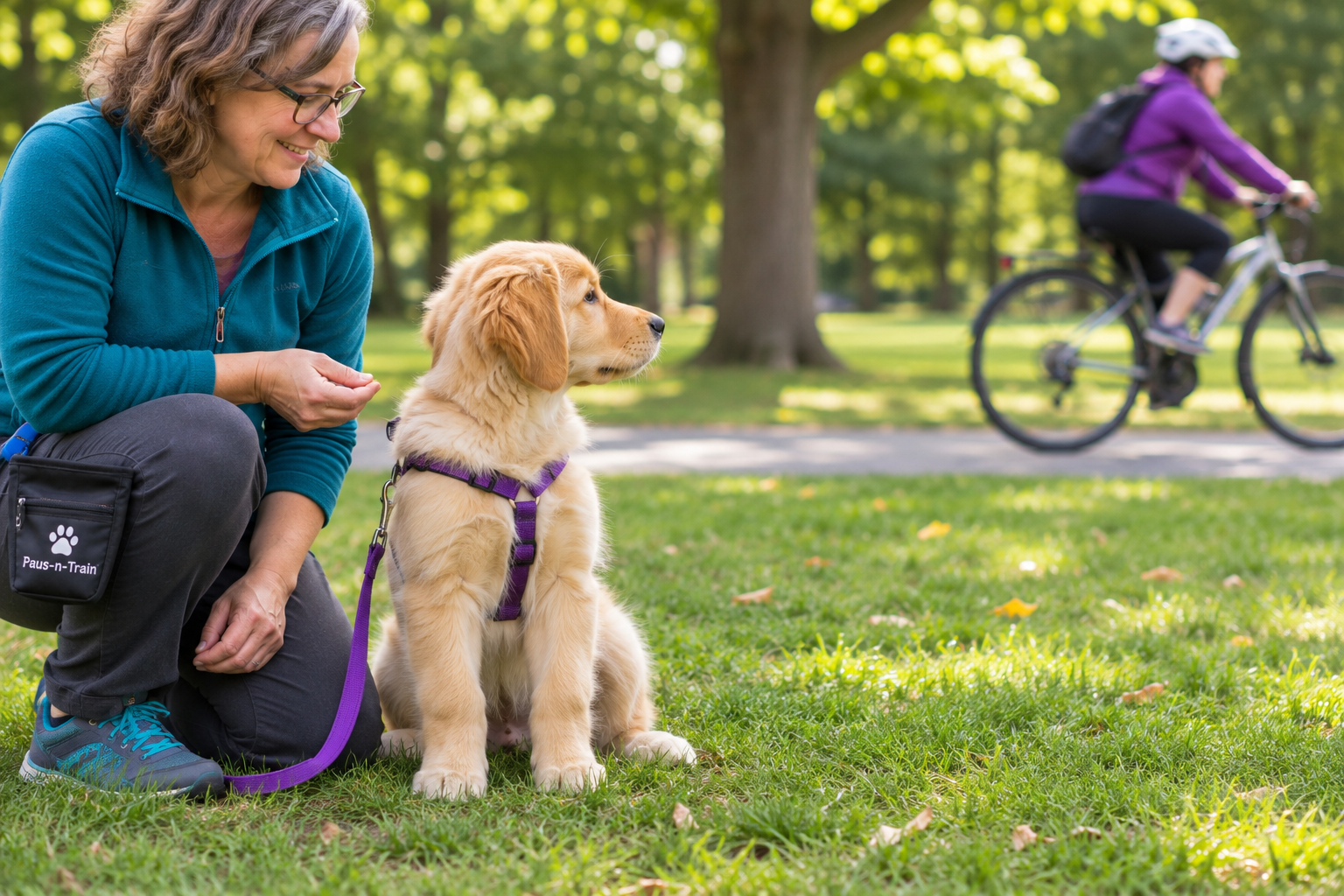
Golden Retriever puppy calmly observing a passing cyclist during positive reinforcement puppy socialization training.
Quick Answer
Puppy socialization is the process of helping your puppy develop positive associations with the people, animals, environments, sounds, surfaces and experiences they are likely to encounter throughout their life.
The goal isn't to expose your puppy to as many things as possible.
It's to help them learn that the world is a safe and predictable place.
A well-socialized puppy learns to:
Feel comfortable in different environments.
Remain calm around people and other dogs.
Explore unfamiliar objects with confidence.
Cope with everyday sounds and activities.
Accept appropriate handling.
Remain connected with their handler around distractions.
Socialization is as much about learning to ignore things as it is about learning to interact with them.
Why Is Puppy Socialization So Important?
Imagine arriving in a completely unfamiliar country.
You don't understand the language, recognize the sounds or know what to expect from the people around you.
That's a little like what life can be like for a young puppy.
Everything is new!
During early development, puppies are forming associations with the world around them. These experiences can influence how they respond to similar situations later in life.
Thoughtful socialization can help reduce the likelihood of fear-related behaviour struggles and provide a foundation for confidence, adaptability and resilience.
While genetics, temperament and future experiences also influence behaviour, we have a wonderful opportunity during puppyhood to help our dogs get off to a good start.
When Is the Best Time to Socialize a Puppy?
Puppies experience an important developmental stage known as the sensitive period for socialization, which begins at approximately three weeks of age, with the first three months being particularly important.
Much of this learning begins before your puppy comes home.
Responsible breeders and caregivers introduce puppies to gentle handling, household sounds, different surfaces and opportunities for exploration.
When your puppy comes home, it's your opportunity to continue that learning.
The weeks between approximately 8 and 16 weeks of age provide particularly valuable opportunities for introducing your puppy to the experiences that will be part of their future life.
However, socialization doesn't end at 16 weeks.
Dogs continue learning throughout their lives, and positive experiences remain important as they mature.
Does My Puppy Need to Be Fully Vaccinated Before Socialization?
This is one of the most common questions new puppy owners ask.
The American Veterinary Society of Animal Behavior (AVSAB) supports appropriate socialization before puppies have completed their vaccination series, provided reasonable precautions are taken.
Waiting until your puppy is fully vaccinated may mean missing a significant portion of their sensitive socialization period.
Fortunately, there are many ways to introduce your puppy to the world while minimizing health risks.
You might:
Carry your puppy while exploring a new location.
Observe activity from your vehicle.
Visit a friend's clean, private backyard.
Arrange interactions with known, friendly, fully vaccinated adult dogs.
Attend a well-managed puppy class with appropriate vaccination and hygiene requirements.
Avoid dog parks, areas heavily contaminated with dog waste and locations frequented by dogs of unknown health or vaccination status.
Discuss your puppy's vaccination schedule and local disease risks with your veterinarian.
Does My Puppy Need to Greet Everyone?
Absolutely not!
One of the biggest misconceptions about socialization is that puppies need to meet every person and dog they encounter.
Imagine your puppy learns that every time they see a person, they get to run over and receive attention.
What happens when that adorable puppy becomes a 60-pound adolescent dog?
They may begin pulling toward people, jumping up or becoming frustrated when they aren't allowed to greet someone.
We may have unintentionally taught our puppy that every person is an opportunity for excitement.
Instead, reward your puppy for:
Noticing a person and looking back at you.
Walking past someone calmly.
Remaining relaxed while people are nearby.
Choosing to stay connected with you.
Appropriate greetings can certainly be part of socialization, but they don't need to happen every time.
The same principle applies to other dogs.
We want our puppies to learn:
"Other dogs are here, but I'm working with my person."
This is an incredibly valuable skill for everyday walks, training classes and future dog sport activities.
Should My Puppy Play With Other Dogs?
Appropriate interactions with other dogs can help puppies develop valuable communication and social skills.
However, not every adult dog enjoys puppies, and not every puppy enjoys boisterous play.
Choose your puppy's canine companions carefully.
Look for known, friendly, fully vaccinated adult dogs who are comfortable around puppies and communicate appropriately.
Supervise interactions, watch the body language of both dogs and provide opportunities for breaks.
Avoid assuming that your puppy needs to visit dog parks or participate in large, uncontrolled playgroups to develop good social skills.
A few carefully selected canine companions can provide much more valuable learning experiences than dozens of unpredictable interactions.
What Is the Difference Between Socialization and Exposure?
Exposure simply means your puppy encounters something.
Socialization involves helping your puppy develop an appropriate association with that experience.
Imagine taking your puppy to a busy outdoor festival.
There are loudspeakers, children running, unfamiliar dogs and people reaching toward your puppy.
Technically, your puppy has been exposed to a lot of things.
But what did they learn?
If they felt frightened or overwhelmed, the experience may have had the opposite effect of what you intended.
Now imagine sitting with your puppy at a comfortable distance from that same festival.
Your puppy watches the activity, takes treats and occasionally looks back at you.
After a few minutes, you leave.
That experience may be much more beneficial.
The quality of the experience matters far more than the quantity of experiences.
What Should I Include in My Puppy's Socialization Plan?
Think about the experiences your puppy is likely to encounter throughout their life.
A puppy who will live in an apartment may need different experiences than a puppy who will live on a farm.
Here are some categories to consider.
People
Introduce your puppy to people who look, sound and move differently.
Examples include:
Adults and children.
People wearing hats, helmets or sunglasses.
People using wheelchairs, walkers or canes.
People carrying large objects.
People wearing uniforms.
Observation is often enough. Your puppy doesn't need to be touched by everyone they encounter.
Other Animals
Depending on your lifestyle, your puppy may encounter other dogs, cats, horses, livestock or wildlife.
Help your puppy learn to remain comfortable around these animals without chasing, barking or expecting to interact with them.
Sounds
Introduce everyday sounds such as:
Doorbells.
Vacuum cleaners.
Traffic and garbage trucks.
Household appliances.
Thunder and fireworks recordings.
Begin at a low intensity and gradually increase the challenge as your puppy remains comfortable.
Surfaces and Objects
Provide opportunities to explore different textures and unfamiliar objects.
Consider grass, gravel, rubber mats, carpet, tile, sand, umbrellas, cardboard boxes and stable platforms.
These experiences can help develop body awareness, curiosity and confidence.
Environments
Introduce your puppy to a variety of appropriate locations, such as:
A quiet park.
A friend's home.
A residential street.
A pet-friendly business.
A veterinary clinic for a planned, positive visit.
A dog training facility.
Think about places your adult dog will need to feel comfortable visiting.
Handling and Cooperative Care
Your puppy will need to be handled throughout their life for grooming, veterinary examinations and everyday care.
Begin developing positive associations with having their paws, ears, mouth and body gently handled.
Introduce grooming equipment, nail care and wearing a collar or harness gradually.
The goal is to develop trust and cooperation—not simply tolerance.
How Do I Know If My Puppy Is Comfortable?
Your puppy's body language provides valuable information about how they're feeling.
A comfortable puppy may have a relaxed body, explore voluntarily, take treats comfortably and show curiosity about their surroundings.
Signs that your puppy may be struggling include:
Freezing or attempting to hide.
Tucking their tail or lowering their body.
Repeatedly licking their lips.
Turning their head away.
Refusing food they would normally enjoy.
Barking, whining or attempting to escape.
Becoming unusually still or frantic.
Remember that taking food doesn't automatically mean your puppy is comfortable.
Consider their overall behaviour.
If your puppy is showing signs of fear, reduce the intensity of the experience immediately or remove them from the situation.
That might mean increasing distance, reducing the volume of a sound or simply ending the outing.
What Should I Do If My Puppy Is Afraid of Something?
Imagine your puppy notices a garbage bin that has blown over in the wind.
They stop walking and begin backing away.
Rather than encouraging your puppy to approach the bin, give them more space.
Allow them to observe from a comfortable distance and reward them for looking at the object or choosing to reconnect with you.
Your puppy may eventually choose to investigate.
Or they may simply learn that they can walk past the bin without worrying.
Both are successful outcomes.
Avoid using food to lure your puppy closer to something they are afraid of. They may want the food but still feel frightened, resulting in them finding themselves closer than they're comfortable with.
Instead, use food to build positive associations while allowing your puppy to maintain a comfortable distance.
What Are Confidence Stations?
Confidence Stations are activities designed to introduce puppies to novel objects, surfaces and simple movement challenges in a controlled environment.
At Paus-n-Train, we incorporate Confidence Stations into our Puppy Prep School program.
A station might involve:
Walking across a textured surface.
Stepping onto a low, stable platform.
Exploring a cardboard box.
Walking between cones.
Investigating an unfamiliar object.
Moving through a short, open tunnel.
The equipment itself isn't the most important part.
It's the learning experience.
Your puppy has an opportunity to investigate, make choices, solve simple problems and discover that trying something new can lead to a positive outcome.
We don't need to rush puppies through the stations or expect every puppy to complete every challenge.
A puppy who chooses to investigate something they were initially unsure about has already accomplished something worthwhile.
How Can DMT Help With Puppy Socialization?
One of the games we teach at Paus-n-Train is DMT—Distraction, Mark, Treat.
This game helps puppies develop positive associations with everyday distractions.
Imagine you're sitting with your puppy in a quiet park.
A bicycle passes at a comfortable distance.
Your puppy notices the bicycle.
You use your event marker and deliver a treat.
Over time, your puppy begins to learn that noticing something in the environment can predict something good from you.
DMT can be used with people, dogs, vehicles, unfamiliar sounds and many other everyday distractions.
It also provides opportunities to reinforce your puppy for disengaging from distractions and reconnecting with you.
These are valuable foundations for loose leash walking, recall and future training.
Can You Over-Socialize a Puppy?
Yes!
A socialization checklist can be helpful, but completing the checklist shouldn't become the goal.
Imagine your puppy has visited a new location, met a visitor, attended puppy class and encountered several unfamiliar sounds—all in one day.
Even if those experiences were enjoyable, your puppy may be tired and have less ability to cope with additional challenges.
This is where understanding your puppy's stress bucket becomes helpful.
Excitement, novelty and fatigue can accumulate throughout the day.
You may notice:
Increased puppy nipping.
Difficulty settling.
Frantic behaviour or zoomies.
Reduced ability to focus.
Increased sensitivity to sounds or movement.
Your puppy may need a nap rather than another socialization activity.
Build plenty of opportunities for sleep, relaxation and recovery into your puppy's daily routine.
Why Is Calmness an Important Part of Socialization?
Socialization isn't always about doing something.
Sometimes it's about learning to do nothing.
Imagine visiting a friend's backyard with your puppy.
Rather than spending the entire visit exploring and playing, your puppy also has an opportunity to relax.
This is where the Calmness Triad and Ninja Feeding techniques we teach at Paus-n-Train become particularly helpful.
Using Ninja Feeding, you can quietly drop treats to reinforce layers of calmness without drawing your puppy's attention to you.
Your puppy might begin by standing quietly, then sitting and eventually choosing to lie down.
Learning to relax in different environments is a valuable life skill, particularly for dogs who will accompany their families on outings, vacations or visits with friends.
Is Puppy Class Important for Socialization?
A well-designed puppy class provides opportunities for early learning in a structured environment.
But puppy class should be about much more than puppies playing together.
A comprehensive puppy program helps owners understand their puppy's developmental needs while introducing skills such as:
Confidence-building activities.
Engagement with the handler.
Appropriate behaviour around other dogs.
Gentle handling and cooperative care.
Calmness and impulse control.
Foundational obedience skills.
It also provides opportunities for owners to ask questions and receive guidance as their puppies develop.
At Paus-n-Train, we want puppies to discover that a training environment is somewhere they can learn, explore and work with their person—even when other puppies are nearby.
Can You Socialize an Older Puppy or Adult Dog?
Yes.
Although the early sensitive period provides particularly valuable learning opportunities, dogs can continue developing positive associations throughout their lives.
However, helping an older dog overcome an established fear may require a different approach.
For example, an adult dog who is frightened of unfamiliar people may benefit from a carefully structured behaviour modification plan involving management, desensitization and counterconditioning.
Simply exposing that dog to more people may make the problem worse.
For dogs experiencing significant fear, anxiety or reactivity, individualized professional guidance can be particularly helpful.
Frequently Asked Questions
How many people should my puppy meet?
There is no specific number that guarantees successful socialization. Focus on providing a variety of positive, manageable experiences.
Can I socialize my puppy without leaving home?
Yes. Introducing household sounds, unfamiliar objects, different surfaces, gentle handling and appropriate visitors are all valuable socialization opportunities.
Should strangers be allowed to pet my puppy?
Only when your puppy is comfortable and the interaction is appropriate. Allow your puppy to choose whether to approach and provide opportunities to move away.
How long should a socialization outing last?
There is no set duration. A few minutes of successful observation may be more valuable than a lengthy outing. Consider your puppy's age, energy level and body language.
Is 16 weeks too late to begin socialization?
No. Older puppies can still learn and develop confidence, although they may need a more gradual approach to unfamiliar experiences.
Does socialization prevent all future behaviour problems?
No. Genetics, health, developmental changes and future experiences also influence behaviour. Thoughtful early socialization provides an important foundation but cannot guarantee a dog will never experience behaviour struggles.
Key Takeaways
✔ Begin socialization early, taking appropriate health precautions.
✔ Focus on the quality of experiences rather than the quantity.
✔ Teach your puppy that people and other dogs can be present without requiring interaction.
✔ Include sounds, surfaces, environments, unfamiliar objects and handling.
✔ Use your puppy's body language to guide your training decisions.
✔ Incorporate confidence-building activities, DMT and calmness training.
✔ Provide plenty of opportunities for rest and recovery.
Most importantly:
Socialization isn't about teaching your puppy that everything in the world is exciting. It's about helping them develop the confidence to navigate everyday life.
How Paus-n-Train Can Help
At Paus-n-Train Agility & Obedience, located in the Peterborough, Ontario area, our Puppy Prep School program is designed to help puppies and their families build a strong foundation for life together.
Our positive reinforcement, science-based approach goes beyond teaching basic obedience.
Throughout our comprehensive 10-week program, you'll learn about puppy development, appropriate socialization, Confidence Stations, body language, DMT, the Calmness Triad, cooperative care and essential everyday manners.
You'll also receive access to digital homework resources and a prepaid private training session, providing additional support as you navigate the challenges of puppyhood.
For families who prefer to learn from home, our Puppy Prep School OnDemand program offers comprehensive lessons and resources to support your training journey.
And if your puppy has already aged out of Puppy Prep School, our Dog Manners program provides an opportunity to continue developing those important foundation skills.
Whether you're welcoming your first puppy or adding another dog to your family, we're here to help you get off to a great start.
Learn more about our programs at www.paus-n-train.com.