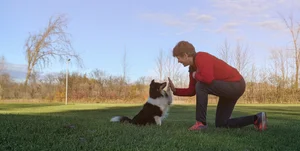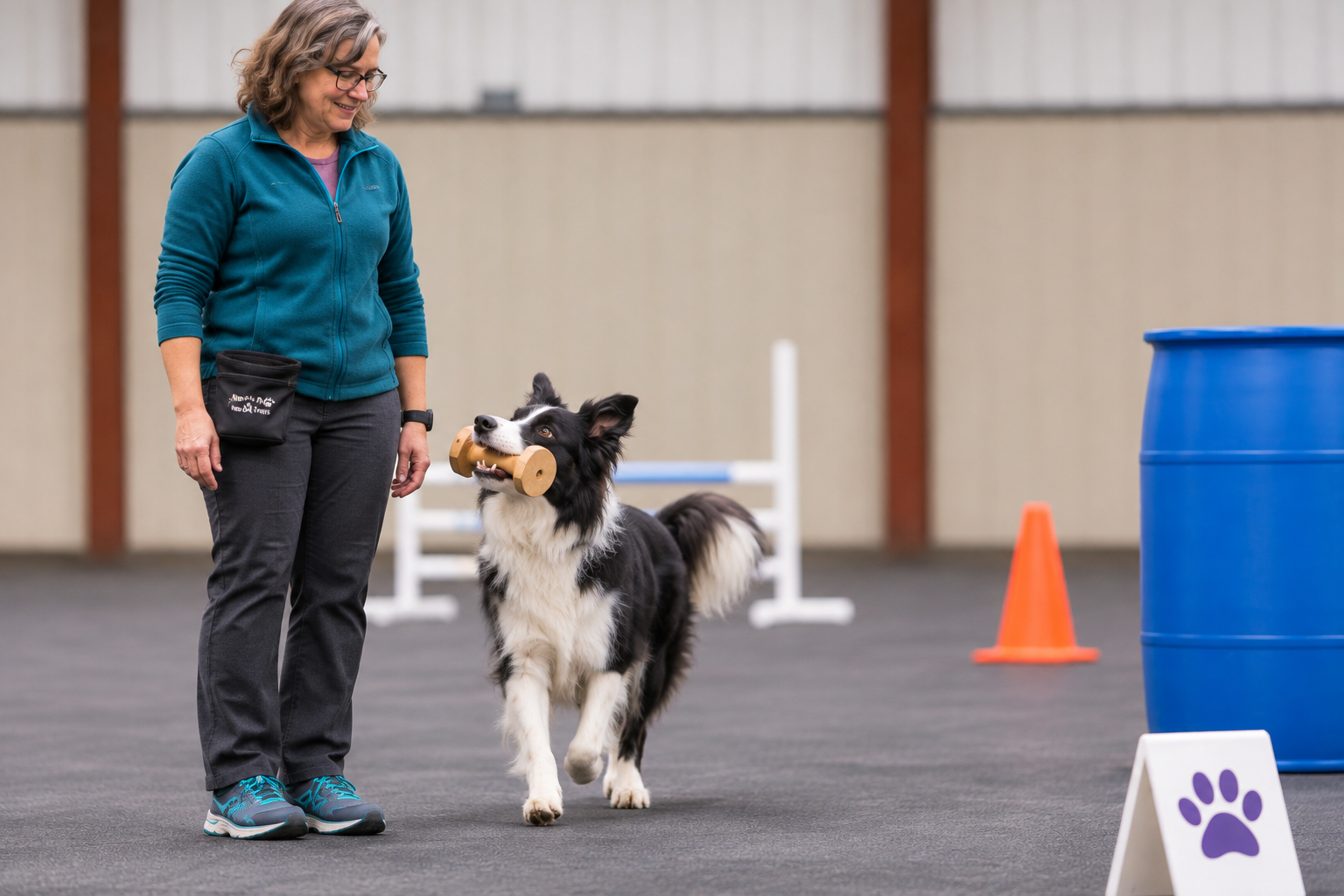
Dog retrieving a dumbbell to it’s owner
Quick Answer
CARO Working Stream is a dog sport offered through the Canadian Association of Rally Obedience (CARO) that challenges dogs and handlers to develop a wide variety of practical and advanced training skills.
Unlike traditional Rally Obedience, where teams navigate a course of numbered signs, Working Stream focuses on teaching and performing individual exercises that test a dog's understanding, confidence, independence and ability to work with their handler.
Depending on the exercise, your dog might learn to:
Retrieve an object.
Identify an object using scent.
Respond to cues from a distance.
Navigate around barrels.
Jump in a particular direction.
Stop and lie down when called.
Move to a designated location.
Think of Working Stream as a collection of training challenges that give both ends of the leash something new to learn.
And here's the best part:
You don't need to have competition goals to enjoy it.
Working Stream can simply be a fun way to challenge your dog, build new skills and discover what you're capable of accomplishing together.
How Does CARO Working Stream Work?
Working Stream is different from the familiar Rally Obedience format.
Rather than navigating a course of numbered signs, teams develop specific exercises that require different combinations of obedience, communication, problem-solving and independent thinking.
Some exercises involve working close to your dog.
Others require your dog to respond accurately while you're standing several feet away.
And some involve your dog making decisions without constant direction from you.
For example:
You might send your dog to retrieve a particular object.
Or ask your dog to move away from you, turn toward a designated jump and complete it on cue.
Another exercise might involve calling your dog toward you and asking them to lie down before they reach you.
Each exercise presents a different training puzzle.
And that's what makes Working Stream so interesting!
What Exercises Are Included in CARO Working Stream?
CARO Working Stream includes ten different exercise areas.
Each one develops a different combination of skills.
1. Drop on Recall
Your dog is called toward you but must respond to a DOWN cue before reaching you.
Sounds simple?
Now imagine your dog enthusiastically running toward you, expecting to arrive for a reward.
Can they interrupt that movement and respond to your cue?
This exercise develops:
Listening while moving.
Impulse control.
Response to cues at a distance.
Reliability during exciting activities.
These are skills that can be useful well beyond the training ring.
2. Scent Discrimination
Your dog learns to identify an object carrying a particular scent among other objects.
Instead of simply retrieving the first object they encounter, they must use their nose to make the correct choice.
This exercise develops:
Scent recognition.
Concentration.
Independent problem-solving.
Confidence.
Careful object selection.
For dogs who enjoy using their noses, this can be particularly rewarding.
3. Designated Retrieve
Your dog learns to retrieve a specific object rather than simply choosing whichever object is closest or most interesting.
This introduces an additional challenge.
Your dog must understand which object you're asking for and respond accordingly.
It's a wonderful opportunity to develop communication, discrimination and thoughtful decision-making.
4. Retrieve on Flat
Your dog learns to retrieve an object and return it to you.
But a reliable retrieve involves more than chasing something and picking it up.
Your dog needs to learn several individual skills:
Move toward the object.
Pick it up.
Hold it comfortably.
Return to the handler.
Deliver it appropriately.
Each part can be taught separately before combining the behaviours.
And no, your dog doesn't need to be a natural retriever to learn!
5. Directed Retrieve
Imagine several objects placed in a row.
Can your dog retrieve the one you indicate?
Directed retrieving challenges your dog's ability to follow information from the handler while making an appropriate choice at a distance.
It develops directional understanding, discrimination and accurate responses to cues.
6. Directed Jumping
In this exercise, your dog learns to take a particular jump based on your direction.
The challenge isn't simply whether your dog can jump.
It's whether they understand which jump you're asking them to take.
Your dog needs to learn to:
Work away from you.
Pay attention to directional information.
Select the correct jump.
Complete the exercise accurately.
This can be a fascinating challenge for handlers who enjoy teaching distance skills.
Jump heights and training expectations should always be appropriate for the individual dog's physical abilities.
7. Distance Signals and Positions
Can your dog SIT, DOWN or STAND when you're standing several feet away?
What if you aren't moving toward them?
What if they need to change positions without creeping forward?
Distance work challenges dogs to respond to verbal or visual cues without relying on their handler being right beside them.
It develops clarity, body awareness and independent understanding of familiar behaviours.
8. Barrel Racing
Yes, barrel racing!
But we're not talking about horses.
Your dog learns to navigate a pattern involving barrels while responding to your directions.
This exercise can develop:
Directional understanding.
Movement around objects.
Confidence working away from the handler.
Accurate responses to cues.
Teamwork.
It's also a great opportunity to make training feel more like a game.
9. Send to Object (retrieve)
Your dog learns to move away from you toward a designated object, pick it up and return to you and release it to your hand.
This may sound straightforward, but working independently at a distance is something dogs need to learn gradually.
At first, you might be standing directly in front of your dog.
Over time, the distance and complexity can increase.
Your dog learns that a cue has meaning even when you're not standing beside them.
10. Impulse Control
Impulse control is woven into so many aspects of dog training.
Working Stream gives us opportunities to challenge those skills in more structured ways.
Your dog may need to:
Wait for information.
Respond despite an exciting distraction.
Resist choosing an incorrect option.
Maintain a behaviour until given another cue.
Think before acting.
The goal isn't to suppress enthusiasm.
It's to help dogs learn how to make thoughtful choices while remaining engaged in the activity.
Is Working Stream the Same as Rally Obedience?
No.
Both sports are offered through CARO, and both develop communication between dogs and handlers.
But the format and training challenges are different.
Rally Obedience involves navigating a course of numbered signs, with each sign directing the team to perform a particular exercise.
Working Stream focuses on individual working exercises involving skills such as retrieving, scent discrimination, distance work and directional understanding.
In Rally, handlers are often thinking:
"Where is the next sign? How do I position myself? What's the next exercise?"
In Working Stream, they might be thinking:
"Does my dog understand which object I want? Can they respond from a distance? Have I taught this exercise clearly enough?"
Both sports challenge the dog-handler team.
They simply do it in different ways.
Does My Dog Need to Know How to Retrieve?
Not necessarily!
One of the biggest misconceptions about Working Stream is that dogs need to arrive already knowing how to retrieve objects.
They don't.
Retrieving can be broken down into small, achievable training steps.
For example:
First, your dog might learn to investigate an object.
Then touch it with their mouth.
Then pick it up.
Then hold it briefly.
Then bring it toward you.
Eventually, those individual skills can become a polished retrieve.
And because we use positive reinforcement, we can make the learning process enjoyable.
Some dogs take to retrieving quickly.
Others need a little more creativity.
Both can make progress.
Is Working Stream Only for Retrieving Breeds?
Absolutely not.
You don't need a Labrador, Golden Retriever or other traditional retrieving breed to enjoy Working Stream.
Dogs of many breeds and mixes can learn these exercises.
A Sheltie might particularly enjoy learning directional cues.
A Terrier might love the problem-solving involved in scent discrimination.
A Border Collie might find distance work especially engaging.
And a mixed-breed companion might surprise everyone with their enthusiasm for retrieving.
Of course, every dog is an individual.
Breed tendencies can influence which activities come naturally, but they don't determine what a dog is capable of learning.
What Skills Should My Dog Have Before Starting Working Stream?
A foundation in basic obedience is helpful.
Ideally, your dog should have some understanding of:
SIT.
DOWN.
STAND.
STAY or WAIT.
RECALL.
Working with their handler.
Responding to simple verbal cues.
Remaining reasonably comfortable around other dogs.
But your dog doesn't need to know all the Working Stream exercises before starting.
That's what training classes are for!
Some dogs will arrive with excellent obedience skills but very little experience retrieving.
Others might love retrieving but have never learned to respond to cues at a distance.
Working Stream provides opportunities to develop both.
Is Working Stream Good Mental Enrichment?
It certainly can be.
Mental enrichment isn't simply about keeping a dog busy.
It's about providing opportunities to think, learn, explore and solve problems.
Working Stream offers a wonderful variety of challenges.
One day, your dog might be learning to identify an object using scent.
Another day, they might be learning to navigate around a barrel.
Another training session might focus on holding a position while you move farther away.
Different exercises require different types of thinking.
And because the exercises can be broken into small training steps, you can adjust the challenge to suit your dog's current abilities.
The goal is to provide an achievable challenge—not frustration.
Can Working Stream Improve Everyday Obedience?
Yes!
Although Working Stream is a dog sport, many of the underlying skills can carry over into everyday life.
Consider a few examples.
Drop on Recall
Learning to respond while moving can strengthen your dog's understanding of cues during exciting situations.
Distance Signals
Your dog learns that SIT, DOWN and STAND still mean the same thing when you're not standing beside them.
Impulse Control
Your dog practises waiting for information rather than immediately acting on the first opportunity.
Send to Object
Your dog develops confidence following directions away from you.
Retrieving
You might even discover that your dog enjoys helping you pick up dropped items!
Of course, learning an exercise in class doesn't automatically make it reliable in every environment.
Those skills still need to be practised in different situations.
But Working Stream provides an excellent foundation.
Does Working Stream Help Build Confidence?
It can.
Confidence often develops when dogs experience manageable challenges and discover that their choices lead to successful outcomes.
Consider a dog who has never picked up an unfamiliar object.
Initially, they may simply look at it.
We reward that curiosity.
Then they investigate it.
We reward that too.
Eventually, they begin interacting with the object more confidently.
Over time, they may learn to pick it up, carry it and retrieve it.
What began as an unfamiliar challenge becomes something the dog understands.
This process can help dogs become more comfortable learning new things.
The important part is adjusting the training to the individual dog rather than expecting them to figure everything out at once.
Is Working Stream Physically Demanding?
Working Stream involves a mixture of mental and physical activities.
Some exercises, such as scent discrimination or stationary distance signals, may be relatively low impact.
Others, including directed jumping and barrel work, involve more physical movement.
The physical demands depend on the particular exercise, the dog's size, age, conditioning and health.
Dogs with orthopedic or mobility concerns may still enjoy selected training activities, but exercises should be adjusted appropriately.
If your dog has a medical condition that could affect participation, speak with your veterinarian or rehabilitation professional.
Recreational training can often be modified, although competition exercises must follow the applicable rules.
Can Older Dogs Enjoy Working Stream?
Potentially, yes!
Older dogs don't necessarily lose their enthusiasm for learning.
Many senior dogs still enjoy:
Problem-solving.
Scent activities.
Learning new cues.
Working with their person.
Practising familiar skills in new ways.
The important consideration is choosing exercises that suit the dog's physical comfort and abilities.
A senior dog might thoroughly enjoy learning scent discrimination or retrieving lightweight objects without needing to participate in more physically demanding exercises.
Training should always be about the individual dog—not simply their age.
What If My Dog Gets Distracted Easily?
Welcome to dog training!
Distraction is something we work through gradually.
Your dog might understand a behaviour perfectly in your living room.
Then you arrive in a training environment with unfamiliar smells, other dogs and interesting equipment.
Suddenly, that familiar behaviour becomes much more difficult.
That doesn't necessarily mean your dog has forgotten what they learned.
It means the environment has changed.
Good training gradually introduces distractions while keeping the exercise achievable.
However, there's an important difference between a dog who is occasionally distracted and one who is overwhelmed or highly reactive.
For dogs experiencing significant fear, anxiety or reactivity, individual training may be more appropriate before participating in group classes.
Do I Have to Compete in Working Stream?
Absolutely not!
You can enjoy Working Stream simply because you like teaching your dog new things.
Some handlers enjoy the process of developing individual exercises.
Others love seeing their dogs solve increasingly complicated training puzzles.
And some discover that they enjoy competition and decide to enter trials.
All are worthwhile goals.
You don't need a title or ribbon to celebrate your dog's progress.
Sometimes the most rewarding moment is watching your dog successfully perform something you weren't sure they could learn.
Why Is Working Stream So Rewarding for Handlers?
One of my favourite things about dog sports is that they remind us how much the human needs to learn too.
Working Stream is a perfect example.
If your dog retrieves the wrong object, we need to ask:
Did they understand which object I wanted?
Was my cue clear?
Did I progress the exercise too quickly?
Have I practised enough with different objects?
Did I accidentally give conflicting information?
Sometimes what looks like a dog making a mistake is actually a gap in our training plan.
And that's useful information!
Working Stream encourages us to become more observant, thoughtful and creative trainers.
Working Stream Isn't About Perfection
When you watch an experienced dog perform a complicated Working Stream exercise, it's easy to think:
"My dog could never do that!"
But you're seeing the finished behaviour.
You aren't seeing all the little training sessions that came before it.
A reliable directed retrieve might begin with simply teaching a dog to touch one object.
Distance signals might begin with asking for a DOWN while standing only a few inches away.
Directed jumping might begin with teaching a dog to move toward a target without any jump involved.
Each successful step becomes the foundation for the next.
The secret isn't expecting more from your dog. It's teaching the individual pieces well enough that the bigger exercise becomes achievable.
What Are the Benefits of CARO Working Stream?
Working Stream can help develop:
✔ Confidence.
✔ Independent thinking.
✔ Scent discrimination.
✔ Retrieving skills.
✔ Directional understanding.
✔ Distance skills.
✔ Impulse control.
✔ Body awareness.
✔ Clear communication.
✔ Response to verbal and visual cues.
✔ Problem-solving.
✔ Handler focus.
✔ Mental enrichment.
✔ Teamwork.
And perhaps most importantly:
It gives you another reason to enjoy spending time training together.
Working Stream vs Agility: What's the Difference?
Both sports can involve working at a distance and following directional cues.
But they're quite different activities.
Agility involves navigating a course of physical obstacles such as jumps, tunnels, weave poles and contact equipment.
Working Stream involves a broader variety of individual training exercises, including retrieving, scent discrimination, distance positions and directional work.
In agility, dogs learn to navigate obstacles accurately and efficiently.
In Working Stream, dogs learn to perform different types of working tasks.
Some dogs and handlers enjoy one sport more than the other.
Many enjoy both!
Working Stream vs Everyday Manners Training
Everyday manners training focuses on behaviours that make living with our dogs easier.
For example:
Can your dog walk politely on leash?
Come when called?
Settle on a bed?
Wait at a doorway?
Working Stream takes some of those foundation skills and asks:
"What else could we teach our dogs to do?"
Can your dog respond to a DOWN cue from a distance?
Retrieve a particular object?
Move to a designated location?
Follow directional information?
It's a natural progression for people who enjoy training and are looking for their next challenge.
Your dog's education doesn't need to end once they've mastered basic manners.
In many ways, that's where the fun begins!
Frequently Asked Questions
What does CARO stand for?
CARO stands for the Canadian Association of Rally Obedience, the organization that offers Rally Obedience and Working Stream competition programs.
Is Working Stream part of Rally Obedience?
Working Stream is offered through CARO but uses a different exercise-based format from traditional Rally Obedience courses.
Does my dog need to know how to retrieve?
No. Retrieving can be taught gradually using positive reinforcement and small training steps.
Can mixed-breed dogs participate?
Yes. Working Stream can be enjoyed by dogs of many breeds and mixes.
Is Working Stream suitable for beginners?
Dogs with basic obedience foundations can begin learning Working Stream skills. The exercises are introduced progressively rather than expecting dogs to perform advanced behaviours immediately.
Is Working Stream good for high-energy dogs?
It can provide valuable mental enrichment and opportunities to develop focus, self-control and problem-solving. Physical exercise, rest and other enrichment are still important.
Do I need special equipment?
Some exercises use equipment such as retrieve objects, scent articles, barrels, targets and jumps. Training classes typically provide opportunities to learn using the appropriate equipment.
Do I have to compete?
No. Working Stream can be enjoyed entirely as a recreational activity.
Can Working Stream help my dog's confidence?
It can. Learning new skills through achievable challenges and positive reinforcement can help dogs become more confident problem-solvers.
Is Working Stream physically demanding?
Some exercises are relatively low impact, while others involve jumping or more active movement. However, the CARO rules allows for jump bars to be placed on the ground for those dogs who need low impact exercises. Activities should be appropriate for the individual dog's physical abilities.
Key Takeaways
✔ CARO Working Stream is a dog sport offered through the Canadian Association of Rally Obedience.
✔ It focuses on individual working exercises rather than navigating a course of Rally signs.
✔ Exercises include retrieving, scent discrimination, distance work, directional skills and impulse control.
✔ Dogs don't need to arrive knowing how to retrieve.
✔ Many breeds and mixed-breed dogs can enjoy the sport.
✔ Working Stream provides mental enrichment and problem-solving opportunities.
✔ The exercises can help strengthen communication between dogs and handlers.
✔ Training can be broken into small, achievable steps.
✔ You don't need to compete to enjoy Working Stream.
✔ It can be a rewarding next step after basic obedience or Rally training.
Most importantly:
Working Stream reminds us that our dogs are capable of learning so much more than SIT, DOWN and STAY.
Sometimes all they need is an opportunity to discover what else they can do.
How Paus-n-Train Can Help
At Paus-n-Train Agility & Obedience, we offer CARO Working Stream classes designed to help dogs and handlers develop these exciting skills using positive reinforcement and science-based training methods.
Our six-week Working Stream programs focus on breaking complicated exercises into manageable training steps so both dogs and handlers can build understanding and confidence.
You'll have opportunities to work on skills such as:
Retrieving and object discrimination.
Scent discrimination.
Distance positions and signals.
Directed jumping.
Barrel work.
Sending your dog to designated locations.
Impulse control.
Developing more reliable responses to cues.
Our classes also include access to digital homework resources so you can review exercises and continue practising between lessons.
For handlers interested in competition, Paus-n-Train also hosts CARO Working Stream trials, providing opportunities to take your training into the competition environment.
But you don't need to compete to participate.
Whether you're looking for a new challenge after Dog Manners, want to expand your Rally Obedience skills or simply enjoy teaching your dog new things, Working Stream offers plenty of opportunities to learn together.
Because training doesn't have to stop when your dog learns the basics. There's always something new to discover!