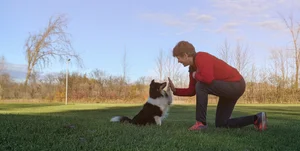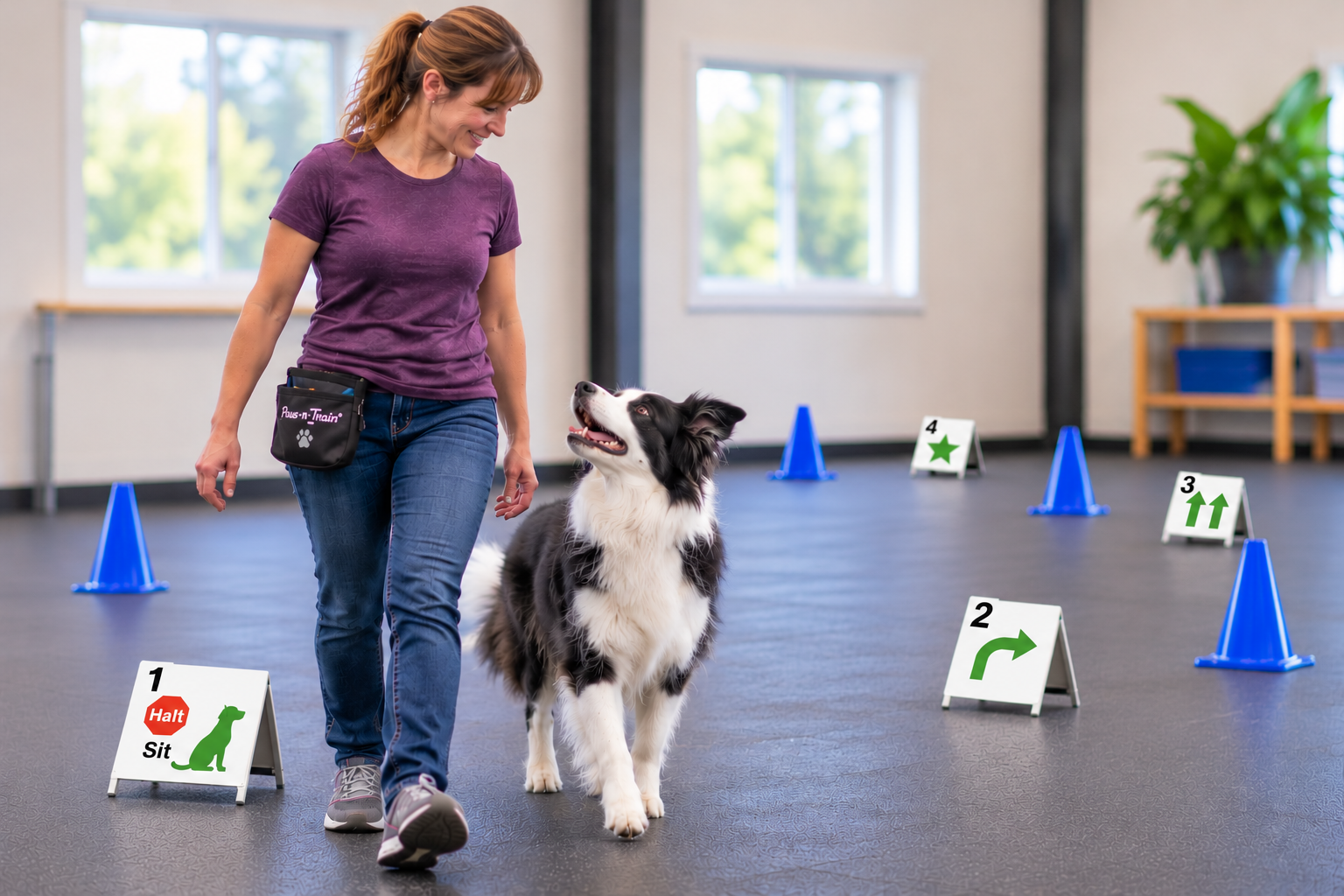
Dog and handler working together through a Rally Obedience course with numbered exercise signs.
Quick Answer
Rally Obedience—often called Rally-O—is a dog sport where you and your dog navigate a numbered course made up of different obedience exercises.
Instead of simply performing a series of traditional obedience exercises in one place, you move together from station to station.
At each station, a sign tells you what to do.
Depending on your level, that might involve:
Sits.
Downs.
Stands.
Turns.
Changes of pace.
Fronts and finishes.
Heeling patterns.
Pivots.
Moving around cones.
More advanced obedience exercises.
Think of Rally as a combination of obedience skills, course navigation and teamwork.
You don't need to have competition goals to enjoy it.
Rally can simply be a fun way to give everyday training more purpose.
How Does Rally Obedience Work?
A Rally course is made up of a series of numbered signs.
You begin at the START sign and work your way through the course in numerical order until you reach FINISH.
Each sign gives you an exercise to perform.
For example, a sign might ask you to:
HALT – SIT
You stop and your dog sits beside you.
Another might ask you to make a particular turn.
Another might involve a change of pace or a more complicated handling sequence.
As you progress through Rally levels, the exercises become increasingly challenging.
The result is something that feels very different from simply standing in a training room practising SIT, DOWN and STAY.
You're putting behaviours together while moving through a course.
Why Is It Called “Rally”?
The sport was designed around the idea of moving through a rally-style course of stations.
Each station presents a new task.
You and your dog need to:
Find the next sign.
Understand the exercise.
Position yourselves appropriately.
Perform the behaviour.
Continue to the next station.
So while your dog is working, you have a job too.
That's one of the things that makes Rally so much fun.
Is Rally the Same as Traditional Obedience?
No.
The two sports share many obedience skills, but the presentation is different.
Traditional obedience generally involves performing specific exercises according to a prescribed routine.
Rally uses individual exercises to create a course.
That adds another layer for the handler.
You aren't simply thinking:
“Can my dog heel?”
You're thinking:
“Where is my next sign? What does it ask us to do? Where do I need to be? How do I set my dog up successfully?”
It's obedience with a navigation challenge added.
Is Rally Just About Heelwork?
Heelwork is an important part of Rally, but Rally is much more than walking beside your dog.
As you progress, exercises can challenge:
Position changes.
Body awareness.
Handler focus.
Impulse control.
Distance skills.
Directional understanding.
Precision.
Communication.
Fluency between behaviours.
One station may be fairly simple.
The challenge comes from putting many different skills together into a smooth course.
What Skills Does My Dog Need Before Starting Rally?
You don't need a competition-ready obedience dog to begin learning Rally.
Foundation skills are helpful, such as:
Attention to the handler.
SIT.
DOWN.
STAND.
Beginning heel position.
Moving with the handler.
Following simple cues.
Working around appropriate distractions.
But these skills don't need to be perfect before you start.
Rally class is where you develop them.
A beginner doesn't need to walk through the door already knowing how to perform an entire course.
What Does a Rally Sign Look Like?
Rally signs are placed in holders around the course.
Each sign contains instructions or a diagram showing the exercise to perform.
Learning to read the signs is part of learning Rally.
At first, this can feel like learning a new language.
You may find yourself thinking:
“Wait—which way am I supposed to turn?”
That's normal!
As you become familiar with the exercises, reading the course becomes much easier.
Eventually, you begin to recognize signs at a glance and can focus more on preparing your dog for what comes next.
The Handler Has to Learn Too
One of the things I love about Rally is that it's very clearly a team sport.
Your dog isn't the only student.
Handlers need to learn:
What each sign means.
Where to position themselves.
How to perform the exercise correctly.
When to cue their dog.
How to prepare for the next station.
How to move smoothly through a course.
Sometimes the dog understands the exercise perfectly.
The human reads the sign incorrectly.
That's part of the fun!
Mistakes give us information about what both ends of the leash need to practise.
Why Is Rally Good for Everyday Dogs?
Rally gives familiar manners and obedience behaviours a purpose.
Consider a few skills you might already be practising:
SIT
DOWN
STAND
WAIT
Walking beside you
Turning with you
Individually, those behaviours may not feel terribly exciting.
Put them into a Rally course and suddenly they become part of a puzzle.
Instead of doing ten sits in a row, you might:
Heel → turn → halt and sit → move forward → change pace → perform another exercise.
That variety can make training much more engaging for both dog and handler.
Rally Can Improve Communication
Rally asks dogs to pay attention to subtle information from their handlers.
Your dog may need to notice:
Changes in your direction.
Changes in your speed.
Your body position.
Verbal cues.
Hand signals.
Where reinforcement may occur.
Handlers become more aware too.
You begin noticing:
Was my cue clear?
Did I turn too quickly?
Did I give my dog enough information?
Was my dog actually ready before I moved?
Rally can make us much more thoughtful trainers.
Rally Can Build Better Heelwork
If walking in heel position feels repetitive, Rally can make it much more interesting.
Instead of simply walking around a room, you may be:
Turning.
Stopping.
Changing pace.
Moving around objects.
Changing direction.
Preparing for the next exercise.
Your dog learns that staying connected with you predicts something interesting.
For many teams, that makes heelwork feel much more like a game.
Is Rally Good for Dogs Who Get Bored Easily?
It can be.
Rally courses change.
Exercises change.
The dog needs to listen for different information rather than simply repeating one behaviour.
A dog might perform a SIT at one station and then need to move immediately into another exercise.
That variety can be very engaging.
Of course, dogs are individuals.
Some dogs adore Rally.
Others may prefer agility, Hoopers, scent-based activities or another sport.
There's no single dog sport that's perfect for every dog.
Is Rally Physically Demanding?
Compared with sports involving jumping or high-speed obstacle work, Rally is generally less physically demanding.
However, that doesn't mean physical comfort is irrelevant.
Depending on the level and exercises, dogs may perform:
Sits.
Downs.
Stands.
Turns.
Pivots.
Changes of pace.
Repeated position changes.
For dogs with orthopedic, mobility or other health concerns, discuss appropriate activities with your veterinarian or rehabilitation professional.
Training can often be adapted recreationally, but your dog's comfort should always come first.
Can Senior Dogs Do Rally?
Potentially, yes.
Because Rally doesn't require the same type of jumping and obstacle performance as agility, some older dogs may enjoy continuing to train through Rally.
The individual dog's health matters more than their age alone.
An older dog may still thoroughly enjoy:
Learning.
Working with their person.
Navigating courses.
Solving training puzzles.
Exercises and expectations should always be appropriate for the individual dog.
Is Rally Good for Young Dogs?
Rally foundations can also be valuable for younger dogs.
You can work on skills such as:
Engagement.
Position.
Following movement.
Body awareness.
Short duration.
Focus around distractions.
You don't need to rush into long or complicated courses.
Foundation skills can be developed gradually as your dog matures.
What If My Dog Isn't Perfect Around Other Dogs?
Your dog doesn't need to love every other dog to enjoy a dog sport.
In fact, one useful skill dogs can develop in training classes is learning:
“Other dogs are here, but I'm working with my person.”
However, there's a difference between a dog who is occasionally distracted by another dog and a dog who is overwhelmed or highly reactive in a group environment.
The training environment still needs to be appropriate for the individual dog.
Do Dogs Interact With Each Other During Rally?
They don't need to.
Rally is about the relationship between you and your dog.
Dogs don't need to greet or play with other dogs in order to participate.
Being able to work calmly while other dogs are present is much more useful than believing every dog in the room is available for interaction.
Do I Have to Compete?
Absolutely not.
You can learn Rally simply because it's fun.
Some people enjoy:
Learning the signs.
Developing better heelwork.
Running practice courses.
Improving communication.
Giving their dog a mental challenge.
Others discover that they love the sport and decide to compete.
Both are completely valid.
You don't need a title or ribbon for Rally training to be worthwhile.
What Happens at a Rally Trial?
At a Rally trial, a course is designed using signs appropriate for the competition level.
Handlers typically have an opportunity to walk the course without their dogs before competing.
This gives you time to:
Find the signs.
Plan your path.
Review the exercises.
Decide where you'll need to position yourself.
Think about how you'll handle particular stations.
Then you and your dog enter the ring and perform the course together.
Your performance is scored according to the rules of the organization hosting the trial.
What Is CARO Rally Obedience?
At Paus-n-Train, we train and host events using CARO Rally Obedience.
CARO stands for the Canadian Association of Rally Obedience.
CARO Rally provides a progression of levels that allows teams to develop increasingly advanced skills as they gain experience.
You can start with foundation Rally skills and continue progressing into more challenging levels and exercises.
That progression gives teams something new to work toward without requiring everyone to have competition goals.
Is Rally Difficult?
Rally can be as challenging as you want it to be.
At the beginning, you may be working on:
Can my dog find heel position?
Later you might be thinking:
Can my dog maintain position while I perform this turn, transition smoothly into the next exercise and then respond correctly to another cue?
As your skills improve, the challenges change.
That's what keeps the sport interesting.
Rally Isn't About Perfection
When people first see an experienced Rally team, it's easy to think:
“My dog could never do that.”
But you're seeing the finished behaviour—not all the training that came before it.
Every polished exercise began with a much easier version.
Good Rally training breaks skills into manageable pieces.
You might work on:
Finding heel position.
Then:
Taking one step in heel.
Then:
Several steps.
Then:
A turn.
Then:
A sequence.
Eventually, those individual pieces become a course.
What Are the Benefits of Rally Obedience?
Rally can help develop:
✔ Handler focus.
✔ Heelwork.
✔ Body awareness.
✔ Impulse control.
✔ Clear communication.
✔ Response to verbal and visual cues.
✔ Confidence.
✔ Training around distractions.
✔ Precision.
✔ Teamwork.
✔ Mental enrichment.
And perhaps most importantly:
It gives you another reason to train together.
Rally vs Agility: What's the Difference?
Both sports involve navigating a course, but they're very different activities.
Agility uses physical obstacles such as:
Jumps.
Tunnels.
Weave poles.
Contact equipment.
Rally uses signs that direct you to perform obedience exercises.
In agility, you're navigating obstacles.
In Rally, you're navigating training challenges.
Some dogs and handlers enjoy one more than the other.
Many enjoy both.
Rally vs Traditional Manners Training
Everyday manners training asks:
Can my dog perform useful behaviours in daily life?
Rally asks:
Can we take some of those behaviours, improve them, combine them and navigate a course together?
That makes Rally a natural next step for people who enjoy training and wonder:
“What can we do after manners class?”
Your dog's training doesn't have to end once they can sit, walk politely and come when called.
Those foundation skills can become the beginning of something new.
Frequently Asked Questions
What does Rally-O stand for?
Rally-O is short for Rally Obedience.
Does my dog need obedience training before starting Rally?
Basic foundation skills are helpful, but your dog doesn't need to be competition-ready. Rally training itself develops many of the skills you'll need.
Is Rally only for purebred dogs?
No. Dogs of many breeds and mixes can enjoy Rally.
Does my dog have to compete?
No. Rally can be enjoyed entirely as a recreational activity.
Is Rally good mental enrichment?
Yes. Dogs need to listen for different cues, change behaviours and work with their handler through varying exercises.
Handlers get a mental workout too!
Is Rally suitable for older dogs?
It may be appropriate for many older dogs because it doesn't involve the same jumping demands as agility. Health, mobility and comfort should still be considered individually.
Can Rally help my dog's everyday manners?
It can help strengthen skills such as attention, position changes, handler focus, impulse control and working around distractions.
Do dogs have to greet each other in Rally class?
No. Dogs can learn to work around one another without interacting.
Is Rally easy?
The foundation exercises can be approachable for beginners, but the sport provides plenty of opportunity for increasing complexity and precision as teams progress.
Key Takeaways
✔ Rally Obedience is a dog sport involving a course of numbered signs.
✔ Each sign asks the dog-handler team to perform a particular exercise.
✔ Rally combines obedience, course navigation and teamwork.
✔ The handler needs to learn the signs too.
✔ Dogs don't need to interact with other dogs.
✔ Rally can make familiar obedience skills much more interesting.
✔ You don't need a competition-ready dog to start learning.
✔ Rally can improve communication, heelwork, focus and body awareness.
✔ You don't have to compete to enjoy Rally.
✔ Dogs of different ages and breeds can participate when the activity is physically appropriate.
✔ Rally can be a great next step after manners training.
Most importantly:
Rally turns training into something you and your dog do together—not simply something you ask your dog to do.
How Paus-n-Train Can Help
At Paus-n-Train, we offer CARO Rally Obedience training from Novice through Versatility Excellent, allowing teams to continue developing their skills as they progress.
Our Rally classes are designed to help handlers understand not only what the signs mean, but how to train the individual skills needed to perform them successfully.
You'll work on areas such as:
Heel position.
Handler focus.
Position changes.
Turns and movement.
Sign exercises.
Course navigation.
Increasing reliability around distractions.
Building increasingly complex Rally skills.
Our Rally programs include digital homework resources so you can review exercises and continue practising between classes.
For teams who discover they enjoy competition, Paus-n-Train also hosts CARO Rally trials, giving students an opportunity to take the skills they've developed in class into the trial environment.
But competition isn't required.
You can learn Rally simply because you enjoy training with your dog.
Whether your goal is your first Rally course, your next title or simply finding a new activity to enjoy together, Rally gives you something that can be surprisingly addictive:
There's always another skill to learn.