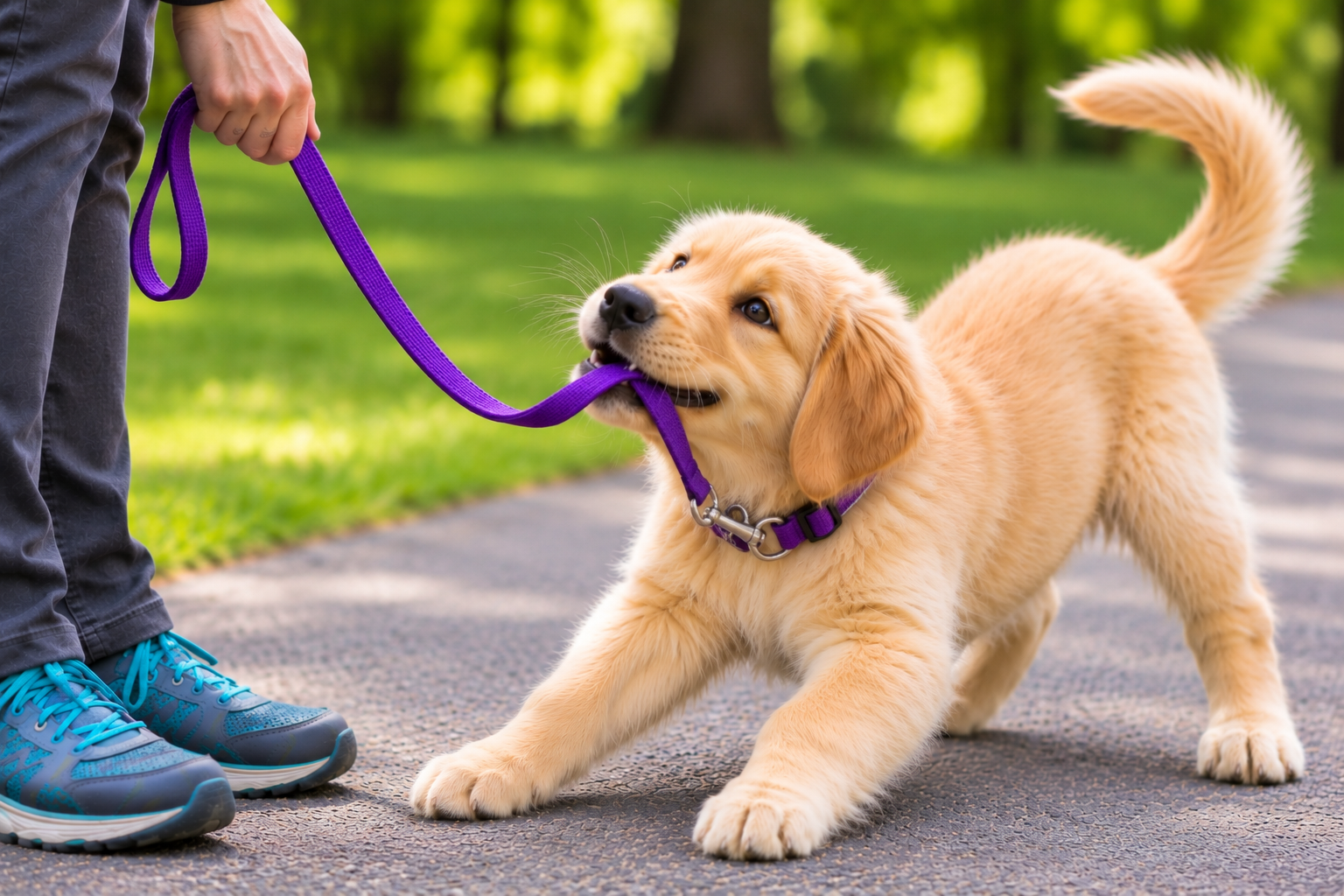
Leash biting is common in puppies and may be caused by excitement, frustration, teething or overstimulation.
Does your puppy grab, chew or play tug-of-war with their leash during walks? Discover why puppies bite the leash and how to teach them better walking habits using positive reinforcement.
Quick Answer
Puppies bite their leashes for several reasons, including excitement, frustration, teething, playfulness and difficulty managing their emotions.
For some puppies, a dangling leash looks like an irresistible tug toy. For others, grabbing the leash is a response to being overwhelmed, tired or frustrated when they can't reach something interesting.
Leash biting is common during puppyhood, but it can quickly become a frustrating habit if we accidentally reinforce it.
The solution isn't to punish your puppy or wrestle the leash away.
Instead, we want to:
Identify what's triggering the behaviour.
Prevent opportunities to practise leash biting.
Teach appropriate alternatives.
Reward walking with a loose leash.
Help your puppy manage excitement and frustration.
The goal isn't simply to stop your puppy from biting the leash. It's to teach them what we'd like them to do instead.
Why Do Puppies Bite Their Leashes?
Leash biting can look similar from one puppy to another, but the motivation behind the behaviour may be quite different.
Understanding what's happening before your puppy grabs the leash helps us choose the most effective training approach.
1. The Leash Looks Like a Toy
Puppies love exploring the world with their mouths.
A leash that swings, bounces or moves across the ground can look very much like a tug toy.
And what happens when your puppy grabs it?
You might pull back.
Your puppy pulls harder.
Suddenly, you've created a wonderful game of tug!
From your puppy's perspective, this might be the most entertaining part of the walk.
2. Your Puppy Is Overexcited
Some puppies grab the leash when their excitement levels become difficult to manage.
You might notice leash biting:
When you first leave the house.
When another dog passes.
After greeting someone.
During an exciting training session.
When heading home from a walk.
Your puppy may be struggling to regulate their excitement and redirecting that energy onto the leash.
3. Your Puppy Is Frustrated
Imagine your puppy spots another dog across the street.
They want to go say hello.
But the leash prevents them from getting there.
They pull, become frustrated and suddenly grab the leash.
This is sometimes called redirected frustration.
Your puppy isn't necessarily trying to be difficult. They're struggling with the disappointment of not being able to do something they want.
4. Your Puppy Is Teething
Puppies explore objects with their mouths, and chewing can be particularly appealing during teething.
A leash provides an interesting texture that's conveniently available during walks.
However, not all leash biting is related to teething.
If your puppy consistently grabs the leash during exciting or frustrating situations, their emotional state may be a more important factor.
5. Your Puppy Is Tired or Overwhelmed
Have you ever noticed that your puppy becomes particularly bitey toward the end of a walk?
Young puppies have limited stamina and are still learning how to cope with stimulation.
An outing that seems short to us may involve an enormous amount of information for a puppy to process.
New smells, unfamiliar sounds, passing vehicles and other dogs can all contribute to their stress bucket.
When your puppy becomes overtired or overstimulated, leash biting may be one of the first signs that they've had enough.
Sometimes the solution isn't more training.
It's a shorter walk and a good nap!
Why Does My Puppy Bite the Leash When I Try to Walk?
One common trigger is tension on the leash.
Imagine your puppy wants to investigate an interesting smell.
You continue walking.
The leash becomes tight.
Your puppy feels the restriction and grabs the leash.
They may be attempting to interact with the thing that's preventing them from moving where they want to go.
Some puppies also learn that grabbing the leash causes their handler to stop, turn around or pay attention to them.
If the behaviour consistently produces an interesting result, it may become more frequent.
This is why teaching loose leash walking skills is so valuable.
When puppies understand how to move with us and what to do when the leash becomes tight, they're less likely to become frustrated by the equipment.
What Should I Do When My Puppy Grabs the Leash?
First, avoid turning the situation into a tug-of-war.
Pulling against your puppy often makes the leash move more, which can increase their excitement and encourage them to grip harder.
Instead, try the following:
Stop walking. Avoid continuing to move while your puppy is pulling on the leash.
Keep the leash as still as possible. Don't deliberately tug or jerk it.
Reward the release. Once your puppy lets go, reinforce that choice.
Create an opportunity to calm themselves. Once they’ve let go of the leash, scatter a few treats on the ground and encourage them to FIND IT.
Resume calmly. Take a few easy steps and reward walking with a loose leash.
If your puppy immediately grabs the leash again, consider whether they're too excited, frustrated or tired to continue.
Move to a quieter location or end the outing if possible.
Important: Avoid repeatedly using treats to negotiate with your puppy after every leash grab. We don't want to accidentally create a pattern of "grab the leash, receive a treat."
Instead, focus on rewarding appropriate walking before your puppy begins biting.
How Do I Prevent My Puppy From Biting the Leash?
Prevention is one of the most effective ways to address leash biting.
Every time your puppy practises grabbing and tugging on the leash, they become more experienced at that behaviour.
We want to interrupt that learning pattern by making appropriate behaviour easier and more rewarding.
Step 1: Start With Calm Leash Introductions
Before heading outside, practise putting your puppy's leash on in a quiet environment.
Reward your puppy for:
Remaining calm while you attach the leash.
Keeping their mouth away from the leash.
Standing or sitting comfortably.
Taking a few steps with you.
If attaching the leash immediately triggers excitement, slow down the process.
Your puppy doesn't need to be bouncing around the doorway before every walk.
Step 2: Reward Loose Leash Walking
Begin in a familiar, low-distraction environment.
With your puppy on leash:
Take one or two steps.
Reward your puppy for moving with you.
Continue for another few steps.
Reward again while the leash remains loose.
Gradually build the number of steps between rewards.
Initially, we want to make staying within the range of the leash very rewarding.
Don't wait until your puppy has walked an entire block before reinforcing them.
A few successful steps are worth celebrating!
Step 3: Teach Your Puppy What Leash Tension Means
At Paus-n-Train, we teach a Tight Leash Game to help dogs understand how to respond when they feel gentle tension on their leash.
Rather than pulling against the leash, we want puppies to learn that moving toward their handler releases the tension and earns reinforcement.
Begin in a quiet environment where your puppy can concentrate.
Gradually practise with more distractions as their understanding improves.
This gives your puppy an alternative to becoming frustrated when the leash becomes tight.
Step 4: Reinforce Offered Check-Ins
An offered check-in happens when your puppy chooses to look toward you or reconnect with you without being called.
These moments are incredibly valuable.
Your puppy might be sniffing the grass, then suddenly look up at you.
Reward that!
Over time, your puppy learns that paying attention to you during walks is worthwhile.
This helps build the connection we want before distractions become too exciting.
Step 5: Keep Walks Appropriate for Your Puppy
Young puppies don't need long walks to become tired.
Exploring, sniffing, learning and processing new experiences can be mentally demanding.
Instead of focusing on distance, consider the quality of the outing.
A short walk with plenty of opportunities to sniff and practise a few simple skills may be far more beneficial than a long walk that leaves your puppy exhausted and overstimulated.
Should I Give My Puppy a Toy to Carry Instead?
For some puppies, carrying an appropriate toy can provide a useful alternative to grabbing the leash.
This can be particularly helpful for puppies who enjoy carrying objects.
You might teach your puppy to pick up and carry a soft toy during short, supervised activities.
However, be careful not to introduce the toy only after your puppy starts biting the leash.
We want carrying the toy to become an enjoyable, independent behaviour rather than part of a chain that begins with leash biting.
And remember that a toy won't necessarily solve leash biting caused by fear, frustration or overstimulation.
We still need to address the underlying reason for the behaviour.
Why Does My Puppy Bite the Leash More on the Way Home?
This is a common pattern.
Your puppy may have managed their excitement beautifully during the first part of the walk.
But as the outing continues, they become tired.
Their ability to concentrate decreases.
Their frustration tolerance drops.
Suddenly, they're jumping, grabbing the leash and behaving like a little alligator!
Rather than assuming your puppy needs more exercise, try shortening the walk.
If leash biting usually begins after 15 minutes, consider returning home after 10 minutes.
Gradually increase the duration as your puppy develops the ability to cope with longer outings.
A successful short walk is much more valuable than a long walk that ends in frustration.
What If My Puppy Jumps Up and Bites the Leash and My Clothes?
Sometimes leash biting escalates into grabbing clothing, jumping or nipping at the handler.
This can happen when a puppy becomes extremely excited, frustrated or overwhelmed.
If this occurs:
Avoid yelling, pushing or wrestling with your puppy.
Keep your movements calm and minimize opportunities for tugging.
Use a treat scatter if your puppy can respond safely.
Create distance from whatever may be contributing to their excitement.
End the activity and provide an opportunity to rest.
If this happens frequently, your puppy may need a more structured training and management plan.
It's also worth considering whether your puppy is getting enough sleep.
Many young puppies need approximately 16–20 hours of sleep in a 24-hour period, although individual needs vary.
A puppy who is consistently overtired may struggle with impulse control in many situations—not just on walks.
Should I Use a Bitter Spray on the Leash?
We don't recommend relying on unpleasant tastes or other aversive methods to address leash biting.
While these approaches may discourage some puppies from putting the leash in their mouths, they don't teach the puppy how to walk appropriately or address the reason for the behaviour.
They may also create negative associations with walking equipment.
Instead, focus on prevention, reinforcement and teaching alternative behaviours.
If your puppy is chewing through leashes, supervise closely and replace damaged equipment. A weakened leash can become a serious safety concern or consider using a chain style leash so they cannot bite through and escape.
Can My Puppy's Harness or Collar Contribute to Leash Biting?
Sometimes.
If your puppy finds their walking equipment uncomfortable, they may attempt to bite or interact with it.
Check that:
Their harness fits appropriately.
Straps aren't rubbing or restricting movement.
The leash attachment isn't creating unnecessary discomfort.
Their collar isn't too tight.
The equipment isn't damaged.
Some puppies may also be uncomfortable with the process of putting equipment on.
In those cases, gradual cooperative care training can help them develop positive associations with wearing a harness or collar.
If leash biting begins suddenly or is accompanied by signs of pain or discomfort, consult your veterinarian.
How Long Does It Take to Stop Puppy Leash Biting?
That depends on why the behaviour is happening, how frequently your puppy has practised it and how consistently you address the underlying triggers.
A puppy who occasionally grabs a dangling leash during play may improve relatively quickly when the leash is managed differently and appropriate walking is reinforced.
A puppy who bites the leash because of significant frustration or anxiety may require a more comprehensive approach.
Rather than measuring success only by whether your puppy bites the leash, look for improvements such as:
Walking farther before becoming excited.
Responding more easily to familiar cues.
Offering more check-ins.
Recovering more quickly after distractions.
Choosing to walk with a loose leash.
Showing fewer episodes of leash grabbing.
Progress isn't always perfectly linear.
Your puppy is growing, developing and learning to manage an increasingly complicated world.
Frequently Asked Questions
Is it normal for puppies to bite their leashes?
Yes. Leash biting is common during puppyhood, particularly when puppies are excited, teething, frustrated or overtired.
Should I pull the leash out of my puppy's mouth?
Avoid tugging against your puppy, as this can turn leash biting into an exciting game. Instead, encourage your puppy to disengage and reward appropriate alternatives.
Will my puppy grow out of leash biting?
Some puppies reduce the behaviour as they mature, but behaviours that are repeatedly reinforced can become established habits. Teaching appropriate walking skills is more reliable than waiting for the behaviour to disappear.
Why does my puppy bite the leash when they see another dog?
Your puppy may be excited, frustrated or overwhelmed. Increasing distance from the other dog and rewarding calm observation can help.
Can teething cause leash biting?
Yes. Puppies may find chewing appealing during teething, but leash biting can also be influenced by excitement, frustration and learned behaviour.
Should I stop walking when my puppy bites the leash?
Stopping can help prevent the leash from becoming an exciting moving target. Once your puppy disengages, reward appropriate behaviour and resume calmly if they're ready.
Is leash biting a sign of aggression?
Usually not. In puppies, leash biting is more commonly associated with play, excitement, frustration or overstimulation. However, repeated intense behaviour, especially when directed toward people, may warrant professional assessment.
Key Takeaways
✔ Puppies may bite the leash because of play, teething, excitement, frustration or fatigue.
✔ Pulling against the leash can accidentally create a tug-of-war game.
✔ Prevention is easier than trying to interrupt an established habit.
✔ Reward loose leash walking, offered check-ins and appropriate choices.
✔ Teach your puppy how to respond to gentle leash tension.
✔ Keep walks short enough that your puppy can remain comfortable and successful.
✔ Use management and appropriate alternatives rather than punishment.
✔ If leash biting becomes frequent or intense, consider the underlying emotional triggers.
Most importantly:
Your puppy isn't trying to make walks difficult. They're still learning how to manage their excitement, understand their equipment and navigate the world around them.
With thoughtful training and a little patience, walks can become much more enjoyable for both ends of the leash!
How Paus-n-Train Can Help
At Paus-n-Train Agility & Obedience, we help puppies and their families develop practical walking skills using positive reinforcement and science-based training methods.
Our Puppy Prep School program focuses on building the foundations for enjoyable walks, including:
Introducing the leash and harness.
Teaching the Tight Leash Game.
Rewarding loose leash walking.
Developing offered check-ins.
Building engagement around distractions.
Understanding puppy excitement and frustration.
Managing puppy nipping and other common puppy behaviours.
Developing calmness and impulse control.
Our comprehensive 10-week program includes in-person training, digital homework resources and a prepaid private training session for additional support with your individual training challenges.
For families who prefer to learn at home, our Puppy Prep School OnDemand program provides access to training lessons and resources you can work through at your own pace.
And for older puppies and adolescent dogs, our Dog Manners program also addresses loose leash walking, impulse control and everyday manners.
Whether your puppy is just learning to wear a leash or has already discovered the joys of tugging on it, we're here to help you build better walking habits.
Because enjoyable walks don't happen by accident. They're skills we teach, practise and reinforce together.