How Do I Crate Train My Puppy?
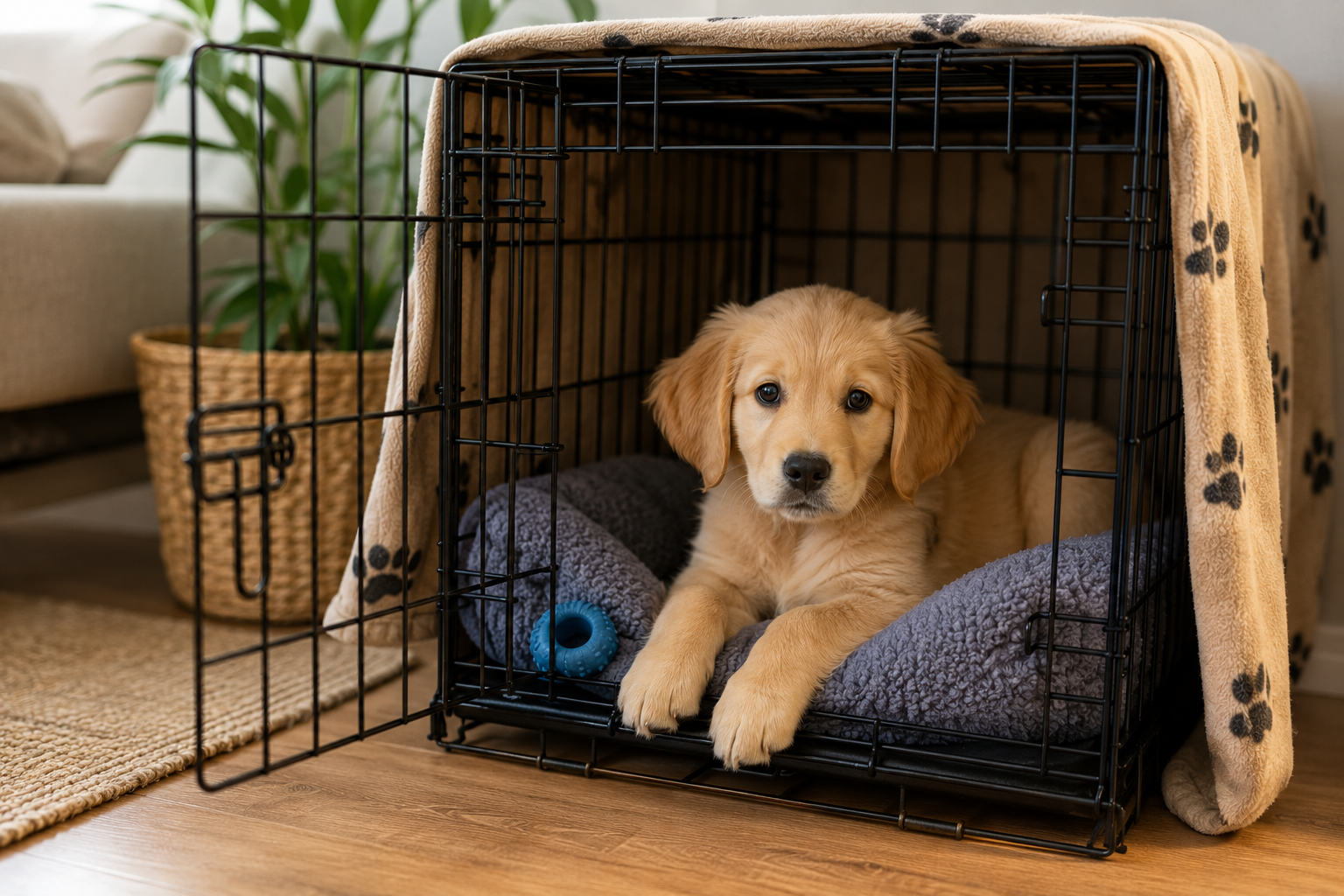
Cozy puppy in an open crate
Quick Answer
Crate training should teach your puppy that their crate is a safe, comfortable and predictable place to relax—not somewhere they're sent because they've done something wrong.
Start with the crate door open and allow your puppy to explore voluntarily. Pair the crate with food, treats, chews, stuffed food toys and rest. Once your puppy is comfortable entering, gradually introduce very short periods with the door closed before slowly building duration and distance.
The goal isn't simply to teach your puppy to tolerate being confined.
We want them to feel safe there.
At a Glance
For successful crate training:
Choose an appropriately sized crate.
Place it somewhere your puppy doesn't feel isolated.
Allow your puppy to explore voluntarily.
Feed meals in or near the crate.
Provide special enrichment activities in the crate.
Practise closing the door for very short periods.
Build duration gradually.
Practise while you're still nearby before leaving the room.
Give your puppy regular bathroom, exercise and social opportunities.
Never use the crate as punishment.
Don't leave a distressed puppy to "cry it out."
Think of crate training as teaching relaxation—not simply teaching confinement.
Why Crate Train a Puppy?
A crate can be an incredibly useful life skill.
Even if you don't plan to crate your adult dog regularly, there may be times throughout their life when confinement becomes necessary.
Your dog may encounter a crate:
At the veterinarian.
Following surgery or injury.
While travelling.
At a groomer.
During emergencies or evacuations.
At dog sports or competitions.
While visiting unfamiliar places.
Teaching your puppy that confinement is safe and predictable can make these situations considerably less stressful later in life.
A crate can also be useful during puppyhood for:
Housetraining.
Preventing unsafe chewing.
Encouraging appropriate rest.
Managing the environment when direct supervision isn't possible.
Helping an overtired puppy settle.
But those benefits depend on the puppy having a positive relationship with the crate.
Start With the Right Crate
There are several crate styles available, including:
Wire crates.
Plastic airline-style crates.
Soft-sided crates.
Fabric travel crates.
There isn't one type that's perfect for every dog.
For young puppies, wire or sturdy plastic crates are often practical because they're easy to clean and secure.
Your puppy should have enough room to:
Stand comfortably.
Turn around.
Lie down naturally.
Many wire crates include dividers so the space can grow with your puppy.
Where Should I Put the Crate?
Dogs are social animals.
Placing a new puppy's crate alone in a distant part of the house may make settling considerably harder.
Initially, consider placing the crate somewhere your family spends time.
During the day, this might be:
The living room.
Kitchen.
Home office.
At night, many puppies benefit from having their crate close to where their people sleep.
Your puppy has recently left their mother, littermates and familiar environment. Expecting them to suddenly feel comfortable sleeping alone on another floor of the house can be a very big ask.
You can always gradually change the crate's location later.
Step 1: Let Your Puppy Discover the Crate
Begin with the crate door securely open.
Allow your puppy to investigate without pressure.
You can:
Toss treats near the crate.
Toss treats just inside.
Place treats farther toward the back.
Put a favourite toy inside.
Feed meals near the entrance.
Let your puppy choose whether to enter.
Avoid pushing, pulling or placing your puppy inside and immediately shutting the door.
We want your puppy to discover:
"Interesting things happen when I go in here."
Step 2: Make the Crate Valuable
Some of your puppy's favourite things can happen in the crate.
Try offering:
Meals.
Food-stuffed toys.
Lickable enrichment.
Safe chews.
Scatter-fed treats.
Part of your puppy's daily food allowance.
You can even occasionally place treats inside the crate when your puppy isn't looking.
Imagine your puppy wandering past, checking inside and unexpectedly discovering a treat.
That little surprise can make checking the crate worthwhile.
Step 3: Don't Rush to Close the Door
One of the most common crate-training mistakes is progressing too quickly.
A puppy walks inside.
The human thinks:
"Great! They like the crate!"
The door closes.
The human leaves.
The puppy panics.
Entering a crate and being comfortable confined in a crate are two different skills.
Spend time building value for going inside before adding longer periods behind a closed door.
Step 4: Introduce the Door Gradually
Once your puppy is happily entering the crate, begin introducing movement of the door.
You might:
Touch the door.
Reward your puppy.
Move the door slightly.
Reward.
Close it briefly.
Reward.
Immediately open it again.
Initially, the door may only be closed for a second.
That's okay.
We aren't testing how long your puppy can tolerate the crate.
We're teaching them that the door closing isn't something to worry about.
Step 5: Build Duration Slowly
Once your puppy remains relaxed with the door closed briefly, gradually increase the amount of time.
Think:
Seconds before minutes.
Minutes before longer periods.
You might give your puppy a food-stuffed toy, close the door, sit nearby and quietly read or work.
Open the door again before your puppy becomes distressed whenever possible.
Over time, the crate becomes associated with relaxation rather than waiting anxiously to be released.
For most puppies, this entire early learning phase moves much faster than people expect. When we keep sessions short, positive and well-paced, many puppies are comfortably entering, settling and coping with a closed door within just a couple of days with consistent practice.
Step 6: Add Distance Separately
Duration and distance are different challenges.
Your puppy might be perfectly comfortable in their crate for 15 minutes while you're sitting beside them but become worried when you disappear around the corner.
Once they're comfortable with duration, begin introducing tiny amounts of distance.
For example:
Stand up and sit back down.
Take one step away.
Walk across the room.
Leave the room for one second.
Return.
Gradually increase the time you're out of sight.
Keep early repetitions easy.
What If My Puppy Cries in the Crate?
First, ask why your puppy is crying.
They may:
Need to toilet.
Be frightened.
Feel isolated.
Be overtired.
Be uncomfortable.
Need exercise or interaction.
Have progressed too quickly in training.
Crying is communication.
It's information—not misbehaviour.
"But Won't I Reward Crying If I Let Them Out?"
This concern causes many puppy owners unnecessary stress.
There's an important difference between teaching a behaviour and responding to genuine distress.
If your puppy is mildly fussing because they'd prefer to be somewhere else, you may be able to wait for a brief moment of quiet before opening the door.
But if your puppy is becoming increasingly distressed, panicking, screaming, biting at the crate, drooling excessively or desperately trying to escape, don't simply wait them out.
At that point, your training plan is too difficult.
Help your puppy, then make the next training session considerably easier.
Our goal is not:
"My puppy eventually stopped crying."
Our goal is:
"My puppy feels comfortable being in their crate."
Those are very different outcomes.
What About Crating at Night?
Nighttime crate training deserves some flexibility.
Your young puppy may need bathroom trips during the night.
Keeping the crate near your bed makes it easier to notice when your puppy wakes and begins becoming restless.
If they need to toilet:
Take them outside calmly.
Keep lights and conversation minimal.
Allow them to toilet.
Reward appropriately.
Return quietly to bed.
Avoid turning nighttime bathroom trips into play sessions.
As your puppy matures, they're generally able to sleep for longer periods.
Can a Crate Help With Housetraining?
Yes—but a crate isn't a substitute for frequent bathroom opportunities.
Most puppies naturally prefer not to toilet where they sleep, which can make a crate useful for housetraining.
However, asking a puppy to remain crated longer than they're physically capable of holding their bladder doesn't teach housetraining.
It simply creates an accident.
Successful housetraining still depends on:
Frequent outdoor opportunities.
Close supervision.
Appropriate management.
Immediate reinforcement for outdoor toileting.
How Long Can My Puppy Stay in a Crate?
There isn't one formula that works for every puppy.
You've probably encountered rules such as:
"A puppy can hold their bladder for their age in months plus one hour."
While formulas may provide a rough starting point, they shouldn't be treated as a guarantee or a target.
A puppy's needs vary depending on:
Age.
Individual development.
Whether they're awake or asleep.
Recent food and water intake.
Activity.
Excitement.
Health.
Previous crate experience.
A sleeping puppy may comfortably remain dry much longer than the same puppy who is awake, playing and drinking water.
Pay attention to your puppy, not just the clock.
A Crate Shouldn't Replace Your Puppy
Crates are management tools—not babysitters.
Puppies need opportunities to:
Explore.
Play.
Train.
Socialize appropriately.
Exercise.
Toilet.
Interact with their families.
Practise settling outside the crate.
Sleep.
Puppies also require an enormous amount of rest, but they shouldn't spend most of their waking lives confined simply because they're inconvenient to supervise.
What Should I Put in the Crate?
This depends on the individual puppy.
Possible options include:
Comfortable bedding.
A safe food-stuffed toy.
An appropriate chew.
A familiar blanket.
However, some puppies chew or ingest bedding.
Safety comes first.
If your puppy destroys and consumes fabric, speak with your veterinarian or qualified trainer about safer options rather than repeatedly replacing bedding.
Should I Cover the Crate?
Some dogs relax more easily with part of the crate covered because it reduces visual stimulation.
Others prefer being able to see what's happening around them.
If you use a crate cover:
Maintain good airflow.
Ensure your puppy can't pull the fabric through the bars.
Monitor temperature.
Observe whether covering actually helps your puppy relax.
Your puppy's behaviour will tell you whether it's useful.
What If My Puppy Hates the Crate?
Don't assume every puppy will automatically love confinement.
If your puppy becomes distressed as soon as they approach or enter the crate, slow the process down.
Return to:
An open door.
Treats near the entrance.
Meals nearby.
Very short voluntary entries.
No pressure to remain inside.
An exercise pen or puppy-safe area may provide useful management while you work separately on creating a positive relationship with the crate.
If your puppy shows intense distress when confined or when separated from you, seek professional guidance rather than repeatedly practising the same difficult scenario.
Common Crate Training Mistakes
Putting the puppy inside and immediately leaving.
Closing the door too quickly.
Increasing duration too fast.
Only using the crate when you're leaving the house.
Using the crate as punishment.
Waiting for a distressed puppy to "cry it out."
Crating a puppy who needs to toilet.
Expecting every puppy to progress at the same speed.
Leaving an awake puppy confined for unnecessarily long periods.
Forgetting to practise crate relaxation while you're still home.
Giving your puppy too much freedom simply because crate training isn't finished yet.
Frequently Asked Questions
Should I put my puppy in the crate for naps?
The crate can be a great place for naps once your puppy is comfortable there.
However, your puppy should also learn to relax and sleep in other appropriate places. We want crate comfort without making the crate the only location where your puppy knows how to settle.
Should the crate be in my bedroom at night?
For many young puppies, yes.
Being near you can help a puppy who has recently left their litter feel safer, while also making it easier for you to recognize when they need a nighttime bathroom break.
You can gradually move the crate later if you prefer your adult dog to sleep elsewhere.
Should I feed my puppy in the crate?
Feeding meals in the crate can be an excellent way to create positive associations.
You can begin near the entrance and gradually place the food farther inside as your puppy becomes comfortable.
Can I crate my puppy when I leave the house?
Eventually, yes.
But don't make your first absence the first time your puppy experiences a closed crate.
Build crate comfort, duration and brief periods out of sight before expecting your puppy to remain comfortable while you're away.
When can I stop using the crate?
There's no required age.
Some families continue using crates throughout their dog's life. Others gradually stop once their dog is housetrained, reliably settles, doesn't engage in unsafe chewing and can safely be left with more freedom.
Even if you eventually stop using it regularly, maintaining positive crate skills can be valuable throughout your dog's life.
Key Takeaways
Successful crate training is about creating comfort and confidence around confinement.
Remember:
✔ Introduce the crate gradually.
✔ Let your puppy enter voluntarily.
✔ Pair the crate with valuable things.
✔ Introduce the door separately.
✔ Build duration slowly.
✔ Add distance gradually.
✔ Practise while you're home.
✔ Respond appropriately to genuine distress.
✔ Provide frequent bathroom and activity opportunities.
✔ Never use the crate as punishment.
✔ Remember that the crate is a management tool—not a substitute for training, supervision or interaction.
The question shouldn't simply be:
"How do I get my puppy to stay in the crate?"
A better question is:
"How do I teach my puppy that their crate is a safe place to relax?"
That shift in perspective can completely change the way you approach crate training.
How Paus-n-Train Can Help
At Paus-n-Train, we believe that the skills puppies learn during their first few months can influence how they approach new experiences throughout their lives.
Our Puppy Prep School doesn't focus solely on traditional obedience. We help owners develop practical everyday skills while teaching puppies that learning, handling, new environments and appropriate independence can be positive experiences.
Crate comfort is one piece of that larger foundation.
Puppy Prep School also supports families with skills such as housetraining, settling, recall foundations, leash skills, socialization, handling and navigating the many everyday challenges that come with raising a puppy.
Students receive continued access to our digital homework resources, allowing families to review lessons and continue practising at home even after the program has been completed.
Whether you plan to use a crate every day or only occasionally, teaching your puppy to feel comfortable with confinement gives them another valuable life skill.
Take your time, build positive associations and let confidence—not the clock—determine how quickly you progress.