How Do I Housetrain My Puppy?
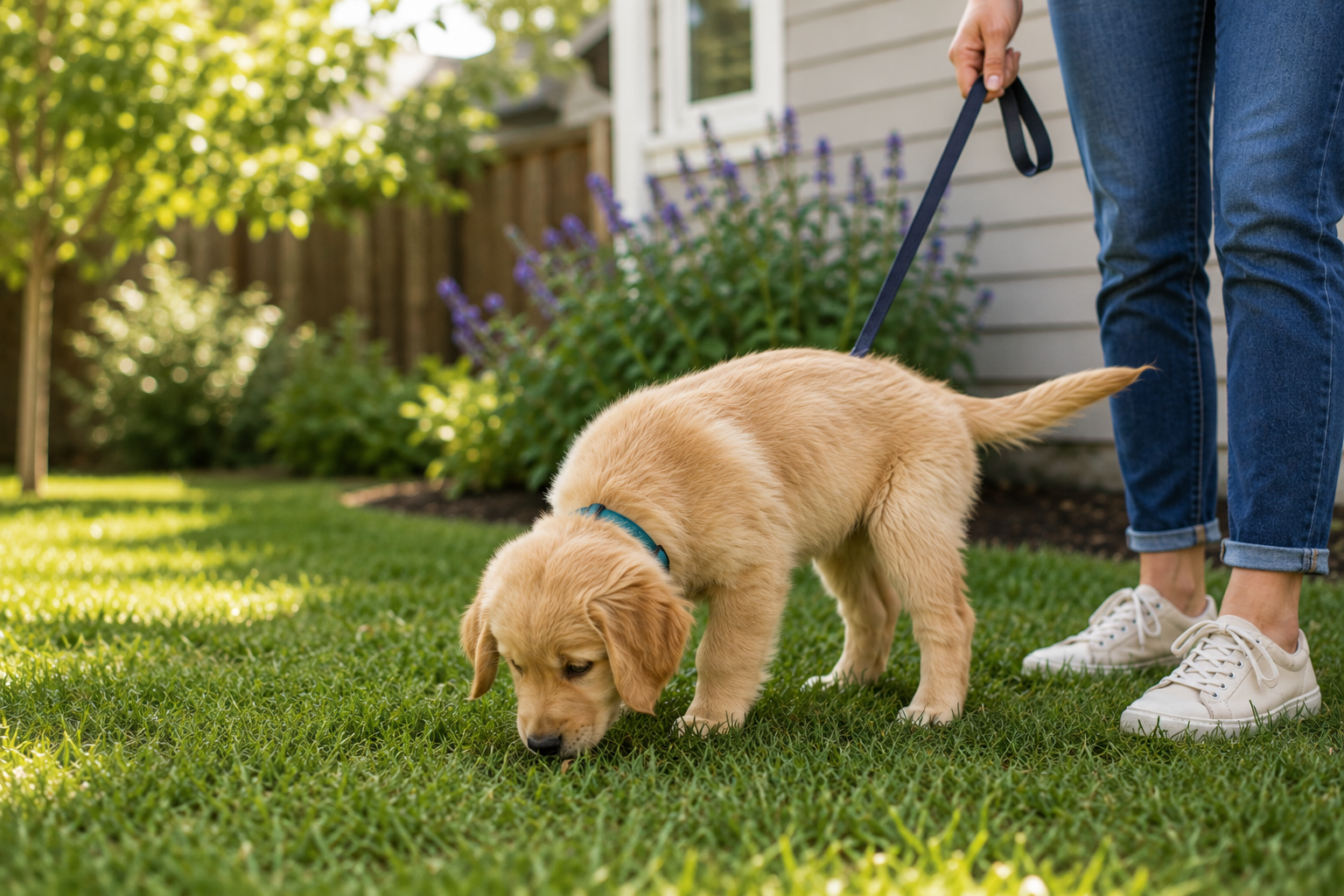
A young puppy sniffing the grass while on leash, preparing to toilet.
Quick Answer
Successful puppy housetraining is less about teaching your puppy not to have accidents and more about giving them frequent opportunities to get it right.
Take your puppy outside regularly, supervise them closely when they're awake, use a crate or safe confinement area when you can't supervise, and reward them immediately after they toilet outside.
Most importantly, don't punish accidents. Your puppy isn't being stubborn or spiteful—they're still learning where you would like them to go and developing the physical ability to hold their bladder and bowels for longer periods.
At a Glance
For successful housetraining:
Take your puppy outside frequently.
Go outside after sleeping, eating, drinking, playing, and exciting activities.
Take your puppy to the same general toileting area.
Stay outside with them so you know whether they've actually gone.
Reward immediately after they finish.
Supervise closely while your puppy is indoors.
Use a crate, exercise pen, or puppy-safe area when you can't supervise.
Learn your puppy's individual signals.
Clean accidents thoroughly with an appropriate enzymatic cleaner.
Never punish your puppy for an accident.
The more often your puppy successfully toilets outside, the faster they can learn where you want them to go.
Why Do Puppies Have Accidents?
Your puppy isn't born knowing that your carpet is different from the grass outside.
From their perspective, both are simply surfaces.
Housetraining requires your puppy to learn two things:
Where should I toilet?
and
How do I get there when I need to go?
Young puppies are also still developing bladder and bowel control. Even when they begin understanding where you would prefer them to toilet, they may not always have the physical ability to wait.
That's why prevention and supervision are such important parts of housetraining.
How Often Should I Take My Puppy Outside?
There's no single schedule that works for every puppy.
Age matters, but so do:
Activity level.
Meal times.
Water consumption.
Sleep.
Excitement.
Individual development.
Previous housetraining experience.
Rather than relying exclusively on the clock, pay attention to what your puppy has just been doing.
Puppies commonly need to toilet:
Immediately after waking.
Shortly after eating.
After drinking.
After energetic play.
After training.
After coming out of their crate.
After exciting interactions.
Before bedtime.
And sometimes simply because enough time has passed.
When you're unsure, take them outside.
Step 1: Choose a Toileting Area
Taking your puppy to the same general area can make housetraining easier.
The smells from previous bathroom trips can help communicate:
"This is where we do this."
Take your puppy outside on leash initially rather than opening the door and hoping they'll take care of business.
This allows you to know whether your puppy actually toileted.
Step 2: Make Bathroom Trips Boring—At First
You've taken your puppy outside.
They sniff a leaf.
They chase a bug.
They pick up a stick.
They watch a bird.
Ten minutes later, you assume they don't need to go and bring them inside.
Thirty seconds later, they pee on the floor.
Sound familiar?
When you take your puppy outside specifically for a bathroom break, keep the first part of the trip fairly boring.
Give them time to sniff and find an appropriate spot, but don't immediately start playing.
Once they've toileted, then the fun can begin.
This creates an added benefit:
Going to the bathroom doesn't mean outside time ends.
Step 3: Reward Immediately
Timing matters.
When your puppy finishes toileting outside, reward them while you're still outside.
Use a small, high-value treat and calm praise.
Don't wait until you return to the kitchen to give them a cookie.
By then, your puppy may associate the reward with walking through the door rather than toileting outside.
We want the connection to be very clear:
Toilet outside → great things happen.
Step 4: Supervise Indoors
One of the most effective housetraining tools isn't a product.
It's supervision.
When your puppy is awake and loose in your home, keep an eye on them.
Watch for behaviours such as:
Suddenly wandering away.
Intense floor sniffing.
Circling.
Moving toward a previous accident location.
Becoming restless.
Heading toward the door.
Abruptly stopping play.
Every puppy develops slightly different signals.
Learning your puppy's patterns can help you get them outside before an accident occurs.
Step 5: Limit Freedom
Giving a new puppy unrestricted access to your entire home makes housetraining much harder.
Your puppy may disappear behind the sofa, into a bedroom, or around a corner and have an accident without anyone noticing.
Instead, gradually increase freedom as your puppy demonstrates that they're ready for it.
You can use:
Baby gates.
Exercise pens.
A crate.
Closed doors.
A leash attached to you while supervised.
A designated puppy-safe room.
Freedom is something puppies earn gradually as their skills develop.
Step 6: Use the Crate Appropriately
A crate can be a useful housetraining tool because most dogs naturally prefer not to toilet where they sleep.
However, a crate shouldn't be used to force a puppy to hold their bladder beyond what they're physically capable of doing.
The crate should be large enough for your puppy to comfortably:
Stand.
Turn around.
Lie down.
If your puppy repeatedly toilets in their crate, don't assume they're being difficult.
Consider whether:
They're being left too long.
The crate is excessively large.
They haven't fully emptied before being crated.
Their previous environment encouraged toileting where they slept.
They're experiencing stress.
There could be a medical issue.
What Should I Do If My Puppy Has an Accident?
Accidents happen.
If you catch your puppy beginning to toilet indoors, calmly interrupt if possible and take them outside.
If you discover the accident afterward, simply clean it up.
Your puppy won't understand why you're upset about something that happened several minutes—or perhaps much longer—ago.
Never:
Rub your puppy's nose in an accident.
Yell at them.
Physically punish them.
Drag them to the accident.
Scold them after the fact.
Punishment can teach puppies that toileting in front of people is dangerous.
That can create a puppy who sneaks away to toilet where you can't see them—or who refuses to toilet while you're standing outside waiting.
That's exactly the opposite of what we want.
Clean Accidents Thoroughly
Dogs have an extraordinary sense of smell.
A spot that smells perfectly clean to you may still smell like a bathroom to your puppy.
Ammonia-based cleaning products may smell “clean” to us, but can actually mimic the scent of urine to a puppy, which may encourage them to toilet in the same area again.
Use a pet-safe enzymatic cleaner designed to break down urine and organic material.
Follow the manufacturer's directions carefully.
Proper cleaning helps reduce the likelihood that your puppy will return to the same location.
Should I Use Puppy Pads?
Puppy pads can be useful in certain circumstances, particularly when immediate outdoor access isn't practical.
However, if your ultimate goal is for your puppy to toilet exclusively outdoors, pads can sometimes add an additional learning step.
You're initially teaching:
Toileting indoors on this surface is appropriate.
Later, you'll need to teach:
Actually, now I'd like you to toilet outside.
For most puppies with easy and safe access to an outdoor toileting area, going directly outside can provide clearer expectations.
Should I Teach My Puppy to Ring a Bell?
You can, but remember that ringing a bell is a separate trained behaviour.
Your puppy needs to learn:
Ring bell → door opens.
Some puppies quickly discover that this also means:
Ring bell → humans take me outside to play.
There's nothing wrong with teaching a bell signal, but don't rely on it as your primary housetraining strategy—especially with a very young puppy.
Your responsibility is still to provide regular bathroom opportunities.
What About Overnight?
Young puppies may need one or more bathroom trips during the night.
Keep nighttime trips quiet and uneventful.
Take your puppy outside, allow them to toilet, calmly reward them, and return to bed.
Avoid turning a 2 a.m. bathroom break into an exciting play session.
As your puppy matures, their ability to sleep for longer periods without needing to toilet will generally improve.
How Long Does It Take to Housetrain a Puppy?
There's no magic age when every puppy suddenly becomes housetrained.
Some puppies develop reliable habits relatively quickly. Others need considerably longer.
And even a puppy who hasn't had an accident for several weeks can make a mistake.
Rather than thinking:
"My puppy is housetrained."
Think:
"My puppy has demonstrated reliability under these circumstances."
Then gradually introduce more freedom, longer intervals, different rooms, unfamiliar homes, and new environments.
What If Housetraining Suddenly Gets Worse?
If a puppy who had been progressing well suddenly begins having frequent accidents, don't automatically assume it's a training problem.
Changes in urination or bowel habits can sometimes have a medical cause.
Contact your veterinarian if you notice:
Suddenly increased urination.
Frequent attempts to urinate.
Straining.
Blood in urine or stool.
Diarrhea.
Excessive thirst.
Signs of discomfort.
A significant unexplained regression in housetraining.
Rule out a medical problem before assuming your puppy has simply "forgotten" their training.
Common Housetraining Mistakes
Waiting for the puppy to ask to go outside.
Giving too much freedom too soon.
Not supervising closely enough.
Assuming being outside means the puppy actually toileted.
Bringing the puppy inside immediately after they toilet every time.
Waiting too long to reward.
Punishing accidents.
Expecting a young puppy to hold their bladder for unrealistic periods.
Relying entirely on a rigid schedule instead of observing the puppy.
Missing predictable bathroom opportunities after sleep, food, play, or excitement.
Frequently Asked Questions
How often should I take my puppy outside?
Very young puppies need frequent opportunities. Instead of relying on one universal formula, combine regular trips with your puppy's activities. Waking, eating, drinking, playing, training, excitement, and leaving the crate are all good reasons to head outside.
Should I carry my puppy outside?
For a very young puppy who may not make it to the door in time, carrying them to their toileting area can be helpful. Based on recent evidence, it is advised not to allow puppies to navigate stairs independently until around 12 weeks of age, as their coordination and joints are still developing.
Why does my puppy pee outside and then pee again inside?
Your puppy may not have completely emptied their bladder, excitement may have interrupted them, or they may simply need to urinate frequently.
After your puppy toilets, consider remaining outside for a little longer rather than immediately returning indoors.
Why won't my puppy pee when I'm outside?
The environment may simply be too interesting.
Choose a relatively quiet toileting location, keep your puppy on leash, and give them enough time. When they do toilet, reward generously.
Why does my puppy hide to poop?
If a puppy has previously been punished for toileting indoors, they may learn that toileting in front of people causes unpleasant things to happen.
Avoid punishment and rebuild confidence by calmly rewarding appropriate outdoor toileting.
Key Takeaways
Successful housetraining is built on prevention, repetition, reinforcement, and patience.
Remember:
✔ Take your puppy outside frequently.
✔ Pay attention to activities
✔ Supervise when your puppy is loose indoors.
✔ Limit freedom until reliability develops.
✔ Go outside with your puppy.
✔ Reward immediately after successful outdoor toileting.
✔ Clean accidents thoroughly.
✔ Never punish accidents.
✔ Increase freedom gradually.
✔ Seek veterinary advice if housetraining suddenly and unexpectedly regresses.
Every successful bathroom trip is another opportunity for your puppy to learn:
"This is where I should go."
Your job is to make those successful repetitions happen as often as possible.
How Paus-n-Train Can Help
At Paus-n-Train, we believe puppy training is about much more than teaching "sit."
Those early weeks are an opportunity to help puppies develop the practical skills, confidence, communication, and positive learning experiences that will support them throughout their lives.
Our Puppy Prep School helps families navigate many of the challenges that come with raising a young puppy while building important foundation skills through positive, science-based training.
Along with housetraining, puppy owners are learning how to approach socialization, settling, crate comfort, recall foundations, leash skills, handling, appropriate play, and everyday life together.
Students also receive access to their digital homework resources so they can review information and continue practising at home even after the program has been completed.
Housetraining can sometimes feel like your entire life revolves around watching a puppy pee—but this stage doesn't last forever.
With good management, frequent opportunities to succeed, appropriate reinforcement, and a little patience, you're helping your puppy develop a skill they'll use for the rest of their life.