How Do I Stop My Dog From Jumping on Guests?
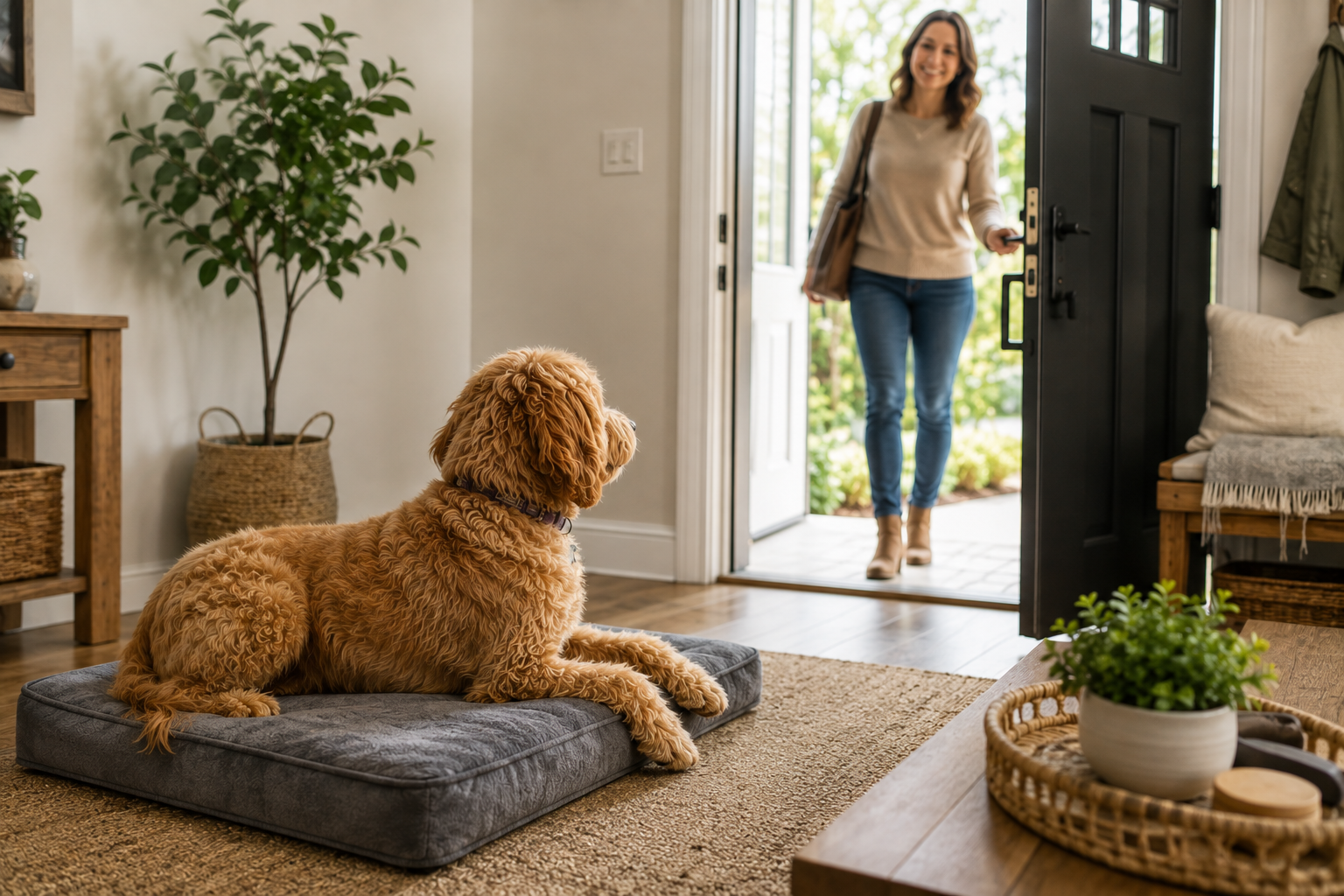
A large doodle remains on its bed as a guest comes through the door
Quick Answer
If your dog jumps on guests, the solution isn't simply teaching them to "get down." Instead, teach your dog what you would like them to do when someone arrives.
For many dogs, jumping is rewarding. It gets attention, creates interaction, and may even have been unintentionally encouraged when they were puppies.
A successful training plan combines management, preventing your dog from repeatedly practising jumping, and teaching an alternative behaviour such as settling on a bed or keeping four paws on the floor.
At a Glance
If your dog jumps on visitors:
Prevent them from rushing directly to the door.
Have your dog on leash before guests arrive.
Have treats ready before your guest arrives.
Teach a behaviour that is incompatible with jumping, such as going to a bed.
Reward calm behaviour generously.
Ask guests not to encourage jumping.
Practise with planned visitors instead of waiting for real-life situations.
Make greetings easier when your dog is overly excited.
Most importantly, don't wait until your dog is already jumping to start training.
Set up the situation so your dog can succeed.
Why Does My Dog Jump on People?
In many cases, dogs jump because jumping works.
Think about what usually happens when a dog jumps.
The person may:
Look at the dog.
Speak to them.
Touch them.
Push them away.
Laugh.
Bend over.
Say "OFF!"
Excitedly greet them.
From the dog's perspective, jumping just created an enormous amount of human interaction.
Even attention that we consider negative can still reinforce behaviour.
"But I Always Tell My Dog to Get Down!"
This is where jumping can become frustrating.
Your dog jumps.
You say, "OFF!"
Your dog gets down.
You reward them.
It may seem like you've rewarded getting down—and you have—but your dog may also begin learning a larger behaviour chain:
Jump → get told OFF → put feet down → receive reward.
It’s also worth asking: what does “get down” actually mean to your dog? Does it mean get off me? Or is it the same word you use when you teach them to lie down, like “down”? When we use similar-sounding or overlapping cues for different behaviours, it can create confusion and make it harder for your dog to understand what we’re asking.
Instead of repeatedly correcting the jump, we want to intervene before it happens and reward the behaviour we actually want.
Decide What You Want Your Dog to Do Instead
"Don't jump" isn't a behaviour we can teach.
We need to give our dogs another option.
For example:
When someone comes to the door → go to your bed.
Or:
When someone approaches → keep four paws on the floor.
For many households, we particularly like teaching dogs to settle on a designated bed or mat.
It gives the dog a very clear job and creates some physical distance between the dog and the exciting visitor.
Step 1: Teach the Bed Behaviour Without Guests
Don't begin practising when the doorbell rings.
Start when absolutely nothing exciting is happening.
Place your dog's bed several feet away from the doorway and reward your dog for:
Approaching the bed.
Stepping onto it.
Remaining on it.
Sitting or lying down.
Relaxing there for increasingly longer periods.
Eventually, your dog should begin thinking:
"Going to my bed makes good things happen."
Only then do we start adding distractions.
Step 2: Practise the Pieces of a Visitor Arrival
A real visitor arriving involves many different triggers.
Your dog may react to:
A vehicle entering the driveway.
Someone walking toward the house.
Knocking.
The doorbell.
You walking toward the door.
The door opening.
A person's voice.
Someone entering the house.
Instead of practising all of these at once, break them apart.
For example:
Knock on the door → reward your dog on their bed.
Walk toward the door → reward your dog on their bed.
Touch the doorknob → reward your dog on their bed.
Open the door slightly → reward your dog on their bed.
Gradually, these exciting events become cues to remain settled rather than rush toward the doorway.
Step 3: Use Management When Real Guests Arrive
Training and management work together.
If your dog isn't ready to remain calmly on their bed while someone enters, don't repeatedly put them in a situation where they're likely to fail.
You might use:
A baby gate.
An exercise pen.
A leash.
A closed interior door.
A food-stuffed toy.
A chew or other enrichment activity.
Management isn't cheating.
It prevents your dog from rehearsing unwanted behaviour while you're teaching them something new.
Step 4: Prepare Before Opening the Door
Don't wait until your guest is standing outside before realizing the treats are in another room.
Before opening the door:
Have your dog in their designated area.
Have high-value treats ready.
Have a leash available if needed.
Possibly put a sign on the outside of the door to let visitors know the dog is in training and it may take a few extra moments before the door will be answered.
Explain the plan to your visitor.
Then begin the greeting.
Preparation can make the difference between a successful training opportunity and complete chaos.
Step 5: Ask Your Guests to Help
This can sometimes be harder than training the dog!
You may hear:
"Oh, I don't mind!"
But your dog doesn't understand that jumping is okay with Aunt Susan but not okay with your elderly neighbour.
Consistency makes learning much easier.
Ask guests to avoid encouraging jumping and to give your dog attention when their feet are on the floor or when they're calmly settled.
If your dog jumps, the visitor can quietly remove their attention rather than pushing, talking to, or wrestling with the dog. However, don’t rely on guests to get the timing right—people’s timing is often inconsistent, and that can accidentally reinforce the behaviour.
Instead, if your dog jumps, calmly and safely remove your dog from the situation (for example, guide them away on a leash or behind a gate) so they lose access to the person they’re trying to interact with. Then reset and try again once your dog has settled.
We want to avoid a pattern where the dog learns: jump → get corrected → return to the person → receive attention. That creates a frustrating feedback loop where jumping becomes part of the greeting routine.
Instead, we aim to practise: approach → no jumping → calm behaviour → attention. If a mistake happens, simply reset by removing the dog from the source of attention, allow them to settle, and then re-approach and try again.
Step 6: Don't Rush the Greeting
Your dog doesn't necessarily need to greet someone the instant they walk through the door.
For dogs that become extremely excited, waiting can actually make greetings much easier.
Allow your guest to:
Enter.
Remove their coat and shoes.
Sit down.
Begin talking with you.
Meanwhile, your dog can remain behind a gate, on their bed, while occupied with an enrichment activity.
Once the initial excitement has passed, you can decide whether your dog is calm enough to greet.
What About Turning Your Back on the Dog?
You've probably heard the advice:
"Just turn around and ignore them."
This can help in some situations, but it isn't a complete training plan.
If the dog continues bouncing from person to person, they're still practising jumping.
And if jumping is driven by very high excitement, simply ignoring the behaviour may not give the dog enough information about what they should do instead.
Teaching an alternative behaviour is usually much clearer.
What About Kneeing or Pushing the Dog Away?
We don't recommend kneeing a dog in the chest, stepping on their feet, yelling, or using physical corrections to stop jumping.
Aside from the welfare concerns, these methods don't address why the behaviour is occurring or teach the dog what they should do instead.
Some dogs may even interpret pushing as play and become more excited.
Positive reinforcement allows us to teach the behaviour we want while maintaining the dog's trust and enthusiasm for interacting with people.
What If My Dog Only Jumps on Certain People?
That's very common.
Dogs don't automatically generalize behaviours.
Your dog might remain perfectly calm when you walk through the door but become wildly excited when Grandma arrives.
Or perhaps they jump on people who:
Speak excitedly.
Bend over them.
Carry bags.
Haven't visited recently.
Frequently play with them.
Encourage enthusiastic greetings.
Practise with different people and in different circumstances so your dog learns that polite greetings apply to everyone, not just the people they practise with most often.
What If My Dog Is Already an Adult?
You can absolutely teach an adult dog different greeting habits.
However, remember that an adult dog may have had years of practice jumping on people.
If jumping has worked hundreds or thousands of times, don't expect the behaviour to disappear after a few training sessions.
Preventing further rehearsal while consistently rewarding an alternative behaviour is particularly important.
Common Mistakes to Avoid
Waiting until guests arrive before beginning training.
Repeatedly yelling "OFF."
Allowing some visitors to encourage jumping.
Pushing or physically correcting the dog.
Asking for too much too quickly.
Allowing the dog to repeatedly practise rushing the doorway.
Expecting a highly excited dog to immediately greet calmly.
Rewarding only after the dog has already jumped.
Forgetting to reward the quiet, calm behaviour you want to see more often.
Frequently Asked Questions
How long does it take to stop a dog from jumping?
There isn't one timeline. A young dog with relatively little history of jumping may learn quickly, while an adult dog who has spent years successfully jumping on visitors may need considerably more practice.
Consistency matters more than speed.
Should I tell my dog "OFF"?
You can certainly teach an "OFF" cue, but it shouldn't be your primary strategy.
Ideally, your dog learns what to do before jumping occurs.
Should my dog sit when greeting people?
A sit can work well for some dogs, but it isn't your only option. For extremely excited dogs, maintaining a sit while someone enters may initially be too difficult.
A bed or mat can provide a clearer location and more distance.
Can I use treats when visitors arrive?
Absolutely.
Food can help reinforce the behaviours you want and can also help create positive associations with the arrival routine.
We're using reinforcement to teach them which behaviours are worth repeating.
Key Takeaways
Don't focus only on stopping the jump. Teach your dog what to do instead.
Remember:
✔ Prevent repeated practice of jumping.
✔ Prepare before visitors arrive.
✔ Teach an alternative behaviour such as settling on a bed.
✔ Practise when you aren't expecting real visitors.
✔ Reward calm behaviour generously.
✔ Keep greetings calm and manageable.
✔ Make sure everyone follows the same rules.
✔ Give your dog time to learn.
Polite greetings aren't created by repeatedly correcting mistakes. They're built by giving dogs many opportunities to practise the behaviour we want instead.
How Paus-n-Train Can Help
At Paus-n-Train, we don't just teach dogs commands—we help owners teach practical skills that make everyday life together easier.
Our Dog Manners program works on real-life skills such as settling on a bed when visitors arrive, polite greetings, loose-leash walking, recall, and other behaviours that help dogs successfully navigate life with their families.
Because successful training doesn't stop when class ends, we also focus on helping owners understand how to practise these skills at home, where behaviours such as jumping on guests actually happen. As part of the program, you also receive continued access to a digital homework portal so that we can continue to support your training journey long after classes have ended.
If you're bringing home a puppy, starting early can make an enormous difference. Our Puppy Prep School introduces puppies to foundation skills, calmness, positive social experiences, and appropriate interactions before unwanted habits have had months or years to develop.
Whether you're preventing jumping with a young puppy or changing a long-established habit with an adult dog, the goal is the same:
Help your dog understand what you'd like them to do—and make that behaviour worth repeating.