Why Is My Dog Reactive?
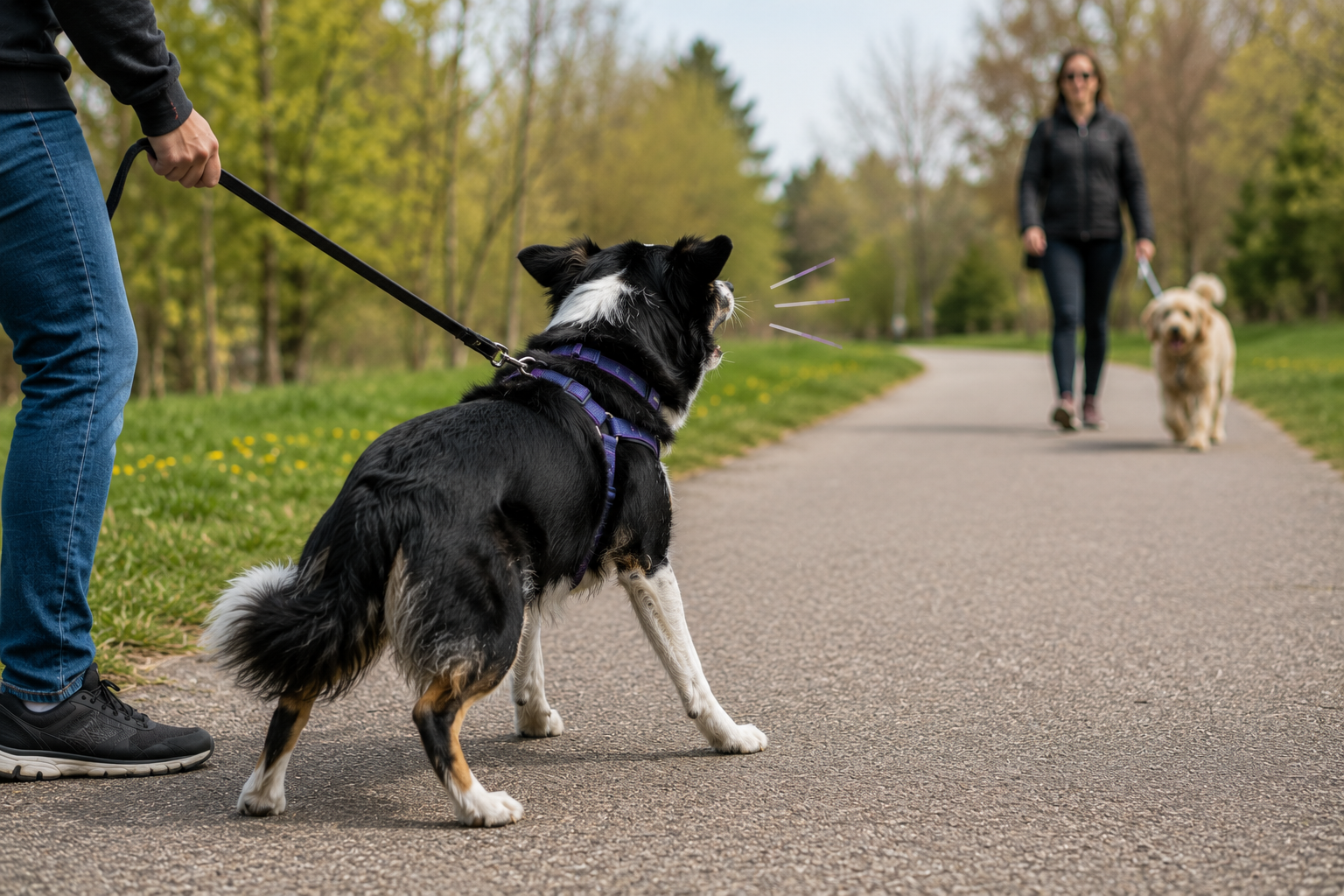
Dog straining on leash while barking while another dog approaches
Quick Answer
If your dog barks, lunges, growls, or becomes overly excited when they see other dogs, people, bicycles, or other triggers, they're not necessarily being "bad" or "aggressive." In many cases, they're reacting because they feel overwhelmed, worried, frustrated, or simply don't know how to cope with the situation.
The good news? Reactivity can often be improved with patient, science-based training that focuses on changing your dog's emotional response—not just stopping the behaviour.
At a Glance
Signs of reactivity may include:
Barking
Lunging
Growling
Whining
Spinning or bouncing at the end of the leash
Staring intensely at a trigger
Pulling toward or away from something
Common triggers include:
Other dogs
People
Children
Joggers or cyclists
Wildlife
Vehicles
Visitors to the home
Veterinary clinics
Most important to remember:
Your dog isn't giving you a hard time—they're having a hard time.
What Does "Reactive" Mean?
Reactivity isn't a diagnosis or a personality trait. It's simply a description of how a dog responds to something in their environment.
A reactive dog has an emotional response that is stronger or more immediate than we'd typically expect.
That response may look dramatic, but it's usually rooted in emotion rather than disobedience.
Reactivity Is Often Driven by Emotion
Every dog is an individual, but most reactive behaviours are linked to one or more of the following emotions.
Fear
Fear is one of the most common causes of reactivity.
Your dog may be trying to increase the distance between themselves and something they perceive as threatening.
Ironically, barking and lunging often work—people or dogs move away, and your dog learns that their behaviour made the scary thing disappear.
Frustration
Some dogs desperately want to greet every dog or person they see.
When a leash prevents them from doing so, frustration builds.
That frustration can quickly spill over into barking, jumping, whining, or lunging.
Anxiety
Dogs experiencing chronic anxiety often have a lower threshold for reacting.
Small challenges that another dog could ignore may feel overwhelming to them.
Over-Arousal
Sometimes excitement itself becomes the problem.
A dog that becomes extremely excited can struggle to think clearly, respond to cues, or regulate their emotions.
Reactivity Is Not the Same as Aggression
This is one of the biggest misconceptions in dog training.
While reactive dogs can look frightening, many have no intention of causing harm.
Instead, they're communicating:
"I'm scared."
"I'm uncomfortable."
"Please give me space."
"I can't cope right now."
That doesn't mean reactive behaviour should be ignored—it simply means understanding the underlying emotion is essential to choosing the right training approach.
Why Punishment Often Makes Reactivity Worse
It can be tempting to correct barking or lunging because the behaviour is embarrassing or disruptive.
However, punishment addresses the symptom, not the cause.
Imagine you're afraid of spiders.
If every time you saw a spider someone yelled at you, would spiders become less frightening?
Probably not.
In fact, they may become even more stressful because now you've learned that spiders predict unpleasant experiences.
Dogs learn in much the same way.
Our goal isn't simply to stop barking—we want to help the dog feel differently about the situation.
Common Factors That Contribute to Reactivity
There isn't usually one single cause.
Instead, reactivity often develops through a combination of factors, including:
Genetics
Early life experiences
Limited or negative socialization
Pain or discomfort
Previous frightening experiences
Lack of appropriate coping skills
Repeated rehearsal of reactive behaviour
The important takeaway is that reactivity is rarely the result of a dog being "stubborn" or trying to be dominant.
What Should You Do If Your Dog Is Reactive?
Give Your Dog Space
Distance is one of the most powerful training tools available.
The farther your dog is from a trigger, the easier it is for them to remain calm and continue learning.
Learn to Recognize Early Signs
Many dogs communicate long before they bark or lunge.
Watch for signs such as:
Freezing
Closing their mouth
Staring
Ears shifting forward
Weight moving forward
Faster breathing
A stiff and high tail carriage
Recognizing these early signals allows you to intervene before your dog becomes overwhelmed.
Reward Calm Behaviour
When your dog notices a trigger and remains relaxed, mark that moment and reward them generously.
Over time, your dog begins to associate the appearance of triggers with positive outcomes.
Avoid Flooding
Flooding occurs when a dog is exposed to something they find overwhelming without the ability to escape.
While it may appear that a dog has "gotten over it," many dogs simply shut down emotionally.
Progress happens when dogs feel safe enough to learn—not when they're forced to endure situations they can't cope with.
Be Patient
Changing emotional responses takes time.
Progress isn't measured by how quickly your dog stops barking.
It's measured by how comfortable and confident they become over weeks and months of thoughtful training.
Common Mistakes to Avoid
Punishing barking or growling.
Forcing greetings with unfamiliar dogs or people.
Walking too close to triggers.
Expecting progress to happen quickly.
Ignoring subtle body language.
Comparing your dog's progress to another dog's.
Assuming every reactive dog wants to be social.
Frequently Asked Questions
Can reactive dogs improve?
Yes. While every dog is different, many reactive dogs make significant progress with appropriate training, management, and patience.
Should my reactive dog meet other dogs?
Not necessarily.
Many reactive dogs benefit more from learning to remain calm around other dogs than from greeting every dog they encounter.
Is my dog trying to dominate other dogs?
Current behavioural science does not support "dominance" as the explanation for most pet dog reactivity.
Looking at the emotions driving the behaviour leads to more effective and humane training solutions.
Key Takeaways
✔ Reactivity is usually an emotional response—not disobedience.
✔ Fear, frustration, anxiety, and over-arousal are common causes.
✔ Punishment often increases stress rather than solving the problem.
✔ Distance, positive reinforcement, and patience are key components of successful training.
✔ Every reactive dog deserves understanding, not judgement.
How Paus-n-Train Can Help
At Paus-n-Train, we understand that living with a reactive dog can feel isolating and overwhelming. While we do not offer in-person group classes for reactive dogs, we have developed resources to help owners build confidence and improve their dog's emotional wellbeing using positive, science-based methods.
Our Reactive Rover OnDemand course provides practical strategies to help you understand why your dog reacts, recognize early signs of stress, manage the environment, and teach new coping skills at a pace that supports your dog's success. Because the course is completed from the comfort of your own home and neighbourhood, your dog can learn without the added pressure of a group class environment.
If you're unsure whether your dog's behaviour is reactivity, fear, or something else entirely, we're also happy to help guide you toward the most appropriate next steps and resources for your individual situation.